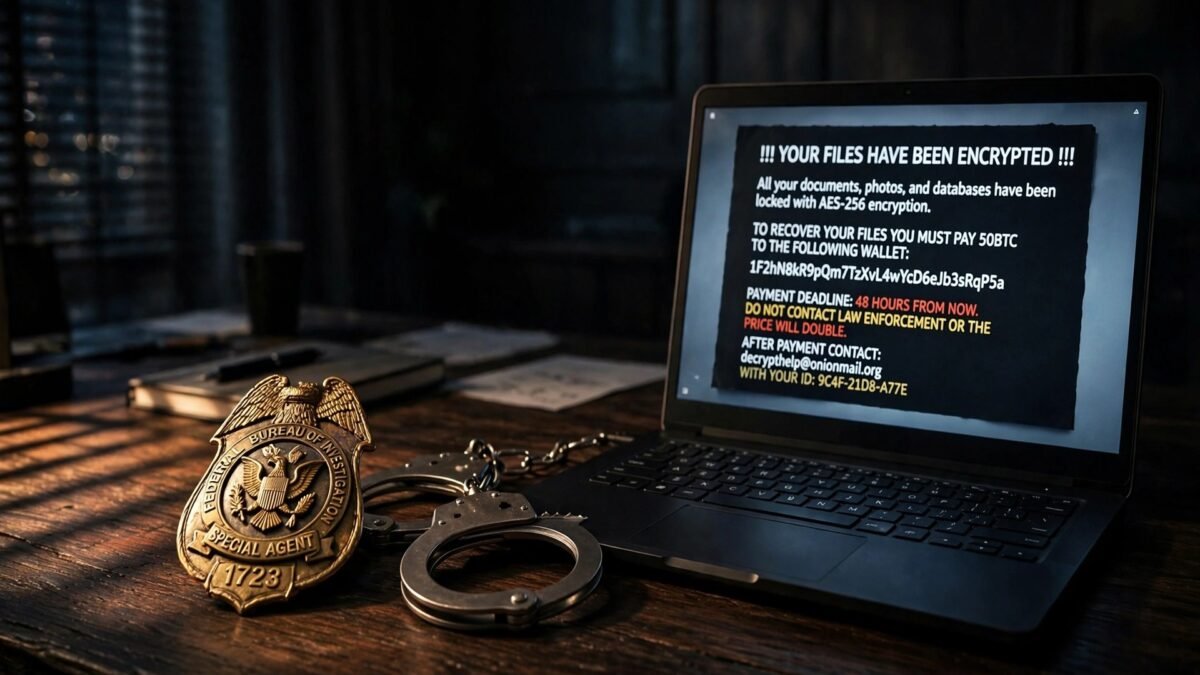
A federal grand jury in Rhode Island has indicted the co-founder of a Florida data-recovery firm, widely reported as RansomwareHelp, for allegedly charging ransomware victims for a decryption capability he did not possess, secretly paying the gangs he claimed he never paid, and charging the victims more than the ransom. The FBI caught him in a June 2026 sting in which it played both sides: the victim company and the ransomware gang. Juan Ricardo Palacio Escobar, 52, a Colombian national, faces three counts of wire fraud, each carrying up to 20 years in prison. An indictment is only an allegation, and he is presumed innocent until proven guilty.
The case matters because of who the alleged victims are: people and companies already hit by ransomware, who paid a firm that promised to get their data back without paying a ransom. The Justice Department announced the charges on Wednesday 25 November 2026. The indictment was returned on Wednesday 18 November.
How the FBI caught him
In June 2026 the FBI ran an undercover operation in which it posed as a company that had been hit by ransomware. Palacio Escobar’s firm told the undercover operatives what it told real customers: that it never negotiated with or paid ransomware attackers, and that it could recover the data through its own sophisticated decryption technology. According to the indictment, there was no such technology. According to the indictment, Palacio Escobar negotiated with the purported ransomware actor, who was in fact a second undercover FBI operative, and paid about $6,000 in Bitcoin for a decryption key. He then charged the undercover victim company about $13,260 for the purported decryption service, more than double what he had paid. The Justice Department’s own summary puts it plainly: he charged the undercover victim “more than double what he paid the undercover ransomware actor”.
Brian Krebs, reading the indictment, reports a higher total: $16,010, including a $2,750 diagnostic fee on top of the $13,260. That is Krebs’s figure, not the Justice Department’s, and the two should not be mixed. On the Justice Department’s numbers the markup is $7,260, about 2.2 times the ransom paid. Counting the diagnostic fee Krebs reports, the undercover “victim” paid about 2.7 times the ransom. Either way, the pattern the indictment alleges is the same: pay the gang, bill the victim more, keep the difference.
I was hit by ransomware. How do I pick a recovery firm I can trust?
Ask for proof before you pay: a firm claiming it can decrypt your files without paying the gang should explain how, in writing, before you sign. Get a second opinion from your insurer or a known incident-response firm, and never pay a recovery fee larger than the ransom it claims to avoid.
- Ask the firm to explain its decryption method in writing before you pay any fee.
- Get a second opinion from your cyber insurer or a known incident-response firm before signing.
- Compare the firm’s fee with the ransom it claims to avoid, and question any fee above it.
- Check whether the firm appears in any court filing or regulator warning before trusting its claims.
- Keep every invoice, contract and message from the firm in case the recovery goes wrong.
The steps above are TechReview’s advice, not the FBI’s or CISA’s. The agencies’ own advice is narrower:
The FBI and the federal cybersecurity agency CISA advise victims not to pay ransoms at all, because paying does not guarantee the data is decrypted, the systems are clean, or the data will not be leaked. The Palacio Escobar indictment is an example of the risk behind that advice: a firm that says it will recover your data without paying may, the indictment alleges, be paying anyway and charging you for the privilege.
The Kansas case: $720,000 in, $445,000 to the gang
The sting was not the only engagement in the indictment. In January 2024 a Kansas-based software consultancy paid $720,000 for data recovery, after which the firm paid the ransomware gang a Bitcoin ransom worth about $445,000 for a decryptor, according to court documents reported by GovInfoSecurity. The difference between the two figures is $275,000, about 1.6 times the ransom, a smaller percentage than the sting but far larger in dollars. The company name in that account comes from the press reporting, not from the Justice Department, which does not name the firm in its release.
The indictment alleges Palacio Escobar used the proceeds to buy several properties in Florida. The firm itself launched in October 2020 and claimed on its website a success rate of “over 99%”. An archived version boasted an in-house team of more than 80 cryptography, cybersecurity, digital forensic and reverse-engineering specialists who enjoyed a “99% success rate” at using custom-built tools to achieve “100% data recovery”. The website now reads “under maintenance”. 404 Media first reported the existence of the indictment last week, before the Justice Department announced it.
The latest in a run of responder cases
The case, widely reported as the RansomwareHelp indictment, is the latest in a run of FBI action against ransomware responders since July, and the alleged method matches at least one of them. In July 2026 Angelo Martino, a former ransomware negotiator at incident-response firm DigitalMint, was sentenced to 70 months in prison for passing confidential negotiation details, including victims’ insurance policy limits, to BlackCat operators. In September 2026 the FBI arrested Zohar Pinhasi, 50, who ran Florida-based MonsterCloud, on charges of defrauding ransomware victims by claiming a silver-bullet recovery while paying ransoms and charging a premium. In October 2026 the FBI arrested Canadian ransomware negotiation expert Edward Dobrovsky, 54. Palacio Escobar was arrested in Las Vegas on Thursday 22 October 2026, transferred to Rhode Island, and granted pretrial release on Friday 20 November under strict conditions set by the court.
FBI Boston Special Agent in Charge Ted E. Docks called Palacio Escobar “the proverbial wolf in sheep’s clothing”, saying he was “representing both himself and his company as experts in data recovery, when all the while he was paying the perpetrators of these ransomware attacks, under the guise of helping his clients”. The pattern is the point, but it is a narrow one. The four cases are not the same conduct: Martino was sentenced for passing negotiation details to BlackCat, and Dobrovsky faces extortion-conspiracy charges. The match is between the Palacio Escobar and Pinhasi cases, where the alleged business model is the same: claim a decryption capability that does not exist, pay the gang quietly for the real key, and charge the victim a premium.
What is still not known
The sources read for this article give no total number of victims and no total amount allegedly defrauded. Only two engagements carry dollar figures in the sources read, the June 2026 sting and the January 2024 Kansas case. The company’s identity as RansomwareHelp rests on reporting by TechCrunch, GovInfoSecurity, The Record and Brian Krebs, not on the indictment, which names no company. The exact role is also reported differently: GovInfoSecurity calls Palacio Escobar the company’s co-founder and chief technology officer, and the Justice Department calls him its co-founder; TechCrunch calls him its former chief technology officer, and The Record’s headline calls him the company’s chief executive. This article uses the Justice Department’s wording. No comment has been reported from Palacio Escobar, his lawyers or the company, and no arraignment or trial date appears in the sources read for this article. The case is being prosecuted by Trial Attorney Christen Gallagher of the Justice Department’s Computer Crime and Intellectual Property Section and Assistant US Attorneys Lee H. Vilker and Julianne Klein for the District of Rhode Island, and the FBI is investigating.
What to watch next is a court filing that names the company, any plea or trial that discloses more of the alleged scheme’s scale, and the Dobrovsky case, where much of the docket remains under seal and the alleged link to the ShinyHunters extortion group is unconfirmed. Until then, the honest description is an indictment, not a conviction. The FBI’s advice is not to pay a ransom. This case adds a question of our own: before paying anyone to recover your data, ask exactly what you are paying for.