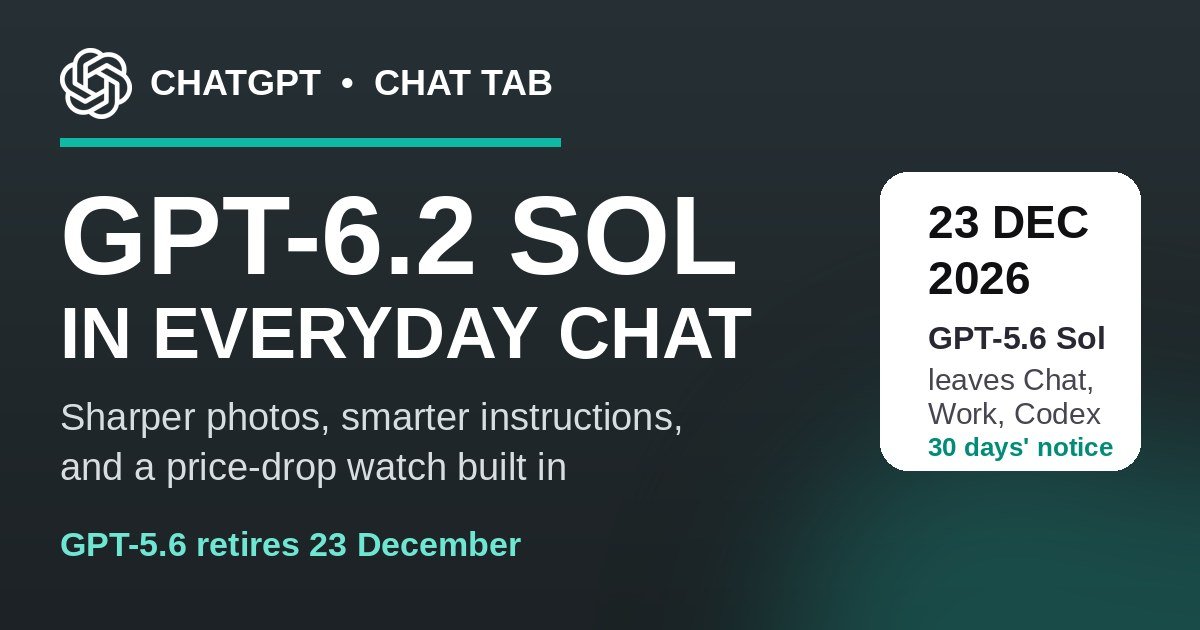
OpenAI has started rolling out a chat-tuned version of GPT-6.2 Sol in the Chat tab for paid subscribers. It began on 23 November for Plus, Pro, Business and Enterprise users, and OpenAI has set 23 December as the day GPT-5.6 Sol leaves Chat, Work and Codex. If your model picker is set to Latest, you move to GPT-6.2 automatically once the rollout reaches your account. If you picked GPT-5.6 Sol yourself, it stays until the cutoff, and then it is gone.
This is the second half of a launch that began six days earlier, on 17 November. GPT-6.2 Sol first arrived in ChatGPT Work and Codex on 17 November, alongside the frontier model GPT-6.2 Astra, and we covered that launch in detail at the time. The Chat tab rollout is the part that touches everyday users, and the December retirement date is the part that forces a decision.
What changes on 23 November and 23 December?
Two dates carry the whole story. The first has already passed. The second is a deadline worth putting in your calendar.
| Date | What happens | Who it affects |
|---|---|---|
| 17 November 2026 | GPT-6.2 Sol and Astra launch in ChatGPT Work and Codex | Work and Codex users |
| 23 November 2026 | Chat-tuned GPT-6.2 Sol starts rolling out in the Chat tab | Plus, Pro, Business and Enterprise users |
| December 2026 | Plus, Pro and Business users move to a single shared usage allowance covering ChatGPT and Codex | Plus, Pro and Business users |
| 23 December 2026 | GPT-5.6 Sol retires from Chat, Work and Codex; GPT-5.6 Terra retires from Work and Codex | GPT-5.6 Sol users in Chat, Work and Codex; GPT-5.6 Terra users in Work and Codex |
The 30-day gap between the announcement and the retirement is the part that matters most. OpenAI announced the 23 December date on the same day the Chat rollout began, which gives paying users exactly a month to test their work on the new model before the old one disappears. That is a short window if you have prompts, projects or workflows tuned to GPT-5.6 Sol, so the testing needs to start now rather than in mid-December.
What does GPT-6.2 Sol actually do better?
OpenAI tuned this version of Sol for everyday conversation, and its own test scores show the gains are concentrated in three places. On image understanding, the chat-tuned GPT-6.2 Sol scored 71.7 percent in OpenAI’s tests, up from 47.4 percent for GPT-6. On following hard, multi-part instructions, it scored 78.1 percent, up from 62.5 percent. On web browsing, figures reported by WinCentral from OpenAI’s tests put it at 64.5 percent, up from 54.4 percent. These are OpenAI’s own numbers, so read them as the company’s claims rather than independent measurements, but the pattern is consistent: image understanding shows the largest point increase among the three benchmarks discussed.
In practice, that shows up in small, specific ways. OpenAI says the model is better at picking out details in photos, such as the symbols on a parking sign or tiny text on a product label. When you ask it to compare options online, it weighs trade-offs against what you actually asked for, so a hotel comparison can balance a shorter walk against a lower nightly rate instead of dumping a generic list. And when you ask whether something is on sale, ChatGPT can now offer to let you know when the price drops, a practical touch for anyone tracking a purchase.
Our analysis: the image-understanding jump is the headline number. A 24.3-point rise, from 47.4 to 71.7 percent, is the largest single gain OpenAI cites for this Chat build. The other two gains are smaller: instruction-following up 15.6 points, web browsing up 10.1 points.
OpenAI also says the updated system card shows stronger safeguards in sensitive conversations, with policy compliance in challenging chats at 91 to 94 percent, up from 77 to 80 percent on GPT-6, alongside higher teen-safety scores. That comes from WinCentral’s reading of the system card, so treat it as reported rather than independently verified. The release pairs those reported safety gains with the capability gains above.
How do I switch to GPT-6.2 Sol?
If you are on a paid plan, switching is straightforward: open ChatGPT and go to the Chat tab, open the model picker, and choose Latest. Then use the Thinking slider to pick the effort level your plan allows. Once the ChatGPT GPT-6.2 Sol rollout has reached your account, Latest uses GPT-6.2 across Instant, Medium, High and Extra High.
Three things can still trip you up. First, the rollout is gradual, so some paying users will not see GPT-6.2 yet, and there is nothing to fix on your end if it has not arrived. Second, there is no GPT-6.2 Pro, so the Pro thinking level still uses GPT-6 Pro, and that option disappears while GPT-6.2 is selected. Third, Enterprise access depends on your workplace admin settings, so company accounts may not get it until an admin allows it.
One more detail worth knowing: the models powering Work and Codex are not changing as part of this release. If you use those surfaces, nothing moves for you on 23 November, though the December retirement still applies to GPT-5.6 Sol and Terra there.
Who does not get GPT-6.2 Sol in Chat?
Free and Go users are not included in this rollout. The launch reporting lists only Plus, Pro, Business and Enterprise for GPT-6.2 in the Chat tab, and no rollout timeline for Free or Go is identified in the available reporting. That is a clean split: the new model is a paid-plan upgrade for now.
GPT-5.6 Sol is being retired from Chat, Work and Codex, and its exit from Chat on 23 December is not optional. If you built anything around it, the month between now and the cutoff is your migration window, and the sensible move is to run your most important prompts against GPT-6.2 Sol now and check the answers hold up.
One more December change: one shared usage allowance for ChatGPT and Codex
There is a second December change landing on the same users, and it has nothing to do with model quality. OpenAI has started rolling out a unified Chat and Work experience to a small group of Pro users, and from December, Plus, Pro and Business subscribers will draw from a single usage allowance, measured in tokens, covering both ChatGPT and Codex. TechCrunch reported on 25 November that an OpenAI spokesperson said most users are not expected to face more frequent usage resets, but a small fraction of the heaviest users may hit their limits sooner.
Two details soften the blow. Conversations using the Instant model will not count toward the shared allowance, and Instant stays available after the allowance runs out. What OpenAI has not disclosed is the size of the combined allowance, or whether it preserves the equivalent of the two old ones, as Decrypt notes, so the effect on any one person’s limit is still unknown. If you are a heavy user of both Chat and Work, watch your usage meter in December rather than assuming the old budgets still apply.
What happens to your old GPT-5.6 chats?
OpenAI has not said how existing GPT-5.6 chats will be handled after 23 December. When GPT-5.1 was retired in March 2026, existing chats moved to the matching current model, but that is a precedent, not a promise, and OpenAI has made no such commitment this time. If a project depends on GPT-5.6 Sol, test it on GPT-6.2 before the cutoff and keep a copy of anything you cannot afford to lose.
The API is a separate story. The retirement announcement covers ChatGPT only, and OpenAI’s API deprecations page listed no GPT-5.6 shutdown when it was checked on 24 November. Developers using GPT-6.2 Sol through the API are unaffected by the December date. For reference, GPT-6.2 Sol has been available through the API since 17 November at $2 per million input tokens and $10 per million output tokens, so the Chat rollout changes nothing on that side.
Verdict
This is a good upgrade wrapped in a deadline. The Chat tab gets a model that reads photos far better, follows long instructions more reliably, and can watch a price for you, and eligible users can switch to it by picking Latest once the gradual rollout reaches their account. The catch is the calendar: GPT-5.6 Sol has 30 days from its announcement to its retirement, and the shared usage allowance arriving in December changes how usage is counted, with the effect on any one person’s limit still unknown, though OpenAI says most users should not face more frequent resets. Switch now, test the prompts that matter, and check your usage before December rather than after.
Read also: GPT-6.2 Astra and Sol: OpenAI’s Cheaper Models Arrive — With a Safety Flag Attached