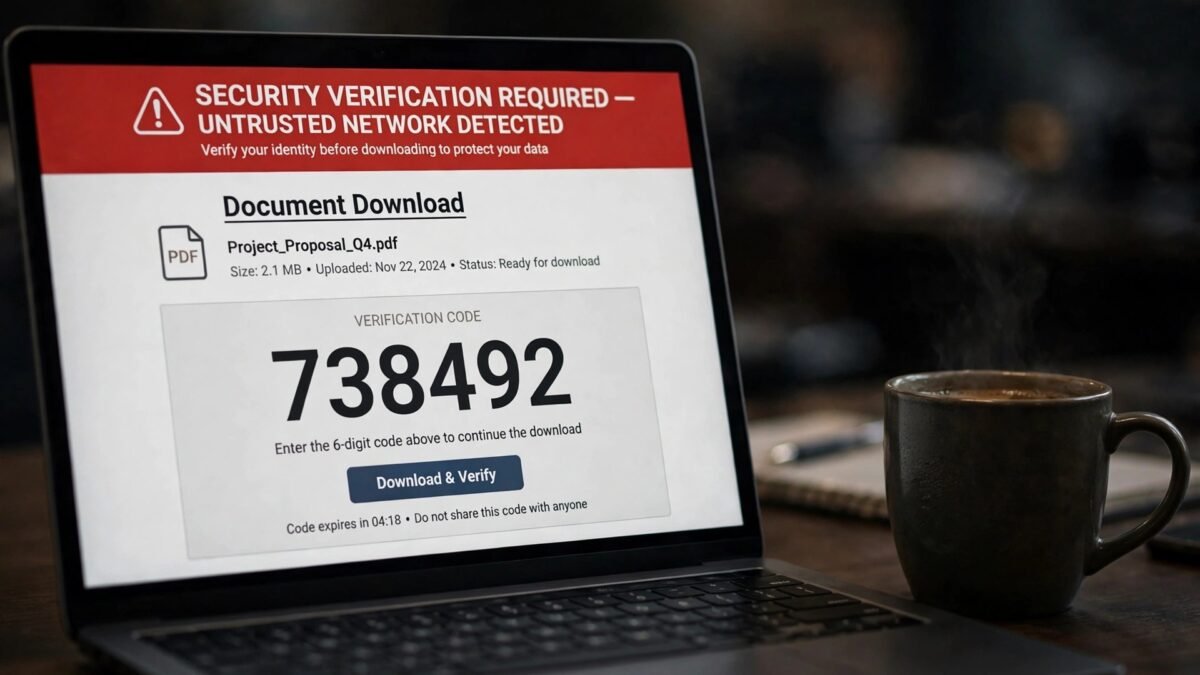
Microsoft shut EvilTokens down on Tuesday 22 September 2026. Two days later, on Thursday 24 September, a new EvilTokens phishing host appeared. By the time VMRay published its report on Tuesday 24 November, the security firm had counted 105 hosts in the kit’s published indicator table, a lure page was still generating live Microsoft device codes on 28 October, and the latest dated host in the table was 13 November. The takedown cut the operation down. It did not kill it.
EvilTokens is a phishing-as-a-service kit sold on Telegram. Microsoft tracks its developer and support operator as Storm-2992. Within months of its launch in early 2026, Microsoft linked the kit to more than 12,000 compromised email inboxes across more than 10,000 organisations worldwide, with the heaviest activity in the United States, Canada, the United Kingdom, Australia, India and France. VMRay’s report is hard evidence that the kit survived the September disruption, and the new hosts show the operators adapting rather than disappearing.
The code is real. That is the whole trick.
EvilTokens does not fake a login page. It abuses the OAuth device code flow, the legitimate sign-in method built for devices that cannot easily take a password, such as a smart TV or a printer. The phishing page asks Microsoft for a short device code, valid for 15 minutes, and shows it to the victim, often dressed up as an Adobe, DocuSign, OneDrive or SharePoint document. The victim is told to enter the code at microsoft.com/devicelogin, which is Microsoft’s real sign-in page. Once the victim approves, the attacker’s backend receives an access token and a refresh token. No password ever changes hands, and no fake page ever appears, which is why the usual advice to check the URL fails.
The theft does not end at the sign-in. Microsoft says stolen tokens are used to read email, create hidden inbox rules and register new devices for lasting access, and that operators have registered a new device within 10 minutes of stealing a token. Access can persist even after a password reset if the associated sessions and tokens are not also revoked. The kit’s AI features read the victim’s mailbox, pick targets, and draft business email compromise messages that impersonate trusted contacts. At its centre was an AI-style chatbot that could analyse a victim’s inbox and help criminals identify trusted relationships, payment authorisations and sensitive responsibilities, then recommend fraud strategies.
The numbers: a rebound, not a flatline
VMRay’s monthly chart of confirmed EvilTokens hosts peaked at 237 in March 2026 and 200 in April. The chart then shows four hosts in the last days of September, after the takedown, and 25 in October. On VMRay’s own chart, October’s 25 hosts sit 89 percent below the March peak of 237, yet more than six times the four hosts recorded in the last days of September. That is a rebound, not a flatline, in the first full month after the disruption.
Counting the indicator table VMRay published with the report gives a busier picture. The table names 105 EvilTokens hosts in total: 62 post-takedown hosts in the main list, running from 24 September to 10 November, plus six hosts in a cluster built around one e-signing link and 37 more in a cluster built on throwaway email domains, the earliest of them first seen in August, before the takedown. The chart counts hosts VMRay confirmed each month; the table lists hosts by the date each was first seen, so the two counts measure different things, and the table is the fuller record of what was found.
One burst in the table stands out. Sixteen brand-name subdomains on yahoosign.com appeared on 17 October alone, including cisco, nike, porsche, luxottica, renault and allianztiriac, and six more followed on 18 October. Twenty-two hosts in two days, all wearing the names of real companies, looks like bulk registration of lookalike domains rather than scattered copycats. The earliest post-takedown hosts in the table are dated 24 September, among them a globusmedical adobesign lookalike. The latest dated hosts, 13 November, sit in the throwaway-domain cluster. Between those two dates, new hosts kept appearing.
What Microsoft seized in September
The September disruption was a joint operation, not a single company’s action. Microsoft’s Digital Crimes Unit filed a civil action and, with authorisation from the US District Court for the Eastern District of Virginia, worked with Cloudflare, Coinbase, OpenAI, Railway, SpyCloud, the Shadowserver Foundation and TRM Labs. Health-ISAC, the health sector’s information sharing non-profit, joined the legal action as a co-plaintiff because healthcare organisations were among those targeted. Microsoft and its partners seized 50 websites used to operate the service and disabled more than 150 additional domains tied to its supporting infrastructure. Cloudflare carried out a technical takedown of the Workers projects and infrastructure behind the kit.
In the United Kingdom, the Metropolitan Police Service’s cybercrime team arrested two men, aged 32 and 38, on Friday 11 September 2026, eleven days before the takedown, and seized digital devices for examination. Both men were released on police bail while the investigation continues. Microsoft says the kit sold through Telegram for a $1,500 initiation fee and a recurring $500 subscription, and that investigators found evidence large portions of it had been “vibe coded”, with AI helping its creators build the platform itself. The action was the Digital Crimes Unit’s 40th court-authorised disruption, and its first against an end-to-end AI-enabled cybercrime service.
Microsoft’s own account of the disruption carried a warning. The infrastructure supporting EvilTokens had been disrupted, the company wrote, but the model it demonstrated would not disappear with it. VMRay’s November report shows how right that was.
New hosts, new hosting
One clear change in the post-takedown hosts is where they live. Of the 62 hosts in the main list, 20 sit on Bunny CDN, about a third, while the device-code calls still route to a Workers.dev host behind the scenes. The front door moved; the engine did not. A lure page scanned on Wednesday 28 October was still generating live device codes, more than a month after the takedown.
The two clusters follow different patterns. Six hosts form the cluster VMRay labelled Cluster 1, built around one e-signing link; three of them carry French business names with “portail” in the hostname. Thirty-seven more cluster around two throwaway email domains, dropoffs.org and dropons.com, used to register Cloudflare accounts that hosted OneDrive-style lures. VMRay also warns that some legitimate domains may be compromised and reused to serve the kit, which means a familiar domain is no guarantee either. A separate Huntress case, in which stolen login tokens helped criminals break into hijacked accounts at 79 organisations, is not an EvilTokens count and is not folded into any figure in this article.
The kit is not the same threat as the phone-scam campaigns that bypass multi-factor authentication by calling victims and posing as IT support. Those rely on voice calls and adversary-in-the-middle proxies. EvilTokens needs no call and no fake page. It needs a victim willing to type a short code into a real Microsoft page, and the lure to look like a document.
I got a code to enter. What should I do?
Never enter a Microsoft device code you did not request. The code arrives on a page dressed up as a document, and entering it on Microsoft’s real sign-in page hands the attacker your session. Close the page, delete the message, and sign in only through your own bookmark or app.
- Treat every unexpected device code as an attack, even when the page looks like a real Microsoft document.
- Enter codes only when you started the sign-in yourself, on a device you recognise, for a reason you know.
- Ask your IT team to block the device code flow for all users and all resources.
- Check your Entra logs for device code sign-ins you did not set up, and revoke any that look wrong.
- Revoke sessions and refresh tokens after a suspicious approval, since a password change alone leaves tokens working.
For administrators, the fix is a Conditional Access policy in Microsoft Entra ID, under Conditions, Authentication Flows, that blocks the device code flow for all users and all resources. Microsoft advises running the policy in report-only mode first to spot legitimate use, then switching it on, and excluding break-glass accounts so administrators cannot lock themselves out. Teams that cannot block the flow should filter Entra sign-in logs for the device code authentication protocol, and the same check works in Microsoft Sentinel by filtering SigninLogs for AuthenticationProtocol set to deviceCode and ResultType set to 0. If a suspicious approval turns up, revoke the user’s sessions and refresh tokens and remove any device the account registered. Standard session revocation can leave access tokens working for up to an hour, so Microsoft suggests disabling the account for a while instead of relying on a password reset alone.
What to watch next
Whether Microsoft and Cloudflare move against the new hosts, since the device-code backend still routes through Workers.dev and a third of the new front doors sit on Bunny CDN. Whether the operators rebuild the Telegram panel that sold the kit, or the kit reappears under a new name with the same backend paths. Whether hosts keep appearing past 13 November, the latest date in VMRay’s published table. And whether organisations adopt the fix that already exists: blocking the device code flow is a policy change, not a product purchase, and while it stays off, a real Microsoft sign-in page can keep being turned against its own users.