Google has released an AI model that never writes a word. Gemini Decision 1, announced on 11 November 2026, reads text, images, audio, video or PDFs and answers up to 1,000 yes/no, multiple-choice or rubric questions about them in a single pass, handing back probabilities in 150 to 250 milliseconds. The new Gemini Decisions API, announced in a Google blog post by DeepMind’s Min Choi and Felix Yu, is built for the narrow job most AI calls are secretly doing anyway: making a bounded choice, not writing prose.
A normal language model answers a yes/no question the expensive way. It reads your input, then generates an answer token by token, and you pay for every token it writes. Gemini Decision 1 skips the writing entirely. It scores your candidate options in one forward pass and returns probabilities and confidence scores, not generated text, so Google bills no output tokens.
What it actually does
The API handles three kinds of question, and the limits are part of the point. Each type is built for a different shape of decision, and every answer carries a confidence score from 0 to 1, so your code can route ambiguous cases to a fallback or a human reviewer.
| Type | What it does | Limits |
|---|---|---|
| noul | Estimates the probability that a yes/no condition holds | Optional true and false description criteria |
| choice | Selects one option and returns normalized probabilities for every candidate | 2 to 255 choices |
| score | Grades an input across an ordered rubric | Rubric starts at 0; returns a continuous weighted score and per-level probabilities |
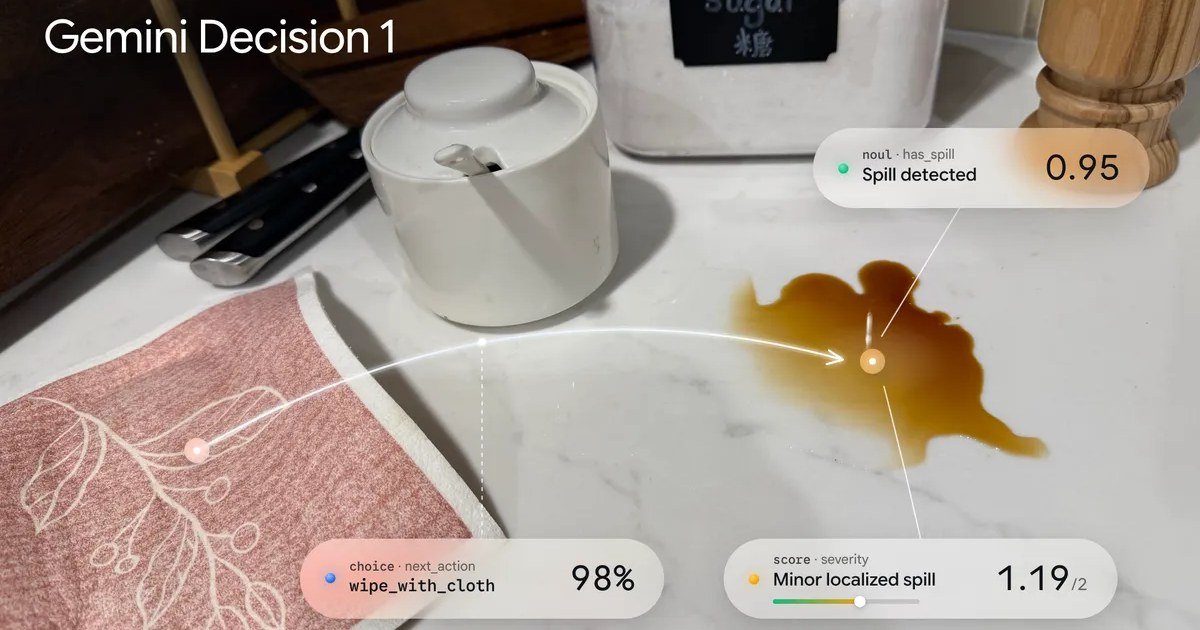
You send one shared input of up to 256K tokens, alongside the questions. Google’s own example in the announcement is a photo of a breakroom counter paired with a short text note, checked in one request for whether there is an uncleaned spill, which cleanup action fits, and how severe the mess is. The input field uses the same Content block format as the Interactions API, so existing Gemini code does not need a new input shape.
The billing is the real story
Gemini Decision 1 costs $0.10 per million input tokens, and output tokens are not billed at all, because the model always returns zero of them. There is a no-cost tier in Google AI Studio for prototyping. But the price per token is not the interesting number. The interesting number is what gets billed once.
Your shared input is billed once per request, no matter how many questions you evaluate against it. Each question adds only its own instruction and criteria tokens. There are no output-token charges, no variable thinking-token bills, and no separate transcription or OCR charges in that request. Google says that makes it 4.9 times cheaper than Gemini 3.5 Flash-Lite with the Interactions API, a figure that comes from Google’s own testing, not an independent lab.
Here is what that billing shape means in practice. Say a team routes 1,000 support tickets against one policy document of 10,000 tokens, and each question’s instructions run about 50 tokens. One Decisions API request costs 10,000 plus 1,000 times 50, or 60,000 input tokens, which works out to about $0.006. The same 1,000 decisions as separate generative calls, each re-sending the policy document and the question, would cost 10,050,000 input tokens, or about $1.01 of input alone at the same rate. That is roughly 167.5 times more input tokens for the same 1,000 decisions. This is an input-token illustration with stated assumptions, not a measurement. A generative call would also bill output tokens, which this comparison leaves out, and real costs depend on question length and which model you compare against. But the shape of it is the product: the input is paid for once, and every extra question is nearly free.
How fast, and where it already runs
Google reports 150 to 250 milliseconds of end-to-end latency, with 50 to 100 milliseconds of median model compute, and says that figure stays nearly flat from 1 to 100 questions per request at contexts up to 16,000 tokens. That flat curve is the other half of the pitch: scoring everything in one pass means asking 100 questions costs about the same time as asking one.
It is already running inside Google. Gemini Notebook uses the Decisions API as a real-time router, directing incoming queries to the best model tier and thinking level, and Google says that delivers up to 40 percent lower latency for everyday queries while reserving deeper reasoning models for complex tasks. The Stitch rapid canvas experiment uses it to generate playable wireframes of a product flow in seconds. CC, from Google Labs, uses it to pick the right emoji reaction from a palette of more than 200 options in a fraction of a second. Google Search uses it as a safety layer for MCP tools, detecting adversarial behaviour and content against adversarial evals.
The benchmark claim, read carefully
Google says Gemini Decision 1 “leads across the suite, with the lowest calibration error” on benchmarks spanning agent routing, reasoning, ranking and multimodal understanding. The “7 of 9” figure that has been circulating comes from the benchmark chart in Google’s post, not from its words. Reads of that chart, including MadRobot’s write-up, put Gemini Decision 1 first on seven of nine tests, but the audio and video tests carry no Jev or OpenAI scores, so on the seven tests where every model was scored, Gemini wins five and Jev wins two, and Jev is cheapest on that shared total at $0.68 against Gemini’s $0.88 and OpenAI’s $0.93.
Two things are worth noting. First, the blog text does not name OpenAI at all, though its chart does compare against GPT-6 Luna, the model behind OpenAI’s Decisions API, so any “beats OpenAI” headline rests on that identification, not Google’s words. Second, every benchmark figure here is Google’s own, with no independent testing cited. The honest version is that Google’s model leads Google’s benchmark suite. Whether it leads anyone else’s is still untested.
That context matters because Google is not first to this idea. OpenAI unveiled its own Decisions API at DevDay on 29 September, Microsoft followed with Microsoft-Decision-1, built on Alibaba’s Qwen, and TypeSafe launched Jev on 15 September. Google’s entry is not the cheapest of the set: at $0.10 per million input tokens it costs more than twice Microsoft’s and Jev’s $0.042. Its edge is multimodal input, text, images, audio, video and PDFs in a single request, where Microsoft’s model takes text only.
How to try it
The API is available now through the Gemini API in Google AI Studio, with demo apps called Doorstep Parcels, Speed Sketch and Find the Zoo Keeper, and Python, JavaScript and REST guides in the Decisions API documentation. You need an API key from AI Studio. The Python example in Google’s post uses the google-genai SDK with the v1beta API version.
There are limits to know before building on it. It is available through the Gemini API in AI Studio, with Gemini in Google Cloud coming soon. Question instructions are text-only, and conversation history and tool-call blocks are not supported. Integrations are rolling out across OpenRouter, LangChain, Vercel, LiteLLM, Pydantic AI, Pipecat, LiveKit and OpenCode. It arrived a day after Google opened Gemini 4 Carbon to paying users.
What to watch next
First, the Google Cloud date, because the API is only useful to teams who can call it from where their code already runs. The second is whether independent testing confirms the benchmark chart, or whether Jev’s two wins are the interesting ones. The third is whether OpenAI or Microsoft answer with pricing of their own, since free output changes what a decision is worth. And the fourth is the simplest: whether developers actually use it for the job Google built it for, the thousands of small yes/no calls that currently pay for a full language model to write a paragraph and then throw the paragraph away.