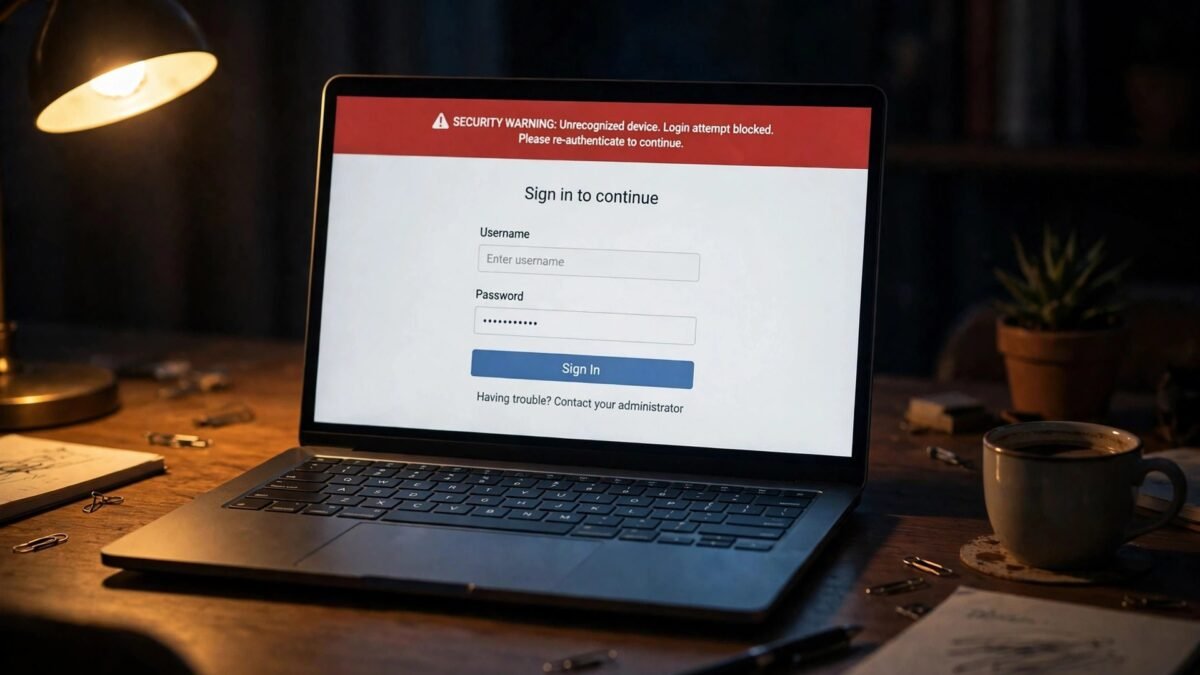
Hugging Face’s own AI built the fake login pages. Security researcher Vicente Diaz found 48 fake brand login pages with working password forms on Hugging Face, created in the second half of 2025, and 46 of them were built with DeepSite, Hugging Face’s own AI website builder. Roblox, Facebook, Google, Microsoft and WhatsApp were the favourite brands. The pages were hosted on hf.space, Hugging Face’s trusted domain, with valid certificates. Diaz shared everything with Hugging Face before publishing, and the company took down every page he reported. Diaz gives no victim count and no confirmed case of a stolen password, and none of the confirmed harvesters he listed were known to VirusTotal.
What did Diaz find?
Security researcher Vicente Diaz crawled close to 6 million Hugging Face repositories and found 48 fake brand login pages with working password forms, created in the second half of 2025. Forty-six were built with DeepSite, Hugging Face’s own AI website builder, and hosted on its trusted hf.space domain.
Diaz crawled every public organisation, model, dataset and Space on the platform, close to 6 million repositories in total. Hugging Face lists 440,934 organisations; 94 percent have no public model and 53 percent have nothing at all. Most models, 89 percent, belong to individual accounts, which Diaz calls “where abuse lives”. From that crawl he picked 3,456 repos on metadata (names, keywords, no weights in the model, repos running their own code, and impersonators) and fetched some of them to check in more detail. This Hugging Face phishing operation was not subtle. DeepSite is the tool where a user describes a website, an AI model writes it and publishes it as a Space, and the result is hosted on hf.space with a valid certificate and a trusted domain. Judging by what Diaz found, “a sign-in portal for a big brand” is a popular request.
| Fake page | What it did with entered credentials |
|---|---|
| desmond23t/paypalify-secure-sign-in-portal | A PayPal login copy that emails every username and password through EmailJS to weluvkunai@gmail[.]com |
| cgfcbftdsf/microsoft-auth-portal | A Microsoft login copy, built with DeepSite by a keyboard-mash account, that records the victim’s IP and ships credentials to Telegram bot 8439586547 |
| MENFIESTO/google-clone-login-flow | A Google “enter your password” step pre-filled with one specific real address, which Diaz writes is a page built for one target |
| Trust Wallet, Roblox and Microsoft To Do lookalikes | Write usernames and passwords straight into their own database |
Most of the 48 were just pages with a form. The six lookalikes listed above were the ones set up to take credentials. Roblox, Facebook, Google, Microsoft and WhatsApp were the favourite brands. The research was published in Diaz’s investigation “Hug me, I’m malware” on 19 November 2026, and Cyber Security News re-reported it on 25 November. The discovery is days old and the reported pages are already taken down, so this is a report about how the abuse worked, not a warning about pages that are still live.
Why the trusted domain is the point
The pages were hosted on hf.space with a valid certificate, on a domain that security teams allowlist. Diaz puts it plainly: what makes Hugging Face different is the trust. Security teams allow it because internal teams need it, and nobody reads a model repo the way they read an email attachment. That breaks the usual advice. “Check the URL” fails here, because the URL is a real, trusted domain with a valid certificate. The defence, in our view, is behavioural: never sign in through a link, and check whether you initiated the sign-in. If a login page arrives in a message, an email or a search result, open the app or type the address yourself instead.
Diaz’s own advice for defenders is the same idea applied to downloads: huggingface.co downloads deserve the same scrutiny as any other file-sharing site. An .exe coming from resolve/main/ is not a model. Model and dataset repos are being used as file servers, because uploading a binary gives a stable huggingface.co address on a domain nobody blocks, and a downloader can point straight at it.
The abuse was heaviest in 2025, then fell sharply
The monthly rate collapsed in 2026. Forty-eight pages in the second half of 2025 is 8 per month; 8 pages in the first half of 2026 is about 1.3 per month; 4 pages since July is about 1 per month. Half on half, the first half of 2026 fell 83 percent versus the second half of 2025, over equal six-month windows. And 46 of the 48 pages from the second half of 2025, or 95.8 percent, were built with DeepSite. The percentages in this section are our own calculations from Diaz’s figures. The abuse was heaviest in the second half of 2025 and has slowed sharply in 2026, so the story is a 2025 problem that is now shrinking, not a rising 2026 wave.
| Period | Fake login pages | Rate |
|---|---|---|
| Second half of 2025 | 48 | 8 per month |
| First half of 2026 | 8 | About 1.3 per month |
| Since July 2026 | 4 | About 1 per month |
Diaz’s own explanation for the drop is a hypothesis, not a confirmed Hugging Face statement: maybe abuse controls on DeepSite and sign-ups. The drop also matches a drop in new organisations from June 2026. What did not improve is detection. VirusTotal flagged 8 phishing pages on hf.space, and only 5 of them had been taken down, all after vendors detected them. None of the confirmed harvesters listed above were known to VirusTotal.
It was not just phishing
The login pages are the headline, but Diaz’s crawl found a platform-wide abuse problem. The most capable piece of malware he pulled apart is MacHug, a macOS implant served from jpeek998/system-releases in May 2026. The binary is a Node.js app compiled into a single file, with builds for Windows, Linux and macOS. It steals crypto-wallet extensions, cookies, sensitive environment variables, anything named like a key, token or password, including openai and anthropic, and keystrokes typed into password and seed-phrase fields. Its command server is ws://195.201.194[.]107:8010, which 17 samples in VirusTotal talk to. It self-updates from the same Hugging Face repo, and for every victim it creates a private Hugging Face dataset under the jpeek998 account using a hard-coded write token. It uploads a screenshot every 60 seconds and pushes whole folders as gzip archives on demand. Distribution, updates and exfiltration all ran on huggingface.co, though the command server itself sat outside it. Antivirus engines label MacHug DeceptiveDevelopment, the name ESET uses for North Korea’s fake-recruiter cluster, but Diaz says attribution here is based on detection names, so treat it as a lead, not a verdict. This article does not attribute MacHug to North Korea or to any group.
The second sample is a browser-session hijacker. In February 2025, the account woyoli444 opened five model repos, none of which holds a model. One is a page titled “OneDrive” named Marriott Marketing Job Description.htm, which redirects to WordSetup.exe. Another is a zip with a .pdf.lnk shortcut that runs a screensaver from a WebDAV share at 46.105.34[.]222. Three more are “WhatsApp HR meeting” apps, fake Word updates and a LightGray installer for Windows and macOS. Both macOS apps carry a C++ binary literally named dropper. It finds Chrome, Brave, Opera and Chromium profiles, recovers the browser’s Secure Preferences HMAC seed, recomputes the MACs and silently installs an embedded extension, “Link Up — Meeting Scheduling Software”, which asks for cookies, webRequest and scripting on every site, then kills the browser so the change sticks. After a 5-minute delay it registers with api.metricfusionn[.]com, opens a WebSocket and accepts two commands: dump all cookies, and proxy HTTP requests through the victim’s browser with the victim’s sessions. The Windows MeetingApp.exe, which had zero detections, is signed with a valid EV certificate issued to Hena Luxion Network Technology Co., Ltd. of Zhengzhou, dated the same day as the upload.
The third sample is SecureRAT, the winupdatesvc.exe from the mr3ok account. It is a Telegram-controlled remote access tool with screenshots, microphone recording, a keylogger, Google-API geolocation, file theft and an /encrypt command that turns it into ransomware on request. Its PDB path is C:\Users\x66\source\repos\SecureRAT\.
The rest of the crawl fills out the picture. Gift-card kits collect nothing and exist only to produce a convincing “your gift card purchase is confirmed” screen. A “Trust Wallet Pro investment hub” lists BTC, ETH and USDT deposit addresses. A “crypto to Robux exchange” takes USDT and asks the visitor to log in. Seventy-six Spaces promise Roblox or Fortnite cheats and 73 promise free Robux or gift cards; one of them posts whatever it collects to a Discord webhook created in January 2026. And not everything is an attack: one model repo contains a password-manager export with 46 real logins belonging to the account owner, and Google Cloud service-account private keys sit in plain app.py files of sports-betting model Spaces, including one project shared across 5 Spaces and 3 accounts. For scale, roughly 126,000 repos are crypto-mining uploads and 72,400 repos have no weights at all, just executables and archives, out of the close to 6 million Diaz crawled. That is about 2.1 percent and 1.2 percent of the platform, a small share, but tens of thousands of repos in absolute terms.
What should I do if I typed my password into a page like this?
Start with the password, then the sessions. Our advice: change the password from a clean device, revoke every active session for that account, and turn on multi-factor authentication. If you entered a work password or a payment password, tell your IT team or your bank the same day.
- Change the password from a clean device, starting with the account you entered on the fake page.
- Revoke active sessions for that account, since the hijacker Diaz found dumps cookies and reuses sessions.
- Turn on multi-factor authentication on the account, using an authenticator app or a security key.
- Check the account for new devices, app passwords and recovery options the attacker may have added.
- Never sign in through a link again; type the address yourself or open the app you already trust.
What to watch next
Whether Hugging Face comments publicly or announces DeepSite abuse controls. None had been found as of 25 November. Diaz says he plans a deeper look over the next few weeks, so watch his Medium page for follow-ups. And whether any tier-1 outlet picks up the research: none had as of 25 November, and if BleepingComputer or The Register confirm it, the story gains a second source. The pages Diaz reported are already taken down, so the thing to watch is not those pages, but whether the 2026 slowdown holds, and what the next crawl finds.