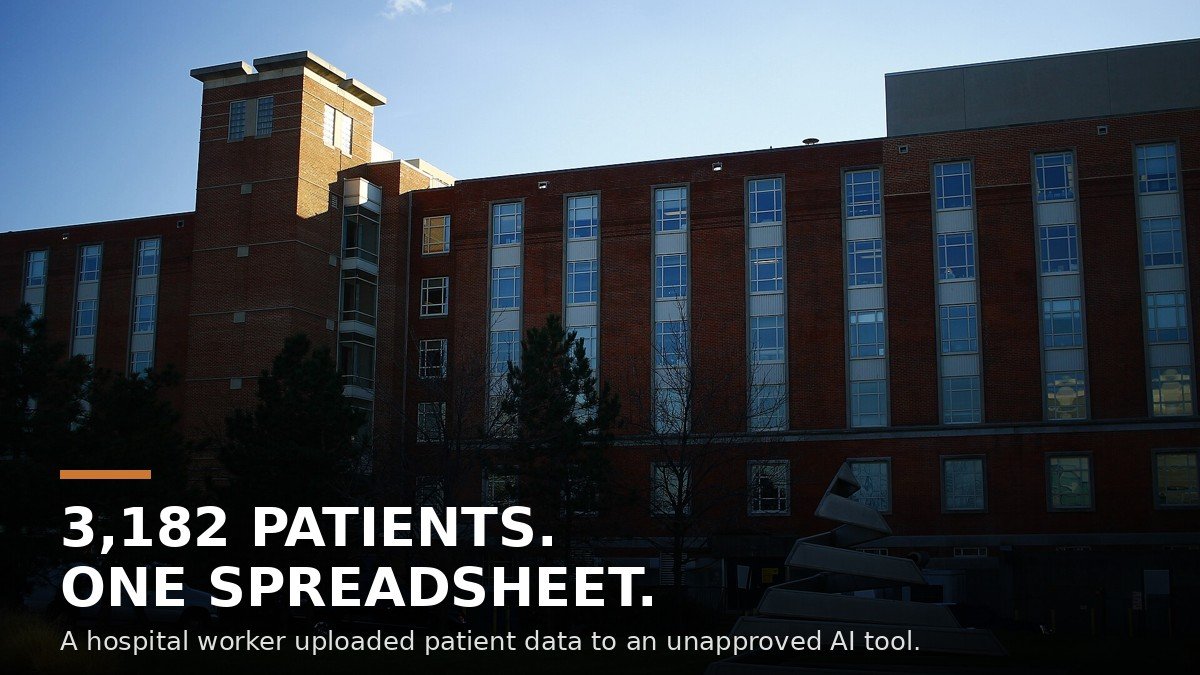
If you were admitted to or treated at Johns Hopkins Bayview Medical Center in Baltimore between May and September 2026, a letter may be on its way to you. The hospital says it is notifying 3,182 patients that information about their care may have been improperly shared with an outside artificial intelligence tool, after a hospital worker uploaded a spreadsheet to a platform the hospital had not approved for use.
The hospital’s account reports no outside attacker, no ransomware claim, and no system intrusion. The exposure route was an insider upload: a staff member put a patient spreadsheet into an AI tool the hospital had not authorised. That distinction matters, because the word “breach” in a headline invites a hacking story that the verified facts do not support.
Who should expect a letter?
The spreadsheet covered people admitted or treated at Bayview from May through September 2026, a five-calendar-month window. The hospital began mailing notification letters on 22 October 2026. The hospital has said it is notifying 3,182 patients, and the mailing only began on 22 October, so a letter arriving days after that date is consistent with the hospital’s own timetable. The letters are the notification itself. If you were treated at Bayview outside that window, this notification does not concern you. The action items for recipients are the call line and the monitoring offer set out in the what-to-do section below.
What was in the spreadsheet?
The hospital says the information in the spreadsheet may have included patients’ names, admission and treatment dates, medical record and account numbers, the departments that treated them, medications administered, and provider names. Note the wording: “may have included”. The hospital has not said every patient’s row contained every one of those items, so the list should not be read as a definite inventory of what was in each record.
| Reported as possibly included | Reported by the hospital as not included |
|---|---|
| Names; admission and treatment dates; medical record and account numbers; treating departments; medications administered; provider names | Social Security numbers; financial account information; “other identifying information” (the hospital’s wording) |
The exclusion side of that table needs a careful reading. The hospital said the file did not contain Social Security numbers, financial account information, or other identifying information. Names and medical record numbers are themselves identifying, so the hospital’s exclusion claim should be read as its own wording about what was not in the file, not as a blanket statement that nothing identifying was exposed. This article reports the claim as the hospital made it.
How did this happen?
The hospital says it discovered the issue on 21 September 2026 and opened an investigation. During an internal review that day, a staff member uploaded the spreadsheet to the unapproved tool. The hospital says the worker then removed the prompt, conversation thread, and document from the tool’s history, and the hospital asked the AI company to delete the data. Whether the company did delete it is not confirmed in the sources available: the hospital is reported as having asked, not as having received confirmation.
The hospital also says it has introduced measures to prevent similar incidents, is reviewing its policies, and is retraining staff on protected health information and on which apps and AI tools are authorised.
Several things remain unknown. No source read names which AI tool received the spreadsheet, and this article does not guess. Nothing in the sources says whether the data was used for training, kept anywhere else, or seen by anyone besides the uploading worker. Nothing says whether any patient has suffered identity theft or other misuse as a result. And the sources describe an upload during an internal review and attribute no intent, so this article calls it neither deliberate nor accidental. None of those gaps is filled by assuming an answer.
The timeline in numbers
As our analysis, built only from the hospital’s reported dates: admissions covered May through September 2026; discovery on 21 September 2026; notification letters began on 22 October 2026. That is 31 days from discovery to the start of notification, by calendar-day count. The sources give no breakdown of what happened inside those 31 days, so the figure is an arithmetic gap between two reported dates, not a finding that the hospital delayed.
Scale, also as our analysis: 3,182 patients is 3.182 percent of the 100,000-person bar this site uses for large incidents. The story qualifies here on the hospital’s name, not on scale: a major medical centre, a named patient group, and a concrete offer of help. Do not inflate it. The 3,182 figure is the hospital’s count.
Read Also: Quest Diagnostics Confirms Patient Data Compromised in Quanum Breach. Quest is a separate patient-data case and is not connected to the Bayview incident.
What should you do if you get a letter?
- Read the letter first and keep the engagement number B174716 with it.
- Call the hospital’s toll-free line at 1-833-931-7766 with questions, weekdays 8 a.m. to 8 p.m. Central time.
- Enrol in the 12 months of free credit monitoring through Experian IdentityWorks offered in the notice.
- Review your medical bills and statements for care you did not receive.
One more caution, as general advice: treat any message that asks you to pay, or to share a Social Security number to “verify” this incident, as suspicious. The hospital’s offer is free credit monitoring through the notice itself, not a payment or a phone request for sensitive numbers.
What to watch next
Three things would change this story: whether the AI company confirms deletion; whether any regulator or further hospital statement names the tool or gives a fuller account of the internal review; and whether any affected patient reports misuse. Until then, the confirmed record is a 3,182-patient notification about an internal upload, not a confirmed case of data theft or misuse.
This incident is separate from the 2023 Johns Hopkins MOVEit incident and from an older employee-snooping story that surfaces in searches for Johns Hopkins. Those involve different dates and mechanisms, and none of their figures applies here.
Sources
- The Baltimore Focal, 24 October 2026: “Johns Hopkins Bayview says 3,182 patients’ records were uploaded to unapproved AI tool” (read in full; every core fact above is attributed to the hospital through this report)
- Wisevoter, 23 October 2026: “Johns Hopkins Bayview Reports Data Exposure” (summary corroboration of the dates and support line)
- WMAR-2 News via EIN News aggregator, 23 October 2026 entry (snippet corroboration of the count and mechanism)
Note: a Baltimore Sun headline flagged this story. Its article body was not used for any fact in this piece.