The outage that was not a configuration fault
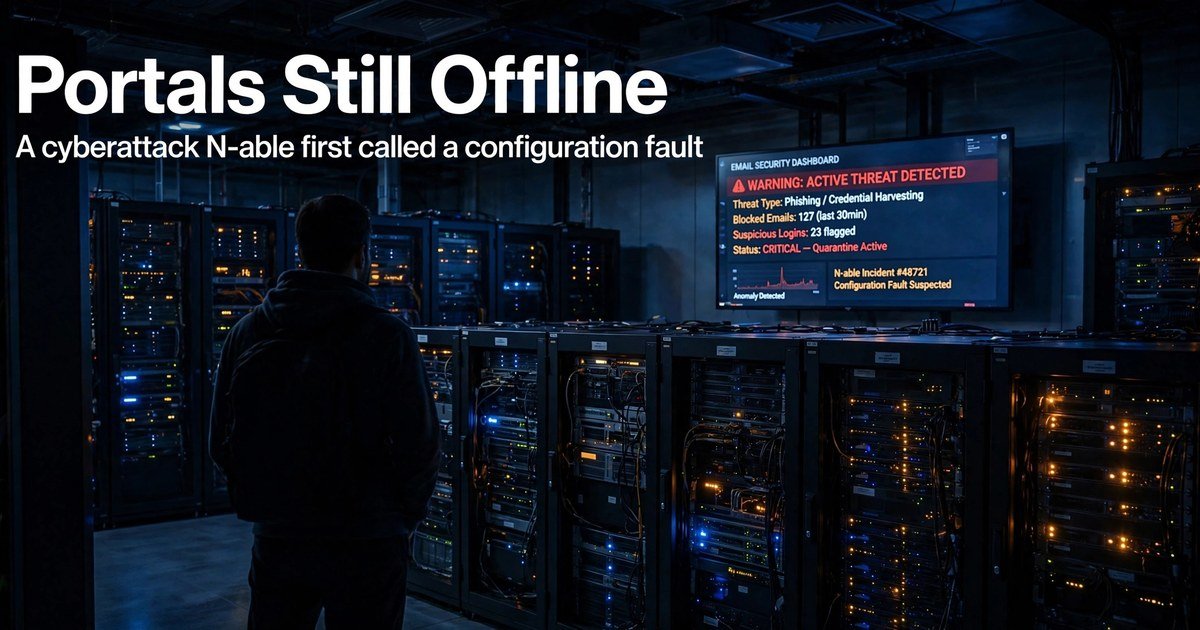
N-able told its customers on Monday 16 November 2026 that Mail Assure and SpamExperts Hosted Cloud had a service disruption. On Tuesday 17 November, the company said it had identified the root cause, a combination of platform configuration and service dependencies, and that a fix was still being developed. The status page listed the incident as resolved the same day. Then, on Wednesday 18 November, N-able reversed itself. The disruption was a security incident, and unauthorised access to one of its servers was behind it.
N-able said so in its own words on its status page: “Our earlier update said the disruption came from platform configuration and service dependencies and we believed we had remediated the issue. As we continued our investigation, we determined that the disruption was caused by a security incident affecting the Mail Assure and SpamExperts Hosted Cloud environment.” N-able confirmed the cyberattack in a status-page update on 18 November. SecurityWeek and BleepingComputer both reported the confirmation on 20 November.
The breach was confirmed two days after the first disruption, and the timeline includes a premature call that the problem was fixed. That is the sharpest fact in this story, because it is the difference between a vendor that caught an attack and a vendor that first told its customers the wrong thing. Mail Assure and SpamExperts are email security services sold through managed service providers, so the customers who were told the issue was resolved are the same providers who filter email for their own clients.
What is still offline, and what still works
The outage is not total, and that split is what partners need to understand first. Core mail flow and inbound and outbound filtering have continued to operate normally throughout the incident, according to N-able’s status page and BleepingComputer. The parts that are offline are the management layer, the tools partners use to control the service. The table below is built from N-able’s own status updates.
| Service | Status |
|---|---|
| Core mail flow | Operating normally throughout |
| Inbound and outbound mail filtering | Operating normally throughout |
| Management portal (dashboard) | Offline, disabled as a precaution |
| APIs | Offline, disabled as a precaution |
| Quarantine | Offline |
| Logging | Offline |
| Mailbox synchronisation | Offline |
Six regional services are affected, Mail Assure and SpamExperts across the Americas, Asia-Pacific and Europe, according to N-able’s status page. Until the offline services are restored, customers may be unable to sign in to the control panel, view or release quarantined messages, review logs, or make configuration changes such as adding or removing domains, according to N-able, quoted by BleepingComputer. N-able has not given a restoration date. The Hacker News reported on Thursday 19 November, at 08:00 UTC, that remediation efforts had progressed but portal and API access remained disabled as a precaution. N-able’s latest status update, at 15:16 UTC the same day, said restoration work continued overnight and is still in progress, with each service to be restored in a controlled way once it has passed security validation.
What N-able did after it found the breach
The breach was isolated to a single web server, according to N-able, quoted by SecurityWeek. The company said an unauthorised party “may have been able to access certain credentials stored on the platform”. That wording matters, because it means credential access is possible, not confirmed. No source has established that credentials were actually taken, and the article does not present it as established.
N-able’s containment steps, as reported by SecurityWeek, were to take the affected server offline, rotate internal platform credentials, revoke existing customer API tokens, invalidate OAuth tokens, and proactively reset passwords for local users. The company also alerted customers by email and gave them specific guidance based on how they access and configure Mail Assure or SpamExperts Hosted Cloud, according to SecurityWeek. N-able said it contacted Mail Assure and SpamExperts partners directly by email with information relevant to their environment and whether action is required, according to its status page.
On customer data, N-able’s position is stated plainly in its own statement: “The investigation is ongoing, but at this time we do not have evidence that customer data was compromised, including access to tenants’ mailboxes.” That is the company’s position as of 18 November, and it has not changed in the updates since. No affected customer, partner or mailbox count has been disclosed anywhere, and no attacker has been identified. How the attackers got in has not been disclosed either. Those gaps are stated here because they are the gaps, not because the story is thin without them.
Two N-able incidents in ten days
N-able has now had two serious security events in ten days, and the company has stated explicitly that the two are unrelated. The comparison below is our own construction from the verified facts in both stories.
| N-central (Able2Shell) | Mail Assure / SpamExperts | |
|---|---|---|
| Product | N-central remote monitoring and management | Mail Assure and SpamExperts email security |
| First disclosed | 9 November 2026, hosted environments taken offline worldwide | 16 November 2026, disruption; 18 November 2026, confirmed breach |
| Cause | More than 30 alleged zero-day vulnerabilities publicly disclosed; 4EverAble2Shell exploit chain subsequently exploited | Unauthorised access to one cloud server; method undisclosed |
| Confirmed impact | At least 21 servers compromised, cryptocurrency miners deployed | Management portals, APIs, quarantine, logging and mailbox sync offline across three regions; core mail flow unaffected |
| Data compromise | None evidenced at disclosure | None evidenced at disclosure |
| Link between them | N-able states explicitly unrelated |
The N-central incident began on 9 November, when a researcher publicly disclosed more than 30 alleged zero-day vulnerabilities, dubbed Able2Shell. N-able took all hosted N-central environments offline as a precaution while it developed and validated security fixes, according to BleepingComputer. Hackers are now exploiting a newly disclosed N-able zero-day vulnerability called 4EverAble2Shell to deploy cryptocurrency miners on vulnerable N-central servers, as BleepingComputer previously reported. TechReview covered that incident separately, in the N-central Able2Shell articles. The Mail Assure incident is a different product and a different incident, and N-able’s own statement says so: “This is unrelated to the N-central incident.”
The angle no source states is the one that should concern N-able’s customers most. N-able is a vendor that managed service providers trust to secure their customers, and it has now had two serious security events hitting two different product lines within ten days, a vulnerability disclosure on 9 November and a confirmed server breach on 16 to 18 November. The second one was first misread as a configuration fault. That is not a claim that the two are connected, because N-able says they are not. It is a claim about the vendor’s month, and it is the reason this story matters beyond the outage itself.
What should Mail Assure and SpamExperts partners check now?
Check whether N-able contacted you directly, because the company emailed partners with environment-specific guidance and said whether action is required. Then check your quarantine backlog and API integrations, since the portal, quarantine and APIs are offline and you cannot release messages or change domains until they return.
- Check your inbox for N-able’s direct email, since it says whether your environment needs action.
- Review your quarantine backlog once access returns, because held messages could not be released.
- Test your API integrations after restoration, since N-able revoked customer API tokens.
- Rotate any credentials shared with the platform, even though N-able found no evidence of theft.
- Watch N-able’s status page for the controlled restoration, since no return date is published.
The API token revocation is the step most likely to catch partners out. N-able revoked existing customer API tokens as part of containment, so integrations built on those tokens will need new ones before they work again. The password reset for local users and the OAuth token invalidation point the same way. Partners should treat the return of the portal as a reconfiguration event, not a simple switch back on.
What to watch next
Whether the management portal, APIs, quarantine, logging and mailbox synchronisation come back, and in what order, since N-able says each service will be restored in a controlled way once it passes security validation. Whether N-able discloses how many partners or mailboxes were affected, since no count exists anywhere. Whether the investigation establishes that credentials were actually accessed, since N-able has said only that an unauthorised party may have been able to access them. Whether N-able names the attacker or the initial access method, since neither has been disclosed. And whether a third N-able product is affected, since two product lines in ten days is the pattern that will define how this month is remembered.