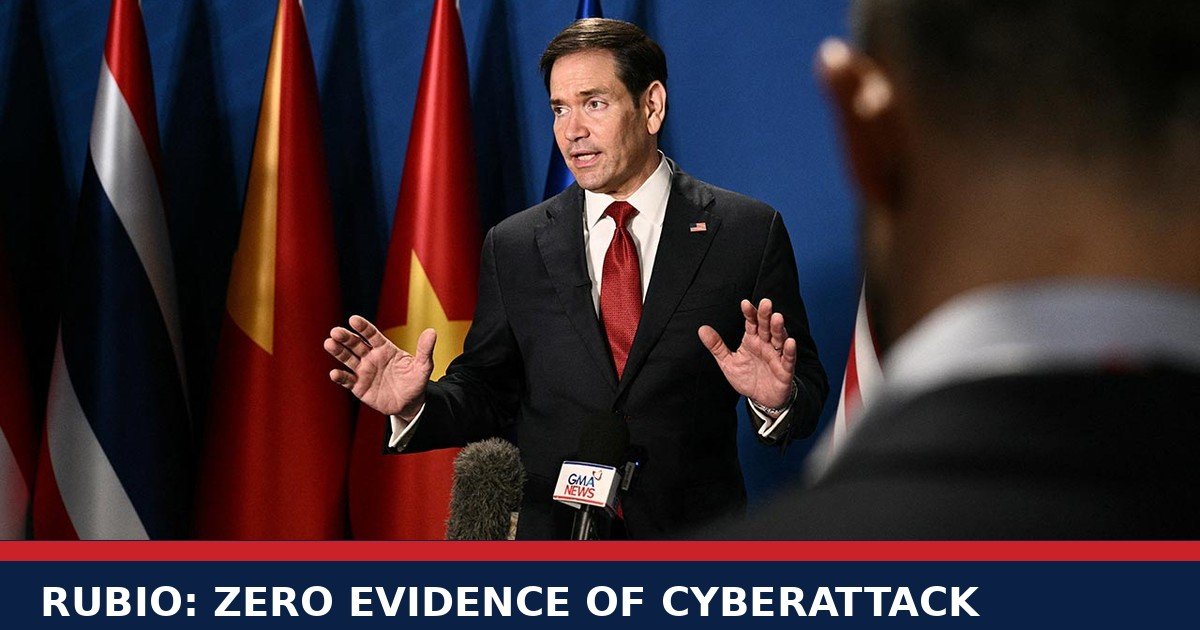
US Secretary of State Marco Rubio said on Tuesday that there is “zero evidence” the week’s run of American tech outages are linked to each other or to a cyberattack, as President Donald Trump brushed the incidents off as “fine”. Speaking to reporters in Manila, where he was travelling with Trump, Rubio said the country is “not under systemic attack”, the first time the administration has answered the week’s US tech outages as a group, rather than one incident at a time.
The answer matters because the outages arrived across every weekday since Thursday: Microsoft’s email outage, the FAA’s nationwide ground stop, a Chase software bug that left customers struggling to reach their online accounts, a United Airlines system failure, an Apple services outage and a temporary degradation of the NSA’s network. Six incidents, four weekdays, and officials saying they saw no evidence of a coordinated cyberattack. That is the story of the week.
What Rubio and Trump actually said
Rubio, who doubles as national security adviser, was blunt. “We have zero evidence or any reason to believe that any of these isolated or individual instances have anything to do with nefarious actors, with cyber hackers, with criminals, with another nation state, with a malign actor of any kind,” he said, according to Reuters. The AP wire carries the identical wording. He called the incidents “unsettling” but said they were completely unrelated, adding: “In essence, the Microsoft incident has nothing to do with what we saw with the FAA. The FAA has nothing to do with what we saw with the banks a few days ago.”
Trump was dismissive. “It’s like when you’re big and powerful, and you have all the money. Things like that happen. It’s fine,” he told reporters in Manila, where he was attending meetings of the Association of Southeast Asian Nations, according to Reuters. The AP wire transcribes the same remark slightly differently: “It’s life. When you’re big and powerful and you have all the money, things like that happen. It’s fine.” So this article quotes the Reuters version only. Trump was dismissive too when AP asked whether he was concerned about the Chase outage. Rubio spoke on Tuesday 17 November in US time, which was Wednesday 18 November in Manila, where he was travelling with Trump ahead of meetings with Chinese President Xi Jinping and Russian President Vladimir Putin in Shenzhen.
Five officials weighed in over two days
Rubio was not the first voice, and not the only one. Counting the on-record statements across Monday and Tuesday, five separate officials and agencies addressed whether the outages were a cyberattack. That count is TechReview’s own tally, built from the statements reported this week.
On Monday, National Cyber Director Sean Cairncross told Semafor there was no coordinated, nefarious cyberattack behind the outages. On Tuesday, Rubio gave the “zero evidence” answer in Manila. Also on Tuesday, Director of National Intelligence Jay Clayton said on Fox Business: “We do not see the indicia of a coordinated cyberattack… And we do not see the indicia of state-sponsored activity here. And we can be fairly confident in that.” Homeland Security Secretary Markwayne Mullin told CNBC the outages come from aging systems that need upgrades, saying “it has nothing to do with cyber attacks.” And the NSA itself said its network experienced a “temporary degradation” during routine maintenance, with mission-critical capabilities fully operational.
Clayton went further than the others on the cause. He attributed the outages generally to institutions patching and upgrading after vulnerabilities were identified: “Lots of institutions, because these vulnerabilities have been identified, are patching. They’re taking their systems down. They’re upgrading them. They’re putting patches in place.” He linked the NSA outage specifically to patching after a PHP vulnerability, saying the patching “has caused some of these systems to not come back up when you patch them as expected. That is what has happened at the NSA today.” He named no CVE or flaw, so this article does not link the NSA outage to any specific vulnerability, including the PHP2Shell flaw, because that connection is unverified. Reuters paraphrased Clayton as attributing the NSA outage to patches for a PHP vulnerability “discovered using AI last month”, a bug that could let hackers remotely take control of servers.
Six US tech outages, four weekdays, no evidence of a coordinated attack
Here are the six US tech outages, incident by incident. Each has a reported cause or explanation. Chase called its software bug ‘not cyber-related’ and Apple said its outage was ‘not caused by a cyberattack’; the broader assessment that there is no evidence of a coordinated attack comes from Rubio and Clayton. The scale is dominated by the two infrastructure incidents, Microsoft and the FAA, not by the consumer-facing ones.
| Incident | Day | Stated cause | Scale |
|---|---|---|---|
| Microsoft 365 / Outlook | Thu 12 Nov | Network capacity upgrade | Millions of workers affected; fully recovered Saturday |
| FAA nationwide ground stop | Fri 13 Nov | Router upgrade | 4.5 hours, longest halt since 9/11; 18,000+ flights cancelled over three days |
| Chase and US banks | Mon 16 Nov | Software bug at Chase, “not cyber-related” | 6,000+ Downdetector reports; resolved Monday evening |
| United Airlines | Mon 16 Nov | Internal system outage | About 150 departing flights delayed; resolved same day |
| Apple services | Tue 17 Nov | Internal update, “not caused by a cyberattack” | Initial reporting named iCloud, App Store, Apple Pay and Apple Music. The nine services Apple listed on its feed are now resolved. Apple Pay and Apple Music were not among the nine. |
| NSA network | Tue 17 Nov | Routine maintenance / patching after a PHP vulnerability | Temporary degradation; mission-critical capabilities remained fully operational |
Reuters put the pattern the same way: “Technology-related disruptions have hit every weekday since Nov 12.” The banks’ impact, by contrast, is measured in thousands of Downdetector reports, with no affected-customer count from any bank. That gap matters. Downdetector counts reports, not customers, and the week’s biggest disruptions were the ones most people never saw directly: email that would not load for millions of workers, and planes that did not move for four and a half hours.
Why the scare spread faster than the facts
A new outage every weekday looks like a pattern, and some people read it as one. Laura Loomer wrote on social media: “Our leaders are lying to us. This is very clearly a coordinated cyber attack. President Trump should come back to the United States.” AP, which reported the post, noted that she “did not present any evidence of an attack”. The officials cited here said they had seen no evidence of a coordinated cyberattack, and five on-record statements across Monday and Tuesday addressed the question.
A viral claim that bank balances would be wiped and the internet shut down on 17 November also has no support behind it. According to a chatter check at candiddragon.com, no statement from CISA, the Federal Reserve or the FDIC describes a system-wide banking failure or wiped balances. That claim was already debunked in TechReview’s coverage of the banks outage.
Downdetector spikes fed the confusion too. A Guardian roundup on 17 November noted a Gmail spike of more than 2,800 reports, but Google’s Workspace Status Dashboard listed no Gmail incident and Google said there was no outage. Gmail was not part of the wave, and this article does not list it as one. A spike on a crowdsourced tracker is a signal to check, not a confirmed incident.
The political pressure for answers is real, and it cuts both ways. Senator Josh Hawley, a Missouri Republican, told reporters: “If this is all a coincidence, it’s like the greatest coincidence in the history of the world.” Senator Jack Reed, a Rhode Island Democrat, said: “Just the last few days, America has seen tech glitches all across the board… The president has to get on top of it, explain to the American people what’s going on, and do it quickly, and that is a mission that he is not doing at this moment.” Former White House press secretary Karoline Leavitt said on Fox News that “transparency is key” and that the president or someone else at the White House should explain what they know after Trump returns from Asia “to really calm the temperature”. She also praised the White House for having Clayton address the outages on Fox Business.
The layoffs question, and what Reuters itself says
One thread running through the coverage is whether the outages follow staffing cuts. Reuters reports that the outages follow layoffs and, in some cases, explicit warnings: the FAA was hit by job cuts after Trump took office last year, and Congress warned its sped-up modernization effort was poorly organized. United said last year that AI advances had helped it cut management headcount by 4 percent and that it planned to cut by an additional 4 percent this year. Microsoft’s email outage came a month after the company said it was offering buyouts to a quarter of its global workforce.
Reuters itself states the limit of that thread: “While there is no evidence job losses at any of these places led to the disruptions…” This article carries that qualifier in full, because the layoffs context is worth reporting and the causal claim is not established. A thinner safety margin is a plausible contributing factor; it is not a confirmed cause of any of the six incidents.
There is a separate trend figure worth keeping apart from the wave. Insurance provider Marsh said on Tuesday its clients reported 105 cyber incidents in the last two weeks of October, more than double the 48 recorded in the final two weeks of May. That is a figure about the wider cyber-incident trend, not about this outage wave, and it should not be read as evidence about these six incidents. Cynthia Kaiser, a former senior FBI cyber official now at Halcyon’s Ransomware Research Center, told Reuters the string of disruptions “highlights how deeply interconnected our digital infrastructure has become, and how a single technical failure or software update can cascade with outsized effects across critical systems.”
What to watch next
Apple’s part of the story is closed. A direct check of Apple’s System Status feed on the morning of 18 November shows all nine services Apple listed on its feed: the App Store, Apple Business, Apple School Manager, AppleCare on Device, iCloud Account and Sign In, iCloud Mail, iCloud Web Apps and Schoolwork, plus the Volume Purchase Program, now listed as resolved. Apple Music and Apple Pay never appeared as Apple-acknowledged events.
Four questions are still open. Whether the NSA confirms its network is fully restored, and when. No restoration time has been given. What the FAA’s investigation concludes about the router upgrade behind the ground stop. Whether any bank publishes a count of affected customers, which none has done so far. And whether the PHP vulnerability behind the NSA patching gets named. Clayton named no CVE, and the link to the PHP2Shell flaw remains unverified. The White House did not respond to a request for comment, according to AP. Until those answers arrive, the week’s record stands as six separate outages across four weekdays, five on-record statements in TechReview’s tally, and officials saying they saw no evidence of a coordinated cyberattack.
Update, November 18
Vice President JD Vance cancelled his appearance at The New York Times’ DealBook summit in New York on Wednesday, about 20 to 30 minutes before it began, to stay in Washington for emergency meetings on the outages. The host, Andrew Ross Sorkin, announced it on stage, saying Vance had been called back for a series of meetings about the outages at Microsoft, the NSA, the airline ground stop, JPMorgan and Zelle. Vance’s office confirmed the meetings but did not say who was in the room, according to The Times. Officials still say they have found no evidence of a cyberattack.
Reuters reported on Wednesday that the causes of the disruptions remain unclear, but cybersecurity experts and US officials say the increased effort to rapidly patch newly discovered vulnerabilities in the AI age is likely a major factor, not confirmed causation for any specific outage. Secretary of State Marco Rubio, speaking to reporters in Manila, said company patching efforts are at times “creating short-term disruption in the way the system works.” The scale is new: Microsoft addressed more than 1,200 software vulnerabilities in November, nearly 20 times the same month a year ago, according to Qualys. More than 100,000 vulnerabilities have been disclosed in 2026, over double 2025’s full-year total, yet the share known to be exploited stayed flat at 1.4 percent, by TechReview’s calculation from VulnCheck’s figures.