On Monday 16 November 2026, customers at Chase, Bank of America and Wells Fargo reported problems getting into online banking and mobile apps, and Chase said some transactions took far longer than usual to complete. The US banks outage centred on JPMorgan Chase, the largest US bank by total assets, where Chase reported a software bug in an on-premise hardware system. An FBI official separately traced it to a software release rolled out earlier Monday, saying other banks were affected only on transactions involving Chase. Chase said the problem was not cyber-related, and by Monday evening it said transactions were posting normally again.
Which banks were actually down, and which were not
Customer reports named four banks. The evidence says something narrower. Chase confirmed a problem of its own, and Wells Fargo’s website said online banking was temporarily unavailable. Bank of America said its own services were not having issues, and U.S. Bank said its systems were not directly impacted.
| Bank | Status on 16 Nov | What the evidence says |
|---|---|---|
| Chase | Confirmed outage | Chase Support acknowledged an online banking issue on X, and Chase told Fox Business that some transactions were taking longer than usual |
| Wells Fargo | Confirmed outage | Its website said online banking was temporarily unavailable, according to NBC Chicago |
| Bank of America | Reports only | Customers reported problems, but the bank told the Associated Press its own services were not having issues |
| U.S. Bank | Reports only | Customers reported problems, but U.S. Bank said its systems were not directly impacted |
| Zelle | Not down | The network was fully operational, according to Early Warning Services; delays came from the banks, not from Zelle |
Wells Fargo’s row comes with a wrinkle. Fox Business later reported that Wells Fargo told it the bank was not impacted by Monday’s events. That sits oddly against the bank’s own website notice earlier in the day, and Fox Business did not reconcile the two. Wells Fargo may have meant it was not hit by the Chase glitch itself, but the report does not say that, so the website notice stands.
This was a Chase outage with knock-on delays elsewhere, not four banks failing at once. Chase spokesman Joe Evangelisti put it plainly to the Associated Press: “This is not a systemic issue — other banks may have been impacted by slowness in transactions only to the extent that they were a party to a transaction with us.”
How the reports built up through the day
Downdetector counts only what users report, never how many customers were affected. With that label attached, here is how the day unfolded.
The first spike in Chase reports came at 9:48 a.m. ET, according to The Sun. Shortly after 10:00 a.m. ET, more than 3,400 Chase reports had come in. By 12:19 p.m. CT, the count had passed 4,000, with Chicago among the hotspots, NBC Chicago reported. At 1:18 p.m. ET, the tally stood at 4,039 Chase reports, according to The Sun. Around 1:50 p.m. ET, the snapshot was Chase 4,600 plus, Bank of America 1,900 plus, Wells Fargo 800 and U.S. Bank 900 plus, according to NBC Connecticut. Chase reports stood at about 4,800 around 2:00 p.m. ET, USA TODAY reported, and later in the evening the count passed 6,000, according to Times Now. By 7:00 p.m. ET, the reports had eased to about 1,050 for Chase, about 500 for Bank of America and about 260 for Wells Fargo.
The most reported Chase problems were viewing account balances and transactions, web login issues, and problems with money transfers and wires, The Sun reported. At about 1:50 p.m. ET, Chase alone had more reports than Bank of America and Wells Fargo combined, about 1.7 times as many. That is our approximate calculation from a single snapshot, not a total for the day, and it covers that 1:50 p.m. moment only.
What caused the US banks outage
Chase spokesman Joe Evangelisti told the Associated Press that JPMorgan Chase had experienced a temporary issue related to a software bug in an on-premise hardware system, and that it was not cyber-related. An FBI official gave Fox Business a sharper detail: the US banks outage was traced to a software release the bank rolled out earlier Monday that affected a subset of its systems, and there was no indication of malicious or external cyber activity. That attribution belongs to the unnamed FBI official, not to Chase itself.
Chase’s own statement, given to Fox Business, was simpler: “Due to a technical issue, some transactions are taking longer than usual to complete but customers still have access to their accounts and funds.” Homeland Security Secretary Markwayne Mullin told USA TODAY that DHS investigators do not believe the outages were caused by a cyberattack or a foreign actor. The Washington Examiner reported him saying he could tell reporters with 98% certainty that no cyberattack was taking place.
One claim deserves a careful read. The Washington Examiner reported that Mullin relayed an unnamed technology expert’s claim blaming artificial intelligence for the run of outages, suggesting AI incorporated into older systems had self-fixed code and caused malfunctions. That is speculation from an unnamed expert, not a finding by DHS, and there is no verified evidence that AI was involved in the Chase software bug. Treat it as a theory doing the rounds, not as the cause.
No full root cause has been published beyond the cause category. Chase has not said which system the software release touched, or what the bug actually did.
When did it end
A Chase spokesperson told NBC News at about 6:30 p.m. ET that transactions were posting normally, according to Insurance Business, which cited NBC News. At about 7:00 p.m. ET, Chase told USA TODAY the issue had been resolved. At 8:15 p.m. ET, Chase told FOX Local: “We can confirm that transactions are processing normally again,” according to Gulf Business.
That is as far as the confirmations go. Chase has not announced a full restoration, and Plaid’s notice about Chase connections still said “Investigating” at the last check. Wells Fargo has not said its online banking is fully restored either. Transactions were flowing again by Monday evening, not that every system was declared fixed. Bank stocks closed lower on the day: Chase fell 2.3%, Bank of America 1.8% and Wells Fargo 1.4%, according to MarketWatch.
What should I do if my payment is still stuck?
First check whether the payment went through, because a slow transaction can still land. If it did not, save proof of the failed attempt and contact your bank directly instead of sending the money again. Do not trust texts or emails about the outage until you verify them through your bank’s own app or number.
- Check your bank app or statement to see whether the payment went through before you retry it.
- Save a screenshot and any reference number for a failed transaction before you close the app.
- Call your bank on its published number if a payment is still missing after service is back.
- Ignore links in outage texts or emails and open your bank’s app yourself to check anything.
These are general precautions, not instructions from Chase or any other bank.
What this outage was not
Chase said the problem was not cyber-related, the FBI official quoted by Fox Business said there was no indication of malicious or external cyber activity, and DHS said its investigators did not believe a cyberattack or a foreign actor was involved. Those are the assessments on the record, not a final forensic finding. It was not connected to the Microsoft 365 outage of Thursday 12 November or the FAA nationwide ground stop of Friday 13 November. The cited reports do not identify a link between the banks outage and either incident, and the Associated Press reported that government officials and company leaders said they were unrelated.
It was not a bank-wide ATM outage either. The ATM trouble in the reporting is branch-level only: one Chase branch in Atlanta put a temporary $1,500 withdrawal limit in place, a Georgia mortgage lender could withdraw only $3,000 inside her local branch and $1,000 from its outside ATMs, and a Washington, D.C. branch manager told Fox Business that ATMs there were working as normal. The cited reporting does not establish a bank-wide ATM outage, and the branch reports point in different directions.
A viral claim that bank balances would be wiped and the internet shut down on 17 November has no support behind it. According to a chatter check at candiddragon.com, no statement from CISA, the Federal Reserve or the FDIC describes a system-wide banking failure or wiped balances.
Update, November 17: US intelligence chief rules out a cyberattack
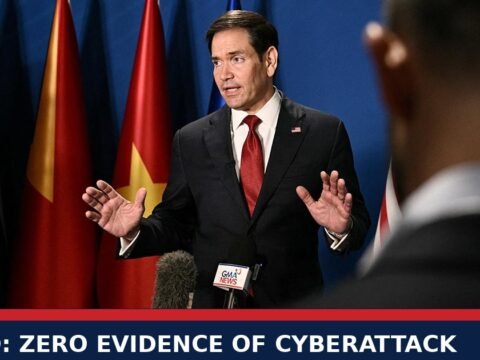
Director of National Intelligence Jay Clayton said on Fox Business on 17 November that officials see ‘no indicia of a coordinated cyberattack’ and ‘no indicia of state-sponsored activity’ behind the week’s outages, calling it ‘just an upgrade in patching, an upgrade in systems.’
Homeland Security Secretary Markwayne Mullin told CNBC the outages come from aging systems that need upgrades, saying ‘it has nothing to do with cyber attacks,’ Reuters reported. Senator Mark Warner, the top Democrat on the Senate Intelligence Committee, backed the assessment, saying there was ‘no indication that these incidents are the result of a cyberattack, foreign interference, or some coordinated effort’ (USA Today).
Update, November 16: Vance says no crisis is coming
Vice President JD Vance told Fox News on Monday evening that Americans do not need to build bunkers or stock up on food and water after the week’s outages. “My answer to that is no. We do not see some crisis coming down. But you have to be prepared for everything,” Vance said on The Ingraham Angle. He also dismissed reports that Pentagon facilities were preparing to operate off the power grid for 90 days, describing military preparedness as basic responsible government rather than evidence of an approaching disaster.
What to watch next
Four answers are still open. Whether Plaid closes its Chase incident, which still said “Investigating” at the last check. Whether Wells Fargo confirms its online banking is fully restored. Whether any bank publishes a count of affected customers, which none has done so far. And whether Chase says more about the software release behind the bug. Until those answers arrive, the story stands as a Chase software bug, a day of slow transactions, and transactions processing normally again by Monday evening, as Chase confirmed.