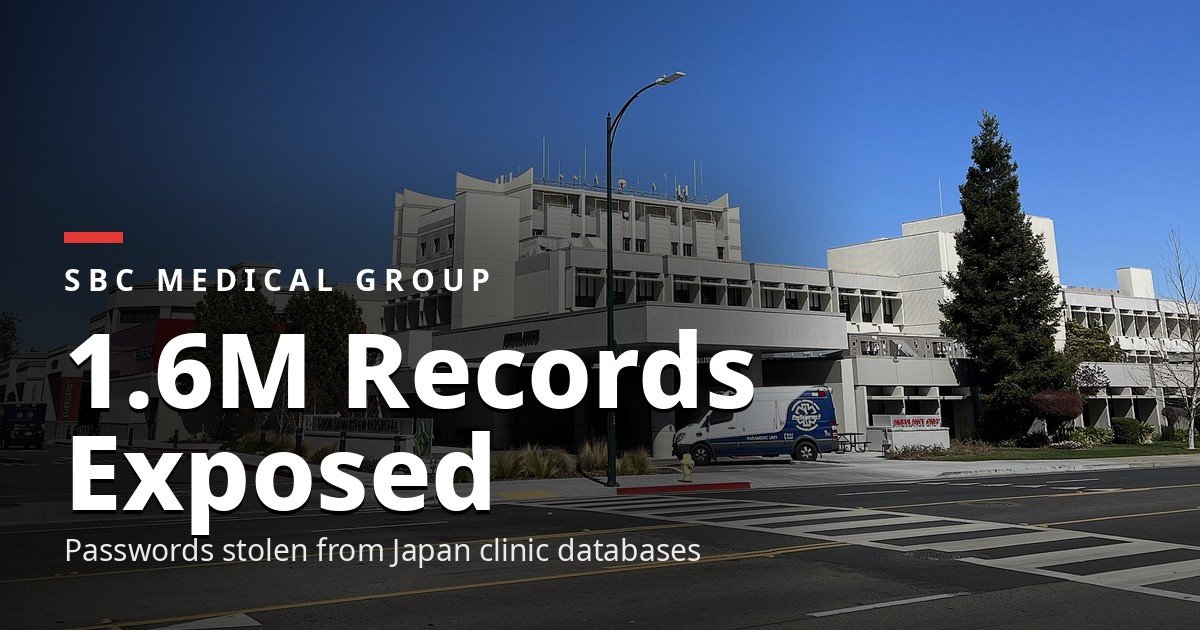
SBC Medical Group has told US regulators that hackers stole personal data belonging to 1.6 million people from its Japan clinic databases, including passwords. SBC is a Medical Services Organization that provides management support to clinics in Japan, and it is listed on the Nasdaq. The company disclosed both incidents in a press release on 18 November and in a filing with the US Securities and Exchange Commission on 19 November, after detecting the database breach on 16 November. BleepingComputer reported the filing on 19 November.
The speed of the disclosure stands out. SBC detected the database breach on 16 November, published a press release on 18 November, and filed the SEC form on 19 November. That is two days from discovery to public statement, and three days to the regulator. SBC moved fast, but the data it lost is old.
The basic personal information, which includes passwords, covers 2010 to 2023. Reservation requests go back to 2007, and website inquiries go back to 2004. A breach discovered in November 2026 exposed records going back 22 years, and some of the people affected may not have been SBC patients for over a decade.
What the attackers took
The company published this breakdown in its 18 November press release. The largest category is basic personal information for 1,624,000 people, covering 2010 to 2023. Depending on the individual record, the exposed fields may include names, sex, telephone numbers, email addresses, passwords, addresses, dates of birth, patient card numbers, member IDs and survey responses. The company says not all of the listed data types were exposed for all 1,624,000 people.
| What was taken | How many people | Period covered |
|---|---|---|
| Basic personal information, including passwords | 1,624,000 | 2010–2023 |
| Reservation requests | 255,416 | 2007–2026 |
| Website inquiries | 217,769 | 2004–2026 |
| Treatment-monitor records | 4,513 | 2013–2026 |
| Reviews submitted to the group | 15,007 | 2015–2018 |
| Employee account records | ~20,000 | — |
The treatment-monitor records contain treatment descriptions and stored image file names, not the images themselves, according to the press release. The reviews contain treatment names and review text. SBC has not confirmed unauthorised access to electronic medical records or information from its mySBC reservation site, and the company says clinical care systems and direct treatment histories were outside the scope of the database incident.
Employees were hit too. The attackers stole approximately 20,000 employee account records, including names, IDs and passwords. For a small subset of 459 employees, the affected data also included bank account and pension-related information, withholding tax certificates and dependent exemption declarations. That 459 is 2.3% of the employee records taken, and it is where the bank account and pension details sit.
Why the passwords matter more than the cards
Here is the number that frames this breach. Basic personal information covered 1,624,000 people, passwords among the data types, though not every listed type was exposed for every person. In a separate category, historical customer inquiries from 2010 to 2018, 14 individuals had credit card information in the exposed data, and all 14 cards were unusable for additional payments. Put the two figures side by side: 1,624,000 people with basic personal information exposed, against 14 people with card details. That is 116,000 to one, by our calculation.
The consumer risk here is credential stuffing and account takeover from reused passwords, not card fraud. A password taken from a clinic database in 2026 is dangerous precisely because people reuse it, and a reused password can unlock an email account, a shopping account or a banking login today. Card numbers expire and get replaced. Passwords do not, unless the person changes them.
That is also why the age of the data matters. Website inquiries go back to 2004, and reservation requests go back to 2007, while the basic personal information records, including passwords, cover 2010 to 2023. A person who last dealt with SBC a decade ago is still in this breach. SBC has not said whether the passwords were hashed or stored in plaintext. Either way, anyone who used the same password elsewhere should treat it as compromised.
Two breaches on the same day
The filing describes a second incident, and it happened on the same day. On 16 November, SBC was notified of unauthorised access to clinic administrator accounts on Tribeau, a third-party booking platform used by 56 clinics that SBC provides management services to. The platform operator reported access to reservation information for 12,641 people, as well as treatment names, dates and fees for 6,804 people who received treatment. Three people who exchanged messages with a clinic also had message contents, date of birth and sex accessed.
The Tribeau incident is much smaller than the database breach. Its 12,641 reservation records are 0.8% of the 1,624,000 headline figure. Email addresses, residential addresses, credit card information, passwords and electronic medical records were not included in the Tribeau incident, according to the press release, and the obtained information was not linked to case or review information, including photographs, on Tribeau. Whether the two 16 November incidents are connected is not stated in any source. Do not read a link into the same-day pairing. It is a striking coincidence, and it is unconfirmed as anything more.
After its security monitoring system detected anomalous activity on 16 November, the company isolated the affected server, blocked unauthorised access, set up an incident response team, preserved system logs, strengthened access restrictions and monitoring, and commissioned a detailed investigation by external cybersecurity specialists. On Tribeau, all accounts of the clinics SBC manages on that platform had their passwords invalidated, and communications from the attacking sources were blocked. The company reported the database incident to Japan’s Personal Information Protection Commission on 16 November and said it will consult the police.
What should I do if my SBC password was exposed?
If you have ever used an SBC Medical Group clinic or its websites, change the password you used there, and change it everywhere else you reused it. Passwords were among the exposed data types for 1,624,000 people, and the real danger is someone trying those passwords on your email, shopping and banking accounts.
- Change your SBC account password first, then change the same password on every other service where you reused it.
- Turn on two-factor authentication on your email account before anything else, since email resets unlock most other accounts.
- Check whether your email address appears in a known breach, and treat any match as a prompt to rotate passwords.
- Watch for phishing emails pretending to be from SBC, and never click a link in a message about this breach.
- Review your bank and card statements for the next few weeks, even though only 14 cards were stolen.
What SBC has not said yet
No actor, ransomware group or intrusion method has been named in any source. The filing does not say who is behind the intrusion or whether ransomware or extortion was involved, and the method of intrusion and full scope remain under investigation, according to the 8-K quoted by BleepingComputer. As of the 18 November press release, the company had not seen any evidence of misuse of the exposed data, and it has not confirmed any fraudulent use.
SBC has also not said whether it will offer credit monitoring or identity protection. That is not stated in the company release or in BleepingComputer’s report, so do not assume an offer exists.
The company says it cannot estimate the financial impact of the incidents yet. It expects costs for customer notification, call centre operations, forensic investigation, legal and advisory services, and compensation, a portion of which may be covered by cyber insurance held by its Japanese subsidiary. The medical corporations involved have decided to suspend television and certain other advertising for a limited period, and the company expects new patient inquiries at the affected clinics may decline during that period.
Our take: this is a password breach wearing a healthcare breach’s clothes. The medical angle draws the eye, but no electronic medical records were confirmed taken, and the clinical systems were outside the scope. What was taken, at scale, is basic personal information, passwords among the data types, some of it more than a decade old. SBC disclosed fast, which deserves credit. The hard part now belongs to the 1,624,000 people whose basic personal information was taken, and to the 459 employees whose bank and pension details were in the stolen employee records. Change the password. Then change it everywhere else.
What to watch next: whether a second major outlet picks the story up, whether SBC names the intrusion method or an attacker, whether any of the passwords exposed in this breach surface in credential-stuffing datasets, and whether SBC offers credit monitoring or identity protection. The investigation is ongoing, and the company says the categories and scope of affected information remain under investigation.