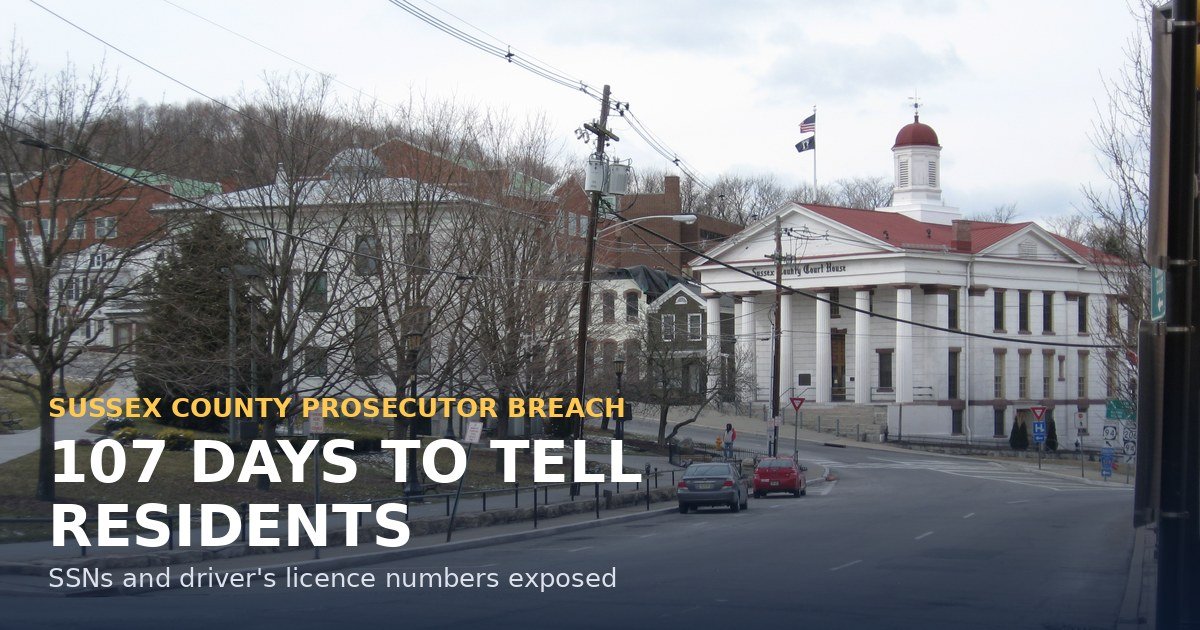
Sussex County’s prosecutor’s office was broken into in July. The public was not told until November. The gap between those two dates is the story.
The Sussex County Prosecutor’s Office in Newton, New Jersey, was the subject of a notice published on 6 November by Kennedys CMK LLP, the office’s counsel. The notice said someone accessed its network without authorisation between 15 and 22 July 2026. The files they reached held people’s first and last names, Social Security numbers, and driver’s licence or state ID numbers, according to the notice, published by PRNewswire. The notice says the files were “accessed and may have been taken”. It does not say they were stolen.
What the notice says
The office received alerts of a disruption to its computer network on or about 10 August 2026, and it launched an investigation with outside cybersecurity specialists, the notice says. The investigation found the unauthorised access ran from 15 to 22 July. The office reported the incident to state and federal law enforcement, the New Jersey Cybersecurity and Communications Integration Cell, and the New Jersey Office of Attorney General. A call centre is open at (888) 269-1448, Monday through Friday, 9:00 a.m. to 9:00 p.m. EST.
That is what the 6 November notice says. The notice does not name an attacker or a ransomware group. It does not say how many people are affected, or who they are. It does not say whether the files were actually taken or only viewed. And it does not mention a credit monitoring or identity protection offer.
The timeline: 107 days from intrusion to notice
Here is the timeline, worked out from the dates in the notice. The unauthorised access ran for 8 days, 15 to 22 July. The disruption alerts came on or about 10 August, 19 days after the access ended. The public notice was published on 6 November, 88 days after detection and 107 days after the access window closed. People whose Social Security numbers were in those files were told more than three months after the intrusion ended.
| What | Confirmed | Not stated |
|---|---|---|
| Access dates | 15 to 22 July 2026 | None |
| Detection | On or about 10 August 2026 | None |
| Data exposed | Name, Social Security number, driver’s licence or state ID number | Which people and records; whether every record held all three |
| People affected | None | How many, and who |
| Attacker | None | Who did it, and how they got in |
| Files taken? | None | Whether files were copied or only viewed |
| Credit monitoring | None | Whether any offer exists |
The table is our own summary of the notice. The dates and the arithmetic are ours; every fact in it comes from the county’s notice.
What should I do if my information was in the Sussex County breach?
Freeze your credit at all three bureaus first. A freeze is free by federal law and it stops anyone opening a new credit account in your name, though it does not prevent all forms of identity theft. Then place a fraud alert, get an IRS Identity Protection PIN, and watch your tax and benefits accounts. The notice does not mention a credit-monitoring offer.
- Freeze your credit at Equifax, Experian and TransUnion. Our credit freeze guide walks through all three bureaus step by step.
- Place a fraud alert with one bureau. That bureau tells the other two, and the alert warns lenders to verify your identity.
- Get an IRS Identity Protection PIN. It helps prevent someone filing a fraudulent federal tax return using your Social Security number.
- Watch your tax return, benefits and bank accounts for activity you do not recognise.
- Call the county’s call centre at (888) 269-1448 for further information.
The exposed combination is the one identity thieves look for: a full name, a Social Security number and a driver’s licence number. That is the material used in identity-theft attempts, which is why the freeze, the fraud alert and the IRS PIN matter. A freeze does not fix what was already exposed, but it closes the easiest door a thief can walk through.
What we still do not know
Five things are still open. The notice does not say how many people are affected. It does not name the attacker or the method used to get in. It does not confirm whether the files were copied or only viewed. It does not say whether the county will offer credit monitoring. And it does not say who exactly was in the files: employees, people involved in cases, or residents.
The delay is the part that should bother New Jersey residents most. The intrusion ended on 22 July, and the public notice came on 6 November, 107 days later. That is the gap between the end of the access and the public warning. A freeze placed today still helps, because a freeze makes it harder for someone to open new credit accounts using the exposed information, but the warning came late, and the notice says nothing about paying for protection.
What to watch next: any state attorney general filing that carries a victim count, any ransomware group claiming the incident, and any credit monitoring offer from the county. If any of those appear, this article will be updated.
Photo: Sussex County Courthouse, Newton, New Jersey, by ColonelHenry, licensed under CC BY-SA 3.0, via Wikimedia Commons.