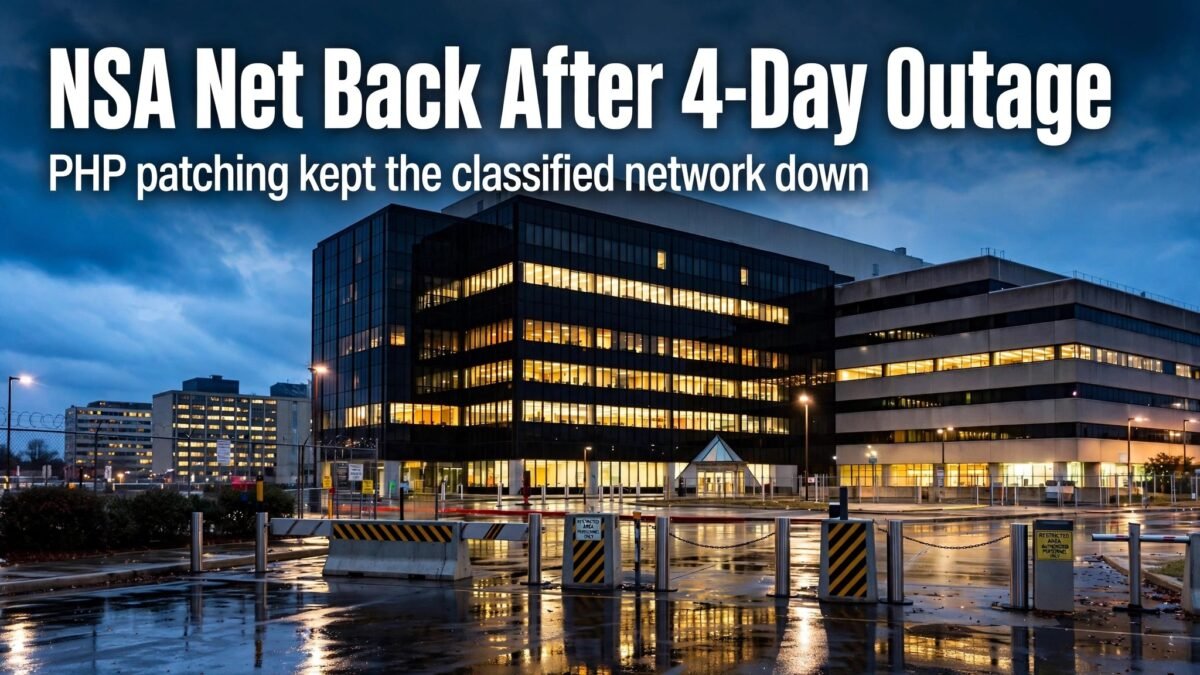
The National Security Agency’s highly classified internal network is back. NSA Net, the system the agency uses to communicate classified information internally, was down for almost four days, and an agency spokesperson confirmed to Nextgov/FCW on Friday that it is now operating under normal conditions. The outage froze employees out of what amounts to the NSA’s classified email system, closed its Maryland campus to most staff at one point, and closed a week in which four of America’s biggest systems failed in six days.
The cause, according to the Director of National Intelligence, was patching. Jay Clayton said on Fox Business that the patching carried out after a PHP vulnerability was identified “has caused some of these systems to not come back up when you patch them as expected. That is what has happened at the NSA today.” The NSA itself had urged organisations to apply software patches for the same vulnerabilities, according to CNN.
Four failures in six days
TechReview has now covered the four biggest failures of the week. The sequence began on Thursday, November 12, when Microsoft’s products went down, leaving people unable to access Outlook email and Teams meetings. On Friday, November 13, the Federal Aviation Administration ordered a nationwide ground stop after a massive systems failure, which the FAA attributed to excessive data flooding its network, with its initial investigation identifying a radar site in Amarillo, Texas, and a radio communications site in El Dorado, Arkansas, where its provider L3Harris had been deploying a new router, as potential sources. On Monday, November 16, customers reported problems involving Chase, Bank of America and Wells Fargo, among other financial institutions. JPMorgan Chase confirmed a software bug in its on-premise hardware systems that slowed some transactions and could cause delays at other banks processing transactions involving JPMorgan. Then, on Tuesday, November 17, NSA Net went down.
The four incidents were separate, and no shared cause has been established for them. They are grouped here because TechReview covered all four, not because they were the only disruptions of the week. A fifth hit on Monday too: a United Airlines technology problem held up departing flights for about 30 minutes, directly affecting fewer than 150 flights, according to the airline. The FAA said it was not an FAA equipment issue.
The week reads differently with the fourth failure in it. The first three were public-facing outages that millions of people could see. The fourth was the internal communications backbone of America’s lead signals-intelligence agency, and it stayed down longer than any of the others. CNN reported that the length of the outage, almost four days, was unusually long and disruptive, according to current and former officials.
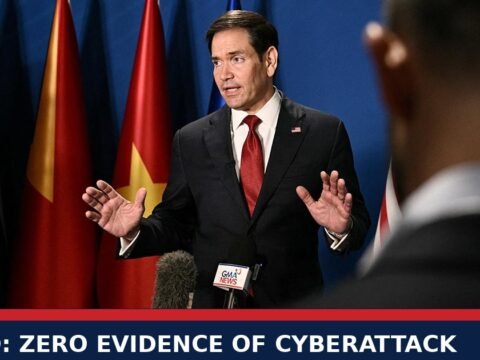
There is also an official reassurance that landed on the same day as the outage. Homeland Security Secretary Markwayne Mullin told CNBC on Tuesday that the recent series of outages was not tied to cyberattacks but to aging computer systems, saying “I can tell you with 98% certainty this isn’t a cyberattack,” according to the Jerusalem Post. The NSA outage was reported later that same day, though the network had already been down since at least early Tuesday morning. Mullin’s comment was about the series of outages generally, not about NSA Net specifically, and the distinction matters, because the NSA outage turned out to have its own cause.
One small discrepancy in the coverage is worth noting. CNN’s November 17 article attributed its reporting to six people familiar with the matter, while Reuters’ summary of CNN’s reporting described five. The Jerusalem Post version of the Reuters piece says six. Nextgov/FCW separately cited six people familiar with the matter. The published accounts do not establish whether the anonymous sources overlapped. This article follows CNN and says six, and attributes the outage itself to CNN throughout, rather than to “reports” generally.
What went down at Fort Meade
NSA Net is the highly classified network the NSA uses for its internal communications, according to CNN, which first reported the outage on Tuesday, November 17. It is the primary platform for transmitting top-secret data, according to Nextgov/FCW. When it went down, employees could not reach what CNN described as essentially the agency’s classified email system.
The agency’s first response was to stagger arrivals. CNN reported that as the agency worked to understand the scope of the problem, it enacted staggered arrivals for personnel. Bloomberg Law reported that the network had been down since at least early Tuesday morning and that some staff had been unable to access their workplace systems.
The return to work did not go smoothly. On several occasions over the past several days, some employees were told to report to work on a staggered basis, only to have to return home without ever logging in, CNN reported. The employee voicemail told the story in colour codes. On Tuesday morning it described the situation as a “code yellow,” the second-highest level in the three-level system that governs whether employees report for work, telling non-emergency personnel to arrive in a staggered manner. Sometime on Tuesday evening it reverted to “code green,” instructing employees to report to work as scheduled. But later that night the inbox moved to a “code orange,” closing the campus for most employees until further notice and reverting to essential personnel only, according to the inbox recording and a source familiar with the matter. A source told CNN that restoration was ongoing but not yet complete.
The resolution came on Friday, November 20. CNN reported that the outage, which had kept large swaths of employees locked out for more than three days, had been resolved, according to a source familiar with the matter and a voicemail recording for employees at the Maryland headquarters. Employees were told to return on staggered arrivals to avoid overloading the system with too many simultaneous logons, and the expectation was that most staff would be back by midday on Friday. The voicemail said: “November 20, 2026, NSA Washington is operating under normal conditions with exceptions. Personnel must follow their designating building opening times.”
The Georgia campus was also affected. Nextgov/FCW reported that the NSA’s Georgia campus, a key hub focused in part on Middle East intelligence collection, was hit as well, according to a person familiar with the matter.
The patch that would not come back up
The first cause claim came from the Wall Street Journal, which reported with its own sourcing that a person familiar with the incident said the NSA was updating its software to patch the system, and that the network would be offline only temporarily. The NSA did not return the Journal’s request for comment.
Nextgov/FCW deepened that sourcing the same day. Four of the six people familiar with the matter told the outlet that there were no immediate signs of a cyberattack and that the outage “may be linked to a series of software upgrades on the network.” The published accounts do not say whether these were the same people CNN spoke to, so this deepened the claim rather than independently confirming it.
The strongest attribution came from the Director of National Intelligence. Jay Clayton told Fox Business that officials saw no signs of a coordinated cyberattack or state-sponsored activity, saying “We do not see the indicia of a coordinated cyber attack. And we do not see the indicia of state-sponsored activity here.” He linked the NSA outage specifically to patching after a PHP vulnerability, saying “The patching that has gone on following [a PHP vulnerability] has caused some of these systems to not come back up when you patch them as expected. That is what has happened at the NSA today.” He added that the FBI and the NSA had appropriately called for affected systems to be taken offline so security fixes could be installed. TechCrunch also reported Clayton’s comments the same day.
CNN’s resolution reporting re-confirmed the cause. Multiple current US officials briefed on the outage said it was not a cyberattack but appeared connected to the NSA’s handling of software updates for vulnerabilities in PHP, a programming language that powers about 70 percent of the world’s websites, according to CNN. Private researchers had disclosed the vulnerabilities the previous month, and AI tools had helped discover them. Two people familiar with the matter told Nextgov/FCW that Clayton’s remarks were generally accurate.
One line must not be drawn. The NSA had publicly identified a group of PHP vulnerabilities as PHP2Shell (CVE-2026-109618 and CVE-2026-109619) in an October 21 advisory and urged organizations to install the relevant security patches. However, neither Clayton’s public remarks nor the available outage reporting explicitly identifies the November NSANet incident as involving a particular CVE or confirms that the patches were specifically for PHP2Shell.
What the NSA itself said
CNN’s first report noted that the agency had not publicly confirmed the outage when asked for comment. The NSA’s own statement came later the same day. Published on November 17, it described the incident as “temporary degradation during scheduled routine maintenance,” adding: “While some internal systems were affected, mission-critical capabilities remain fully operational and our ability to defend national security continues.” Scripps News quoted the same wording from a US official the same day, and Nextgov/FCW updated its reporting to include the spokesperson’s statement.
The maintenance framing was NSA-stated from the start, and it stayed the agency’s line through the week.
The restoration confirmation came from a spokesperson. “NSA can confirm that we are now operating under normal conditions,” an agency spokesperson told Nextgov/FCW after its story was published. The same piece carried a caveat: the network “appears to be mostly back up and running,” the Friday morning voicemail still said “operating under normal conditions with exceptions,” and Code Orange staggered arrivals continued in parts of the agency.
A senior administration official acknowledged that the patches needed to resolve the outage took longer than anticipated, according to CNN.
What this was not
Officials said they had found no evidence that it was a cyberattack. That is the one point on which every source agrees, from CNN’s six anonymous sources to the DNI on the record to the White House. White House spokesperson Lauren Bis said on Newsmax: “We see no evidence that this was a cyberattack. There is no crisis, or anything like that, for Americans to be worried about.”
It was not a breach. No source has reported that classified information was exposed or compromised. This was an outage, a network down, not a leak, and the two should not be confused.
It did not cut off the president. A current and a former US official told CNN that an outage at NSA Net would not affect the agency’s ability to communicate urgent intelligence to President Donald Trump, who was travelling in Asia on Air Force One, because multiple redundancies and backup networks were available. CNN also reported that several officials emphasised that the agency’s most sensitive intelligence-gathering systems functioned throughout the outage, and that it had multiple backups and workarounds.
And no evidence links it to the other outages of the week. CNN said there was no indication that the NSA, FAA or Microsoft outages were caused by a cyberattack, and the problems at JPMorgan Chase came down to a software bug. No source links the NSA outage to the Optimizely malware campaign affecting 178 organisations that surfaced the same day either.
What to watch next
The story is now closed on its main facts: the outage, the cause, the confirmation and the resolution are all on the record. Two questions remain open. The first is whether the NSA or the intelligence community names the specific PHP flaw behind the patching, which would settle whether the PHP2Shell flaw was involved. The second is whether the agency explains why patches that should have taken hours kept NSA Net down for almost four days. The NSA experienced another major computer outage beginning January 24, 2000. The disruption affected its Fort Meade network and NSA processing systems for approximately 72 hours, although other components of the cryptologic system helped handle urgent mission requirements, according to Nextgov/FCW’s reporting at the time and the NSA’s own account of the incident. Almost four days is longer than that, and it is the number the agency will be measured against the next time it patches.