Vanderbilt University told members of its community to shut down university devices and disconnect from university Wi-Fi on Monday morning, 9 November, as it responded to an active cybersecurity incident. Staff walked into classrooms to warn faculty that school computers were not safe to use, some professors cancelled their classes, and by the afternoon a ransomware group calling itself BYOD was claiming it had taken more than a million Social Security numbers. Vanderbilt has confirmed an active cybersecurity incident. It has not confirmed BYOD’s claims about encryption or stolen data.
Update, 15 November: FBI involved and most systems back
The FBI’s Nashville office has confirmed it is involved in the investigation, The Vanderbilt Hustler reports. Vanderbilt said on 10 November that containing the attack “may take a few weeks”, and that campus Wi-Fi, Okta, Outlook, CampusPrint, Brightspace, Zoom and YES were all safe and available by that evening. A Hustler survey of 2,136 members on Fizz found 79% dissatisfied with the university’s response. Vanderbilt has not confirmed BYOD’s claims about encryption or stolen data.
The morning the campus went dark
The first warning came from inside one school. At 10:06 a.m. Central time, Melissa Rose, dean of the Blair School of Music, told her school that Vanderbilt’s IT team had suggested students log off the network, The Vanderbilt Hustler reports. That was an internal message to one school, not the university’s public notice: Vanderbilt’s own updates page labels its first notice 10:45 a.m. VUIT staff were already walking into classrooms across campus, telling faculty that school-issued computers were not safe to use and to close Word documents, OneDrive and Dropbox folders.
At 11:26 a.m., VUIT told the whole community to shut down university devices, disconnect from university Wi-Fi and remain extremely vigilant, The Hustler reports. Nineteen minutes later, at 11:45 a.m., AlertVU sent the same message to everyone. The instructions were blunt: do not click links, pop-ups, attachments or unfamiliar prompts; shut the device down immediately; contact the IT service desk from a separate device.
BYOD’s leak site says the incident was discovered at 9:50 a.m.; Vanderbilt has given no discovery time. The shutdown order came 96 minutes after that claimed time.
By then, students and faculty were reporting pop-ups and ransom messages on university computers. One professor, Laurie Woods, told The Hustler she got the message on her university computer with about 40 documents saying “Read Me” Junior Audrey Nguyen walked into her Medicine, Health and Society class to find her professor had written “No WiFi, No Class” on the chalkboard and told students faculty had been told not to use Brightspace “because of a cyber threat on campus.”
At 1 p.m., the university said classes were proceeding as scheduled. By 7:15 p.m., campus Wi-Fi was back, but access to most university systems remained restricted that evening, and student services were operating normally, Vanderbilt’s updates page says. By the evening of 10 November, Wi-Fi, Okta, Outlook, CampusPrint, Brightspace, Zoom and YES were all safe and available. Vanderbilt said classes would proceed on their normal schedule on Tuesday.
What BYOD says it took
The group calling itself BYOD claimed responsibility on Monday on its leak site, BleepingComputer reports, alleging it had encrypted Vanderbilt’s databases and stolen sensitive information belonging to students and employees. Its message, quoted by the site, reads: “If you could not tell already, your databases are locked, We have your entire estate and research data. Over 1 Million SSNs, Full Names, Email addresses, Phone Numbers, Student & Employee Records, Full takeover of your DC, whatever was on your network, we possess.”
BleepingComputer says it received a photograph of an alleged computer screen showing Vanderbilt-associated icons and a BYOD ransom note named “README_BYOD_31.txt”, and confirmed the link in the note leads to the site BYOD operates. BleepingComputer verified the link’s destination, not the truth of the note’s claims. The note, which the outlet quotes, says: “Oh no, you have been compromised by BYOD :<,” and “We have all of your data including your backups, your entire network is compromised.” It adds that every SSN is archived, with names, email addresses, phone numbers, work addresses, roles and birthdays. The note gives contact details for the SESSION encrypted messaging platform and threatens to release data it claims to have stolen if the university does not negotiate.
Campus computers reportedly played an audio threat attributed to BYOD, The Register reports, citing posts on the campus social network Fizz that were picked up by The Hustler: “You have been compromised by BYOD. We suggest you reach out to us as soon as possible. Instructions have been placed on your desktop. Failure to communicate will result in this estate being brought to the ground completely. Make the right choice or rot with the wrong one.” The leak site adds a negotiation threat, The Hustler reports: “We will take you down when communication has been established between our team and yours.”
Vanderbilt has not confirmed BYOD’s involvement, whether devices were encrypted, or whether data was stolen. BleepingComputer states it plainly: Vanderbilt has not publicly disclosed the nature of the attack or confirmed whether any data was stolen, and has not officially confirmed BYOD’s involvement or whether devices were encrypted. The Register puts it the same way: “Vanderbilt has not confirmed BYOD’s claims about the extent of its access or the data allegedly stolen.” The Hustler, which first reported the breach, says it “has not yet confirmed this claim” about the 1M+ SSNs.
BYOD is a new group. BleepingComputer reports it launched in 2026 and lists five other organisations on its leak site. Last month, BYOD claimed responsibility for an attack on the University of New Mexico Health Sciences Center; the incident was reported to have caused outages and disrupted patient care and academic activities. The Register adds that BYOD has previously claimed attacks on the University of New Mexico and Trump Mobile’s customer database.
What is confirmed, and what is not
| Confirmed | Claimed by BYOD only |
|---|---|
| VUIT confirmed an active cybersecurity incident to The Hustler; Vanderbilt publicly confirmed an active incident | BYOD says it encrypted Vanderbilt’s databases |
| Campus-wide shutdown order, 11:26 a.m. on 9 November (reported by The Hustler) | BYOD claims “over 1 million” SSNs, plus names, emails and phone numbers |
| Wi-Fi, Okta, Outlook, CampusPrint, Brightspace, Zoom and YES all available by the evening of 10 November | BYOD claims “full takeover of your DC” and “your entire estate and research data” |
| Vanderbilt said classes would proceed on their normal schedule on Tuesday | BYOD claims every SSN is “archived”, with work addresses, roles and birthdays |
| Vanderbilt Health systems “so far have not been impacted” | BYOD claims it has the backups too |
| Athletics ticketing unavailable; students could not claim Alabama game tickets | No ransom amount is identified in the cited reports, and no data sample has been reproduced |
What should I do if I am at Vanderbilt?
Follow Vanderbilt’s latest instructions. Campus Wi-Fi, Okta, Outlook, CampusPrint, Brightspace, Zoom and YES were all available by the evening of Tuesday 10 November. If a university device shows a pop-up, an unfamiliar prompt or a request to approve a login, shut it down and call the IT service desk from another device.
- Shut down any university device that shows a pop-up, a “Read Me” file or an audio warning.
- Do not click links, attachments or unfamiliar prompts on an affected device, and do not investigate the problem yourself.
- Call the IT service desk at (615) 343-9999 from a separate device or telephone to report what you saw.
- Do not enter passwords or approve authentication requests you did not expect, even if they look official.
- Watch for Vanderbilt’s next update on its incident page and follow its latest instructions closely.
- Stay off university IT resources and do not connect removable media to university systems if you are Vanderbilt Health staff.
What to watch next
Vanderbilt’s updates have continued through the week, with the university saying containment may take a few weeks. Three questions matter most: whether Vanderbilt confirms ransomware, BYOD’s involvement or any data theft; whether the 1M+ SSN claim is corroborated or debunked; and when the restricted systems come back.
BYOD also claimed an attack on Texas Health and Human Services on Monday, The Register reports. The agency has not publicly confirmed an incident and did not respond to the outlet’s questions. That claim is separate and unconfirmed; it is not part of the Vanderbilt story.
Three earlier Vanderbilt incidents have no reported link to this one: a July 2026 Vanderbilt Health email incident affecting 3,298 patients, Claim Depot reports; a November 2023 incident at the medical centre, SC Media reported; and a September 2026 incident involving an unsanctioned AI agent and a university link-shortening tool, The Tennessean reported. Vanderbilt Health said on 9 November that its systems “so far have not been impacted” by the current incident.
BYOD claims more than one million Social Security numbers. The Harvard incident TechReview covered on 3 November reportedly exposed 851,000 email addresses — a confirmed count, and a different kind of data, so the two cannot be ranked against each other.
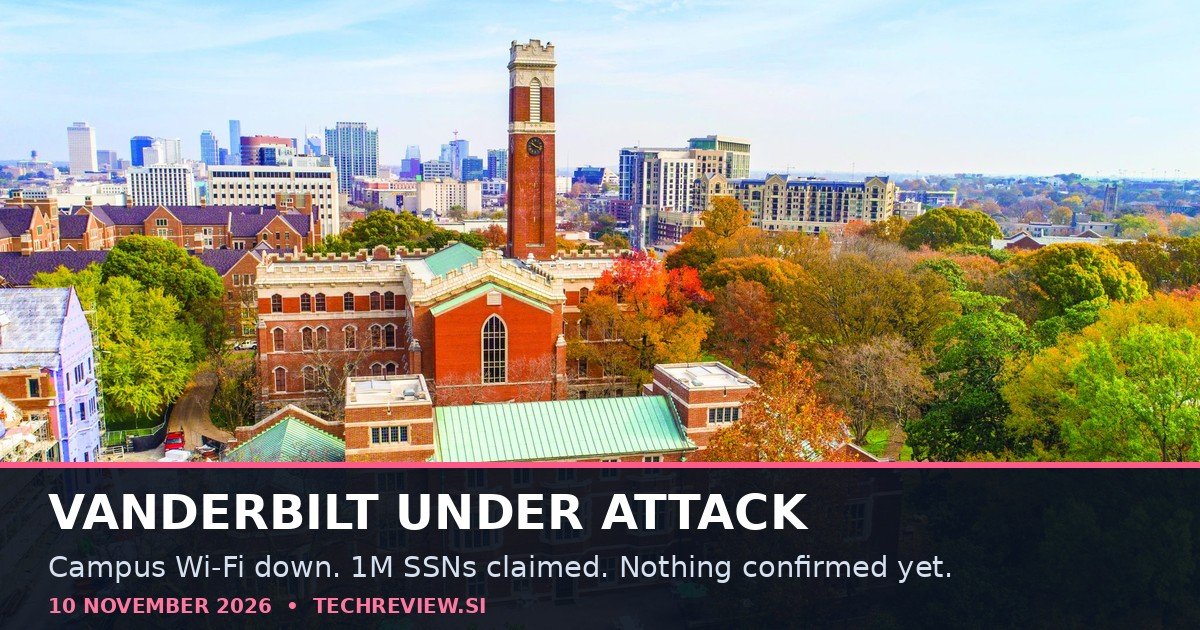
Photo: Vanderbilt University campus, via Vanderbilt University.