Three versions of one departure
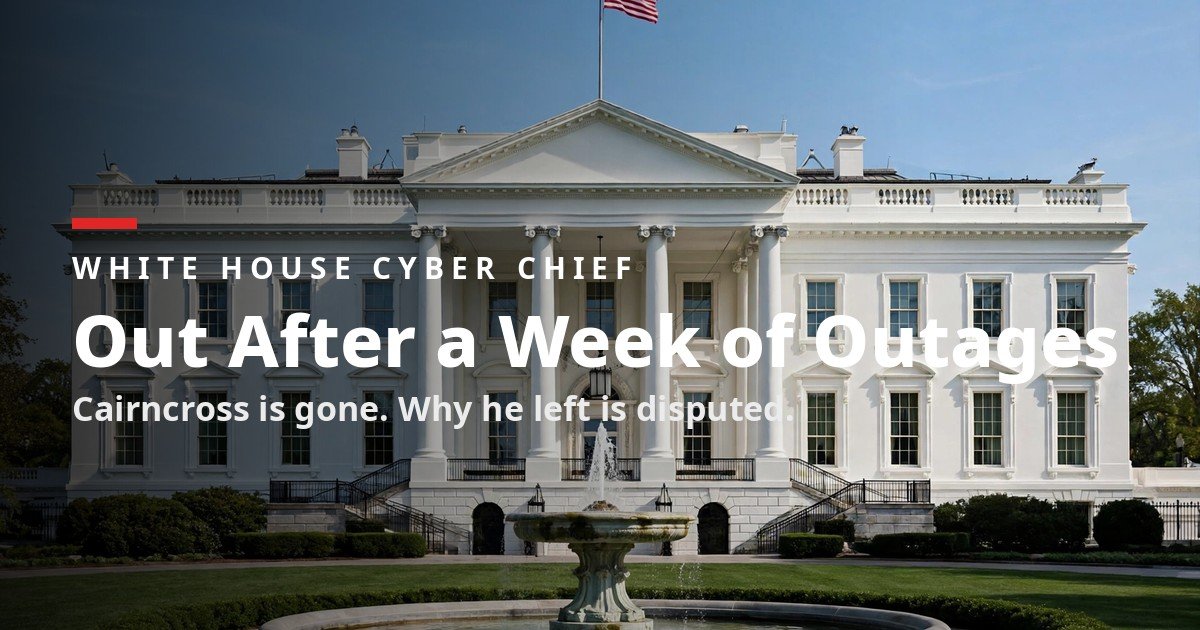
Sean Cairncross is out as the White House national cyber director. A source close to the White House said on Thursday 19 November 2026 that he is being replaced, according to CNN, Reuters and The Wall Street Journal. A White House official confirmed to CNN that Cairncross is leaving the Trump administration. Kirsten Davies, the Senate-confirmed chief information officer at the Defense Department, will take over the role in an acting capacity, according to CNN, Reuters and the Journal.
Why he left is where the story splits. Three versions of the same departure circulated within 24 hours, and they do not agree.
The first version says he was fired. A source close to the White House told CNN: “The president fully supported firing Sean Cairncross from his position as he lacked the strong cyber credentials to perform the job.” Reuters reported the firing without the credentials explanation, and AFP reported that Trump supported the firing because Cairncross lacked proper credentials. That wording rests entirely on anonymous sources. No on-record White House statement uses the word fired or cites credentials as a reason.
The second version says the departure was amicable. Axios first reported that Cairncross was leaving on amicable terms, because he did not want to serve another two years in the role, which requires Senate confirmation, according to The Times. Fox News cited an official as saying Cairncross did not want to serve another two years in the position, according to The Statesman.
The third version is Cairncross’s own. In a statement to CNN on Thursday night he said: “It has been the honor of a lifetime to serve President Donald J. Trump. I leave my role as Director of Cyber incredibly proud of our work to strengthen America’s cybersecurity, protect our critical infrastructure, confront foreign threats, and position America to lead the world in Super Intelligence.” He says “I leave my role.” He does not say he was fired, and he does not give a reason.
This article holds all three versions, because no source resolves them. Picking one would mean choosing between an anonymous claim, a conflicting first report and the man’s own words, and the evidence does not support that choice.
The week that led here
The departure is the administration’s first major personnel move since the outages began, according to Reuters. It came exactly seven days after the first outage, and one day after the administration’s two most public denials, not during the outage peak itself. The timeline below is reconstructed from public reports and official statements.
| Date | What happened |
|---|---|
| Thu 12 Nov | Microsoft 365 and Outlook outage begins, affecting hundreds of millions of users |
| Fri 13 Nov | FAA nationwide ground stop, 4.5 hours, the longest halt to US air travel since 11 September 2001; 18,000-plus flights cancelled over three days |
| Mon 16 Nov | Chase and other banks hit, and United Airlines suffers an internal system outage, the same day |
| Tue 17 Nov | Apple services and the NSA’s classified network go down, the same day |
| Wed 18 Nov | The top US intelligence official says the disruptions were separate service outages, not a coordinated or state-sponsored attack; Rubio says there is “zero evidence” of an attack |
| Thu 19 Nov | Cairncross is out; Kirsten Davies takes over in an acting capacity |
Secretary of State Marco Rubio said there is “zero evidence” that hackers, criminals or foreign governments were behind the tech outages, or that the incidents are connected, according to CNN and Reuters. “We are not under systemic attack,” Rubio said. President Trump told Americans to “relax” about the outages, according to CNN and The Statesman, saying: “Tell them to relax. Everything’s good. These are individual events.” The top US intelligence official said on Wednesday 18 November that the disruptions were separate service outages associated with maintenance and technical changes, according to Reuters.
Republican Senator Josh Hawley of Missouri said on Tuesday that the Trump administration should brief lawmakers on the outages so they can “share with the American people what’s happening here”, according to Reuters. Democrats have faulted the administration’s response to the outages and warned that the country’s cyber defenses are not keeping up with AI-driven threats, according to CNN. Cybersecurity experts told Reuters the disruptions are likely linked to corporate efforts to rapidly patch newly discovered software vulnerabilities in the AI age, according to Reuters. That is an expert assessment, not an established finding.
Who takes over, and what is unsettled
Davies posted on X on Thursday night that she is honored to serve, writing: “Under President Trump’s leadership we will have a more secure, resilient; and supercharged technological future,” according to CNN. Secretary of State Marco Rubio congratulated Davies on X, writing: “Congratulations to the new National Cyber Director Kirsten Davies, look forward to working together to strengthen America’s cybersecurity,” according to The Hindu, carrying the AFP wire, and The Times.
Davies is acting, not permanent. The Senate will have to confirm whoever fills the role permanently, according to CNN and Reuters. Reuters adds that the Senate will be controlled by Democrats beginning in January, which sets up a confirmation fight for any permanent nominee.
Cairncross had led the Office of the National Cyber Director since August 2025, according to The Times and The Statesman, and he was nominated by Trump and served as the Senate-confirmed national cyber director for more than a year, according to CNN. By our calculation, that is about 15 months in the role. He also played a key role in the administration’s dealings with major AI firms, according to CNN, and he was an executive at the Republican National Committee before assuming the cyber director role, according to Reuters. The Office of the National Cyber Director coordinates cybersecurity policy and strategy across the federal government, according to CNN.
That on-record record sits oddly against the anonymous framing. A Senate-confirmed director, 15 months in post, praised by the Secretary of State’s congratulation to his successor on the same day, is described by an unnamed source as lacking the credentials for the job. The tension between the anonymous framing and the on-record record is the spine of this story.
The second unsettled seat matters just as much. Palantir cybersecurity officer Michael LoSapio, Trump’s pick to lead the Cybersecurity and Infrastructure Security Agency, was grilled by senators on Thursday about proposed budget and staff cuts, according to The Wall Street Journal. Hours after the hearing, Senators Ron Wyden and Thom Tillis said they would place holds on his confirmation, after LoSapio told the committee he did not believe the January 6, 2021 Capitol riot was an attack, according to Nextgov. At the moment the administration faces an AI-driven threat wave it says is not an attack, both of the government’s top cyber posts are unsettled at once: the National Cyber Director seat is now acting, pending Senate confirmation, and the CISA director nominee was being grilled by senators on the very same day about budget and staff cuts.
What nobody is claiming
Four things must be stated plainly, because the timing invites conclusions no source supports.
First, the firing was not established as caused by the outages. No source says that. Every source frames it as timing, days after a week of outages, or cites credentials as the stated reason. Timing is not causation, and the conflicting amicable account points the other way.
Second, the outage wave was not a cyberattack, and its incidents are not connected to each other. Microsoft blamed a latent defect in networking gateway servers that became unresponsive under heavy load, according to its preliminary post-incident report. The FAA blamed a routine router replacement, Chase a software bug, United an internal system outage, Apple an internal update, and the NSA routine maintenance and patching. Each has its own stated explanation, though United’s specific root cause was not publicly identified, and Rubio, the Director of National Intelligence and the companies all say the opposite of a coordinated attack.
Third, the claim that chief of staff Stephen Miller sought the removal rests on anonymous sources. Axios later cited two White House officials who said Miller sought the change and pushed out Cairncross because he lacked the strong cyber credentials to perform the job, according to The Times. The Wall Street Journal says replacing Cairncross was one of Miller’s first tasks as the new White House chief of staff, according to a person familiar with the matter. Both are attributed claims, not established facts.
Fourth, the JPMorgan Chase disclosure on Thursday is not a new breach. JPMorgan disclosed that third-party service providers working with the bank had been targeted in a cyberattack, according to The Statesman. That is the same third-party vendor incident already covered in TechReview’s Visa and JPMorgan article, not a new breach. The Cairncross departure is not connected to the n0n and Visa and JPMorgan third-party cyberattack claims or the Expedia third-party incident, which are separate stories.
What does this change for US cyber policy?
Very little in the short term, and a great deal if the vacancies drag on. The Office of the National Cyber Director coordinates policy, it does not run operations, so an acting director can keep the machinery moving. The risk is a confirmation fight in a Senate that changes hands in January, with the CISA nominee already facing roadblocks, leaving both top cyber posts without permanent leadership during a period the administration itself describes as an AI-driven threat wave. The White House did not say when Cairncross’s last day will be, according to CNN, so even the handover date is open.
What to watch next is whether the White House states a reason on the record, whether Cairncross speaks further, and whether the Senate confirms a permanent successor before the Democrats take control in January. The story will move when one of those three things happens. Until then, the departure has three versions, and all three stay on the record.