On Saturday 7 November, customers whose details may have been exposed opened an email from the company’s chief executive, Simon Griffiths, with unwelcome news: their personal information had been accessed without authorisation. The unauthorised access happened in the systems of a marketing software provider the company uses, whose name has not been disclosed.
The email went to customers in Australia, the United Kingdom and the United States, ABC News Australia first reported, and Cyber Daily independently read the message. Canadian customers were not affected, according to the provider. The company has not said how many customers received the email.
The break-in happened at a company you never bought anything from
Who Gives A Crap is an Australian company behind a line of recycled toilet paper, tissues and kitchen towels, Cyber Daily reported. The unauthorised access took place in the systems of a US-based marketing software provider that held a copy of customer records for the company’s Australian, UK and US stores. Customer accounts were not accessed directly, Griffiths said in the email.
Who Gives A Crap has disconnected the provider from its customer systems and changed access credentials, the company said. The two companies are working together to understand the extent of the breach, and Who Gives A Crap said it would engage with the relevant regulatory authorities as required. The provider’s name has not been disclosed, and no attacker has claimed responsibility, Cyber Daily reported. Griffiths apologised in the email, saying he was sorry it happened and that the team was working to monitor the situation and strengthen its defences.
Eight days from break-in to warning
The access began on 30 October, was detected a day later, and the affected systems were secured by 1 November, according to the company. The provider then told Who Gives A Crap on Friday 6 November, and the company began emailing customers late on Saturday 7 November. That is eight days from the first access to the first warning. The company was told on the seventh day, and customers on the eighth. The provider knew about the access six days before it told the company.
Our reading of those dates: the containment was fast, two days from first access to secured systems, but customers learned about it a week later. The delay sits between the provider and the company, not in the company’s own response once informed: Who Gives A Crap emailed customers the day after the provider told it. The company cannot yet say whether the information was copied or downloaded, Griffiths said, and it has no evidence of misuse so far.
What someone could see, and what they could not
The email listed five kinds of personal information that may have been accessed, and three that were not involved. The table below is our summary of the company’s own words.
| Data | What the company says |
|---|---|
| First and last name | May have been accessed |
| Email address | May have been accessed |
| Phone number | May have been accessed |
| Postal address | May have been accessed |
| Total amount spent with Who Gives A Crap | May have been accessed |
| Payment details | Not compromised |
| Order details | Not compromised |
| Passwords | Not compromised |
| Customer accounts | Not accessed directly |
The field that makes the phishing convincing
Four of the five exposed fields are standard contact details. The fifth, the total amount a customer has spent with Who Gives A Crap, is the unusual one, and it is the practical danger here. Our analysis: a scammer who knows your name, your postal address, your phone number and exactly how much you have spent can write a refund or loyalty email that looks far more convincing than a generic phishing message, because it quotes a figure only the real company should know.
That is why the company’s warning covers postal mail as well as email, messages and calls. Customers were advised to be alert to unexpected emails, messages, calls and postal mailings, and to verify any communication that claims to come from the company. A letter quoting your real spend total deserves the same suspicion as an email doing it.
Picture the message. It arrives addressed to you by name, quotes the exact total you have spent with the company, and offers a refund or a loyalty reward if you click a link or call a number. Every detail in it may be true except the sender. That is one shape of scam this breach makes possible, and it is why a message that looks right still needs checking through the company’s own website or app.
What should I do if I got the email?
Do nothing the message asks until you have verified it another way. No payment details, order details or passwords were exposed, so watch for phishing messages rather than a password or card problem. Treat every unexpected message as suspect and check it through the company’s own website or app.
- Treat unexpected messages claiming to be from Who Gives A Crap as suspect until you verify them another way.
- Open the company’s website or app yourself instead of following a link in any message.
- Check the sender’s address closely, since a message that uses your real email address can still be fake.
- Watch your post as well as your inbox, because the exposed addresses include postal ones.
- Watch for unexpected calls and postal mail too, not just emails and texts, since the warning named all four.
What we still do not know
Four things are still open. The company has not said how many customers were affected. It has not named the marketing software provider. It has not said who carried out the attack or how they got in. It does not know whether the information was copied or downloaded.
What to watch next: whether the provider is named, whether a customer count appears, whether any evidence of misuse turns up, and whether regulators in Australia, the UK or the US say anything. The company said it would update customers if it learns anything new that affects them. If any of those appear, this article will be updated.
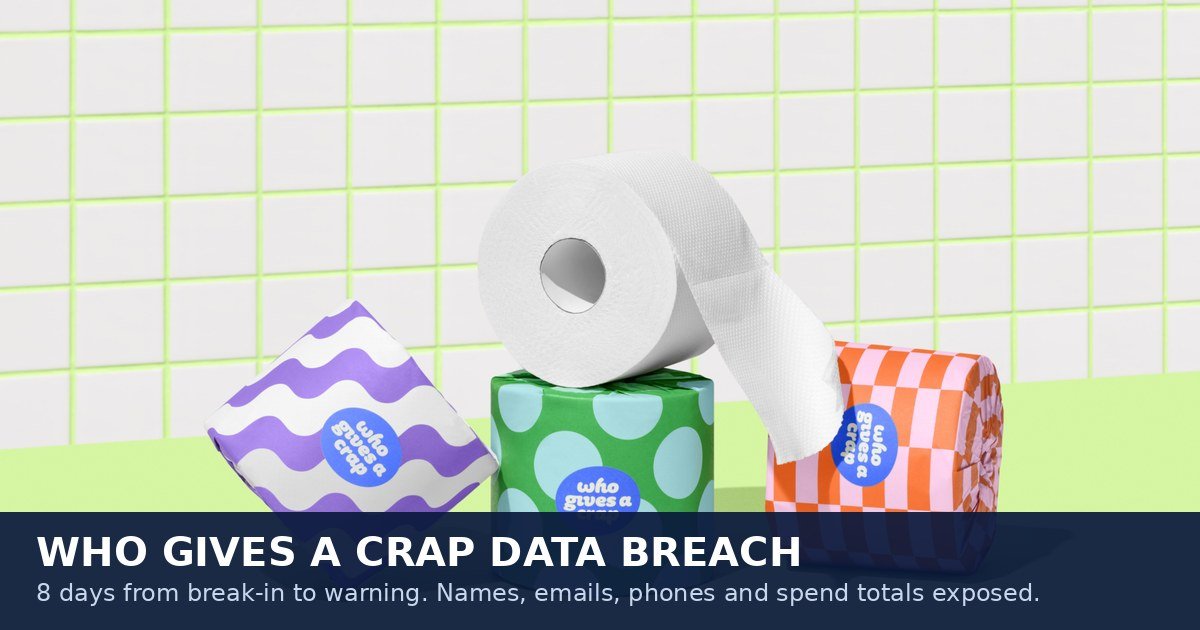
Photo: Who Gives A Crap product photography, via Inside Retail.