The letter that arrived six months late
Winona County, Minnesota, found ransomware on its network on 7 April 2026, and its investigation found intruders had been inside since 13 March, copying county data, according to the county’s own notice of the incident. The notification letters did not start going out until 8 October, 184 days after detection, according to breach tracker CISO News. The county says the notice was not held back because of a law enforcement investigation, its notice states.
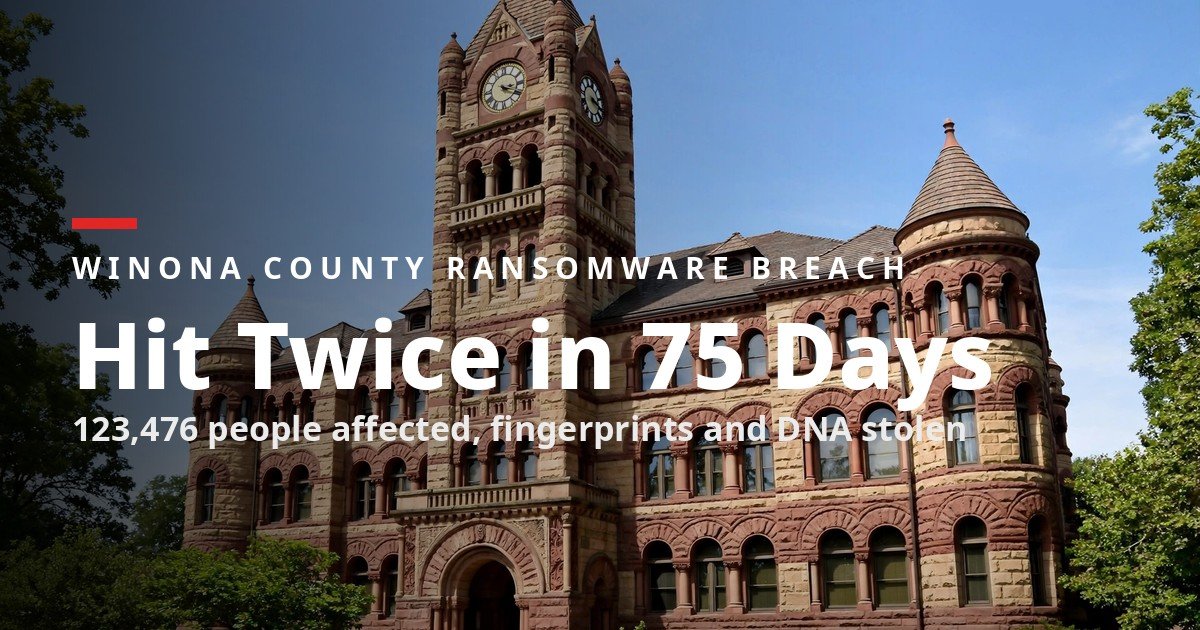
The April attack affected 123,476 people, the figure Winona County reported to Indiana’s attorney general for the notices sent on 8 October, according to CISO News, which cites the Indiana attorney general’s 2026 report. Breach tracker ClaimMoney independently reports the same total. Thirty-two of those people were in Indiana, according to CISO News. The county’s own notice states no total, and does not say whether the 123,476 covers residents, former residents, employees, or people whose records the county holds for its courts, vital records or public health work.
The scale was serious enough that Governor Tim Walz signed Emergency Executive Order 26-06 on 7 April, authorising the Minnesota National Guard to provide cyber protection support, according to the governor’s office. The order states the cyberattack began on Monday 6 April and continued overnight into Tuesday 7 April, when the county detected the ransomware. The county declared a local state of emergency, notified the FBI and brought in outside cybersecurity and forensics consultants, according to the county notice and MPR News reporting carried by ZeroDayFeed. The county took systems offline, and its DMV and vital-statistics systems stayed down for days, according to KTTC reporting.
What the April attack took
The copied data covers almost every record a county keeps. The county’s list includes name, address, date of birth, Social Security number, driver’s license or state ID number, passport number, Individual Taxpayer Identification Number, immigration identification number, military service number and veteran identification number, according to the county notice. It also includes financial account information, credit and debit card information, medical information, health insurance information, information in law enforcement reports, and usernames and passwords for non-financial accounts.
Two items on that list set this breach apart from a typical county ransomware case. The copied data included fingerprints, and DNA reports related to paternity testing, according to the county notice. A credit card number can be cancelled and replaced. A fingerprint cannot be reissued, and a paternity DNA report cannot be taken back. That is the fact that should shape every decision a notified person makes next, and it is why a credit freeze alone does not cover the full risk.
The county did not say every notified person had every listed data type exposed. It reviewed what was involved for each person, according to CISO News, so each letter should say which types applied to its reader. The county is offering free credit monitoring to people whose Social Security number or driver’s license was stolen, according to KTTC. Its assistance line is toll-free 1-866-200-0895, open 8 AM to 8 PM Central time, Monday to Friday excluding major holidays, according to the county notice.
The January attack the county paid to end
The April attack was not Winona County’s first ransomware incident of 2026. The county detected ransomware on 22 January 2026, after unauthorised access that ran from 18 to 22 January, during which criminals took county data, according to the county’s May notice as reported by DysruptionHub. That incident affected 6,196 people, according to a Maine attorney general filing carried by DysruptionHub, and an Indiana attorney general entry dated 7 May 2026 records the same total, with four people in Indiana, according to CISO News.
The county completed its review of the January incident on 16 April 2026 and began mailing notices on 12 May, 110 days after detection, according to DysruptionHub. January victims were offered 12 months of IDX monitoring, identity-restoration assistance and insurance, according to the Maine attorney general filing.
Then the county paid. It negotiated and paid a ransom of $128,539.57 in connection with the January attack, with help from its insurance carrier, to help fully restore county services and protect personal information, according to News 8 Now and KTTC reporting carried by DysruptionHub, and GovTech. County commissioners disclosed the payment between 27 and 31 August 2026. Insurance covered about $50,000 of the payment, and the remaining roughly $78,000 came from county levy funds, according to MPR News and the Winona Post.
Two attacks, different actors, one county
The county describes the two incidents as separate and unrelated, caused by different criminal actors. County Administrator Maureen Holte said on 8 April that a preliminary investigation indicated the April attacker was not the one responsible for January, according to MPR News. The second detection came 75 days after the first, by our calculation from the confirmed dates, 22 January to 7 April.
Paying the ransom did not prevent the second breach. That is the plain reading of the timeline, and it is the point that matters for every other local government weighing the same choice. The county paid $128,539.57 after the first attack, and a different criminal actor hit it again 75 days later.
One group has claimed the April attack. The Interlock ransomware gang claimed credit on 29 April 2026 on its dark-web leak site, posting sample documents and asserting it had taken more than two million files, according to DataFLOQ. That claim rests on a single source, and the county has not named any group, so it stays a claim, not a fact. Whether any ransom was paid for the April attack is not stated in the county’s notice or in KTTC and MPR reporting, according to ZeroDayFeed. How the intruders got in, in either incident, is not stated in any source reviewed, according to CISO News.
The year in one timeline
Put the two incidents together and the pattern is a county that spent most of 2026 dealing with ransomware. The timeline below is reconstructed from the confirmed dates in the county’s notices, the state attorney general filings and local reporting.
| Date | What happened |
|---|---|
| 22 Jan 2026 | First ransomware detected; unauthorised access ran 18 to 22 January |
| 7 Apr 2026 | Second ransomware detected; access ran 13 March to 7 April; governor signs order authorising National Guard support |
| 16 Apr 2026 | Review of the January incident completed |
| 12 May 2026 | January notices mailed, 110 days after detection |
| 27 to 31 Aug 2026 | $128,539.57 ransom payment for the January attack disclosed |
| 8 Oct 2026 | April notices mailed, 184 days after the 7 April detection |
By our calculation, the two incidents affected 129,672 people in total, 123,476 from April plus 6,196 from January. That is the sum of the reported affected-person counts, not a confirmed count of distinct people, because the county has not said whether the two victim sets overlap. A person who dealt with the county in both periods could have received two letters. The figure is still the honest measure of the county’s disclosure workload in 2026.
The county says it has deployed security tools to enhance detection, is actively monitoring with endpoint detection tools, and is conducting an enterprise-wide password reset, according to its notice. Those are the same categories of fix every breached organisation promises. The test is whether a third incident follows, and the county’s own record gives no reason to assume it will not.
What should I do if I got a Winona County breach letter?
Freeze your credit with all three bureaus first, because the stolen data includes Social Security numbers and the county’s free monitoring covers only people whose Social Security number or driver’s license was stolen. Then call the assistance line for your enrollment code and watch statements for accounts tied to the exposed data.
- Freeze your credit at Equifax, Experian and TransUnion, since a freeze blocks new accounts in your name.
- Call the county’s toll-free assistance line at 1-866-200-0895 weekdays for your free monitoring enrollment code.
- Read your breach letter carefully, since it lists which of your data types were exposed.
- Watch bank and card statements for charges you do not recognise, and report them at once.
- Change passwords on any account that shared a password with a county service login you used.
If you dealt with the county and got no letter, the county’s toll-free line is its channel for questions, according to CISO News. The county posted its web notice for exactly that case, people it could not reach by mail.
What to watch next
No settlement has been announced for the April breach as of 16 November 2026, according to ClaimMoney. Whether any ransom was paid for the April attack remains unstated, and how the intruders got in, in either incident, is still unexplained. Whether the county names a group for the April attack is open, and the Interlock claim remains a single-source assertion. The county says its security tools are deployed and its endpoint detection monitoring is active, and it is conducting an enterprise-wide password reset, according to its notice. The question is whether they hold.