
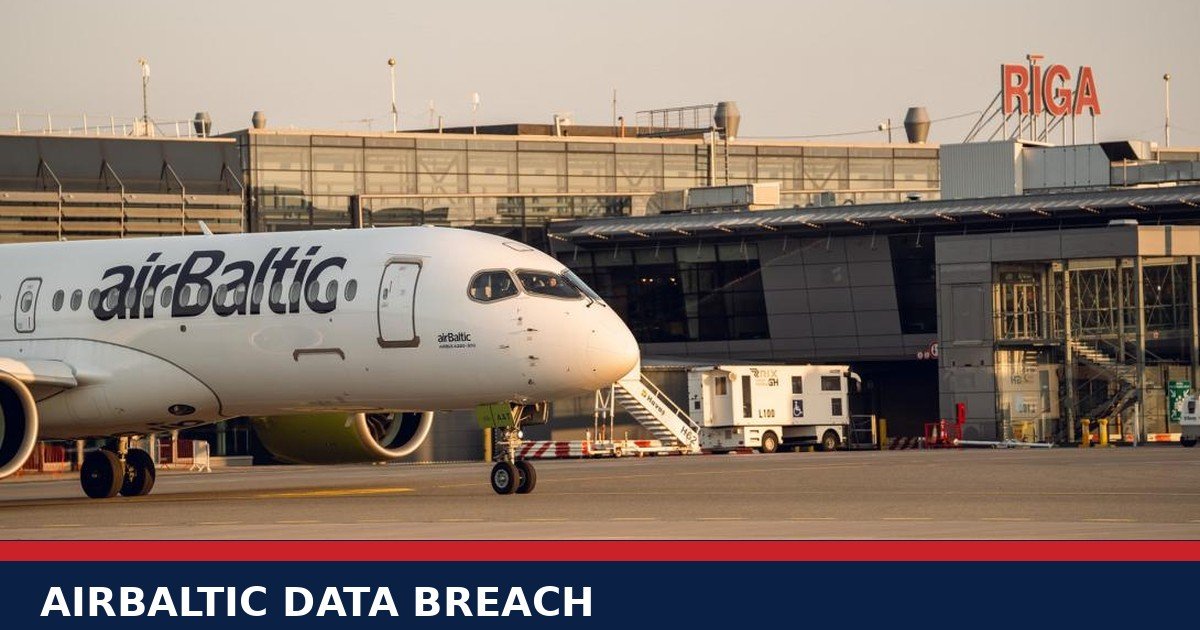
An airBaltic data breach exposed about 618,000 passenger booking records after unauthorised access at an external IT service provider. The incident was first reported on Sunday 15 November 2026, and Latvia’s State Data Inspectorate announced an investigation the next day. The passengers affected are those who checked in online for airBaltic flights between 18 July and 12 November 2026, a window of 117 days. Payment information and travel-document details were not affected, and airBaltic says it has found no sign of misuse so far. The provider has not been named, so no connection to the Amadeus incidents that hit Thai Airways, Caribbean Airlines, Cathay Pacific and Singapore Airlines has been established.
What was exposed, and what was not
The data accessed was names, booking numbers and flight details, according to LSM, TravelCapybara and rp-online. Payment information, travel document details and other sensitive data were not affected, LSM reported. That distinction matters. A booking reference plus a name and a flight date is enough to make a phishing message convincing, but it is not enough to take money from an account or to travel on someone else’s documents.
One number needs care. The 618,000 figure refers to booking records, not to a confirmed count of individual travellers, TravelCapybara noted. Sources say the data was “accessed”; no source read confirms whether it was downloaded, copied or published. No threat actor has been named, no group has claimed the incident, and no attack method has been disclosed. Nothing in the sources mentions ransomware, a leak site or a ransom demand.
How the airBaltic data breach unfolded
The exposure window ran from Saturday 18 July to Thursday 12 November 2026. Across 117 days, 618,000 affected online check-ins works out to about 5,282 a day on average. The window closed on Thursday 12 November. The first reports appeared on Sunday 15 November, three days later. Latvia’s State Data Inspectorate announced its investigation on Monday 16 November, four days after the window closed and one day after disclosure.
About 11,800 of the affected reservations are for flights that have not yet taken place, and airBaltic itself cautioned that figure could be revised. That is 1.91% of the 618,000. The other roughly 98% are historical bookings. As a precaution, online booking management and check-in have been disabled for the affected reservations, and those passengers can check in for free at the airport. Online booking management and check-in remain available as usual for passengers who did not check in online during the period. Flights are operating as scheduled.
The unnamed supplier, and why this is not an Amadeus breach
The breach happened in the systems of an external IT service provider, not in airBaltic’s own systems, which were unaffected. The provider has not been named. That single fact is what separates this incident from the Amadeus cluster TechReview has covered this month: Thai Airways, 60,529 passenger booking records; Caribbean Airlines; Cathay Pacific, about 53,000; and Singapore Airlines, about 46,000. In each of those cases the breach was linked to Amadeus. Here, no provider is named and no link has been established, so this article does not call it an Amadeus breach.
The airBaltic data breach is the largest airline booking-data exposure TechReview has covered in this November run, and the only one where the provider is still unnamed. At 618,000 bookings it is about 10.2 times Thai Airways’ 60,529 and about 11.7 times Cathay Pacific’s 53,000. Those are scale comparisons only. The incidents are separate, the provider in this case is unnamed, and nothing in the reporting links them.
What the regulator is doing
Latvia’s State Data Inspectorate received a personal-data-breach notification from airBaltic and will investigate. LSM reported the investigation citing information the inspectorate provided to LETA. The inspectorate confirmed it had received the notification. airBaltic is working with its service provider to contain the incident and reduce risks to affected passengers, and the investigation is continuing.
The sequence is short. The exposure window closed on Thursday 12 November. Disclosure followed on Sunday 15 November. The regulator’s investigation was announced on Monday 16 November, four days after the window closed. It does not answer the harder questions, who got in and how, but it does mean the file is open while the facts are still fresh.
One note on timing: a headline dated 17 November carried a fresh timestamp but added no new fact. It was a re-report of the 15 November disclosure, not a new incident, and the newest genuine development remains the inspectorate’s investigation announced on 16 November.
What to do if you flew airBaltic between July and November
If you checked in online for an airBaltic flight between 18 July and 12 November 2026, your booking was in the affected set. The direct answer is short: your payment and travel-document details were not affected, your flight is operating as scheduled, and there is no sign of misuse so far. The thing to watch for is phishing. airBaltic says the accessed data could be used in fraudulent messages appearing to come from airBaltic or other travel service providers.
The following steps are general precautions, not instructions from airBaltic. Treat any message about your airBaltic booking with suspicion if it asks you to click a link, download an attachment or enter payment details. Go to the airline’s own site or app instead of following a link in a message. Check that a message uses your real booking reference and flight details, then still verify it through the official channel, because the attackers have those details too. If a message claims your booking has changed or your payment failed, check it at the airport desk or through the airline’s official contact page. And if you were among the affected reservations, online check-in is disabled for now, so plan to check in at the airport, where it is free.
Three incidents this is not
Three separate incidents risk being confused with this one, and none of them is it. First, the CSCTelecom SMS leak: a publicly accessible ClickHouse database belonging to a Baltic telecom, discovered on 28 September 2026 and reported on 11 November, holding more than 125 million SMS messages. airBaltic SMS messages appeared in it, but it is a different provider, different data and a different incident. Second, the May 2023 airBaltic email error: an internal email-distribution fault exposed some passengers’ booking details to other passengers, about 0.009% of reservations. That was a technical error, not a cyberattack, and it is not this incident. Third, the Amadeus cluster: the provider in this case is unnamed, so no link to the Thai Airways, Caribbean Airlines, Cathay Pacific or Singapore Airlines incidents has been established.
What happens next
The open questions are the ones airBaltic has not answered. Who accessed the provider’s systems, and how. Whether the data was downloaded or only viewed. Whether the 11,800 upcoming-flight figure holds or is revised, as airBaltic warned it might be. And whether the provider is named, which would settle the Amadeus question one way or the other. The State Data Inspectorate’s investigation is continuing, and TechReview will fold in anything it confirms.
For now, the facts are these: about 618,000 booking records accessed at an unnamed IT supplier over 117 days; names, booking numbers and flight details, but no payment or travel-document data; no sign of misuse; flights running as scheduled; and a regulator investigation opened within four days of the window closing. That is a large exposure with a narrow blast radius, and the narrow part is what matters most to the passengers in it.


