
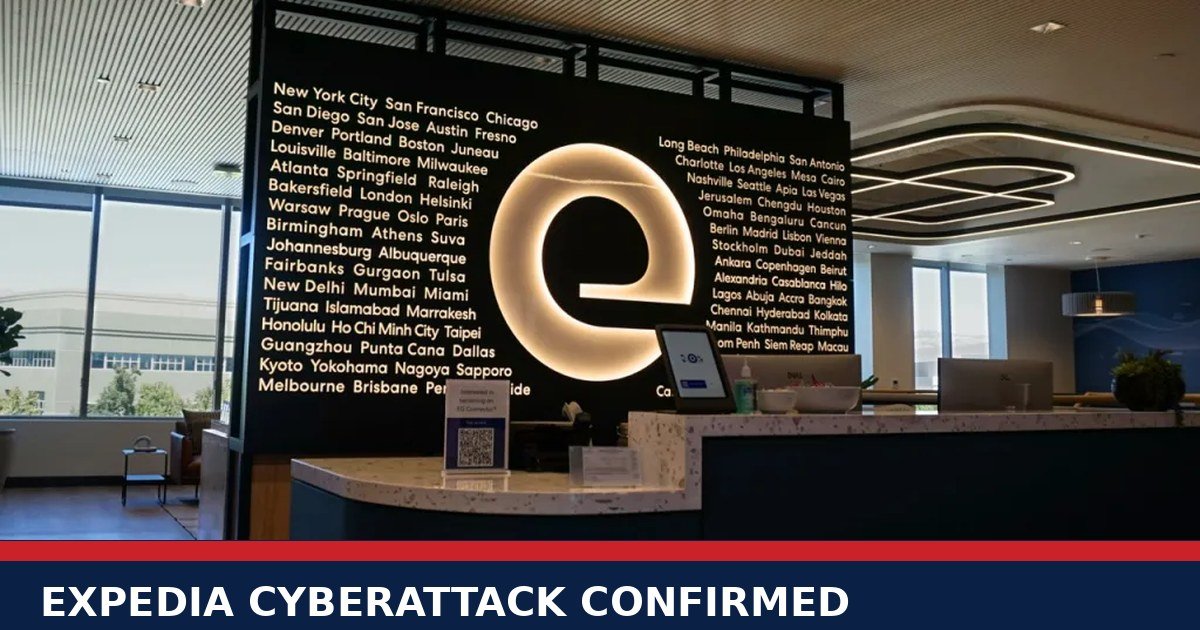
Expedia Group has confirmed that attackers reached its systems through a compromised third-party data platform provider, in a supply-chain attack that also hit other companies. Beyond that statement and assurances that its platforms remain safe to use, Expedia has released few details. The extortion group’s claim of about 1.3 billion rows of stolen data comes from n0n’s own figures and has not been independently verified. Expedia has not said what data was exposed, how many people are affected, or which vendor was compromised.
What Expedia actually confirmed
Expedia confirmed the attack to Skift on Thursday 12 November. The travel company said: “We are aware of a supply chain attack, reported by security researchers, in which attackers compromised a third-party data platform provider and used its trusted access to reach systems at multiple companies, including Expedia Group.” Expedia added that its platforms “remain safe to use for both travelers and partners,” and said it contained the attack once it became aware of it and brought in outside cybersecurity experts to investigate.
What the statement does not do is name the vendor, describe the data involved, or give any affected count. Expedia has not disclosed the extent of any data exposure, and its investigation is still ongoing. The confirmation came three days after the extortion group behind the claim named Expedia on its leak site, and on the same day Cyber Daily reported that an alleged extract of the claimed data had appeared on the dark web, containing hundreds of thousands of email addresses linked to travel data, log-in details, hotel stays and loyalty details. Cyber Daily’s observation is not independent verification that the data is genuine, and date ranges in the files suggest at least some of it may be historical.
Two US law firms, Ahdoot & Wolfson and Console & Associates, have opened class-action investigations into the alleged incident. Those are attorney investigations, not findings that a breach occurred or that any particular person’s data was taken.
The Qubole trail behind the Expedia cyberattack
Three days before Expedia confirmed the attack, cloud security researchers had already documented the campaign that may explain it. On Monday 9 November, Wiz and Sentra published research describing an attack through Qubole, a cloud data platform Expedia once used. Between 14 and 26 October, an attacker used credentials tied to a Qubole Amazon Web Services account to assume access roles that Qubole customers had set up in their own AWS accounts, then downloaded their data, in some cases whole storage folders in a single session. Sentra counts more than a dozen organizations hit.
In the Qubole campaign, attackers used access roles that customers had previously granted to the platform, rather than credentials obtained through a direct break-in to those customers’ systems. Qubole customers had set up access roles in their own AWS accounts, and some of those roles remained in place long after the companies stopped using Qubole. Sentra wrote that Qubole roles “were still in place long after companies had stopped using Qubole,” and that the access had sat unused since spring before the attacker picked it up.
The link to Expedia is circumstantial. Neither Wiz nor Sentra names Expedia as a victim, and Expedia has not said the vendor was Qubole. Skift reports only that Expedia’s description of the attack is consistent with the Qubole campaign. Treat the Qubole campaign as a possible explanation for Expedia’s incident, not as confirmation that Qubole was Expedia’s vendor.
What n0n claims it took
The extortion group calls itself n0n, and it is the source of the figures it claims for the volume and contents of the data in the Expedia cyberattack. n0n first listed the victim anonymously as “Company #122” on Tuesday 3 November, then named Expedia Group on Monday 9 November. It describes the listing as a data exposure, not a conventional ransomware attack: no ransom demand, payment deadline or specific amount appeared in the monitored listing text, and the group threatens to publish the data unless Expedia reaches a settlement.
Here is what n0n says it holds, in its own figures. None of it has been independently verified, and Expedia has not confirmed any of it.
| Claimed category | Claimed rows | What n0n says it contains |
|---|---|---|
| Loyalty program records | 830,069,282 | Emails, member IDs, point balances in 21 currencies, tier names, booking values, across 35 programs |
| Traveller profiles | 58,380,209 | Email, account dates, home airport, three-year booking values |
| Consumer account and credential records | 333,298,275 | Traveller IDs and emails with password-like tokens |
| Consumer matching records | 72,000,000 | Not described in the claim |
| Credit-card spending records | 2,500,000 | Spending records linked to hashed email addresses |
| Guest records | 500,000 | Accommodation details |
Added together, the six categories come to 1,296,747,766 claimed rows, about 1.3 billion. That total is our addition of the attacker’s own figures, and rows are not people: the loyalty file alone counts 830 million rows, or 64 percent of the claimed total, while the credential file counts 333 million rows, or about 26 percent. The claimed credential-row count is about 5.7 times the claimed traveller-profile row count. That is a comparison of two unverified row totals, not proof of 5.7 tokens per traveller or multiple passwords per account.
The claim goes further than rows. n0n also describes about 747 GB of data across 582 storage locations, a 174 GB workforce-planning database backup dated 21 October 2026, and live credentials for the victim’s big-data platform, including a source-code token for 19,935 private repositories and production cloud access. The 21 October date is metadata on the backup n0n says it holds, not a confirmed breach date, and there is no confirmed compromise date for the Expedia incident.
Why the billion-row claim needs scepticism
n0n is new. The group emerged in mid-September 2026, according to threat intelligence firm SOCRadar, and runs data theft and extortion without ransomware. Its leak site lists victims as numbered companies with a countdown timer labelled “pending exposure”, and names a company only if no deal is reached. The site claims 224 attacks since September. But Bitdefender, working from data on the group’s own file server, says n0n targeted just over 20 victims. Comparing 224 claimed attacks with Bitdefender’s figure of just over 20 victims puts the group’s claimed total at more than ten times the count supported by its own server data.
The pattern repeated on Monday 16 November, when n0n named 59 more organisations on its leak site, including Eli Lilly, Visa, Mastercard, JPMorgan Chase, Walmart and Procter & Gamble. None of them has confirmed a breach, and the material n0n describes is the marketing, analytics and customer-database material suppliers hold, according to Ransomnews.
A ransom negotiator who is not working on the Expedia case told Forbes the claims look like a way to pressure victims into paying. Alex Waintraub said the group’s approach is unusual because it lists victims as “Company 89” or “Company 90” without revealing their names until the countdown ends. If that is how the group operates, Expedia’s decision to confirm the breach publicly is an unusual move that could weaken the pressure tactic.
No sample records, screenshots or other technical evidence accompanied n0n’s first Expedia listing, and the files Cyber Daily observed may be historical. Until data surfaces or Expedia reports its own findings, treat the volumes as extortion claims.
What should I do if I have an Expedia account?
Expedia has not confirmed what data, if any, was exposed, and the email and travel-history details described by n0n remain unverified claims. As a precaution, change your Expedia password and any password you reused elsewhere, check your bookings and loyalty points, and treat messages quoting your travel details with suspicion.
- Change your Expedia password on a device you trust, and pick one you use nowhere else.
- Change the same password anywhere else you reused it, starting with your email account.
- Check your bookings and loyalty points for reservations, changes or redemptions you do not recognise.
- Turn on two-factor authentication on your Expedia account and on your email account.
- Treat messages quoting your real bookings with suspicion, and verify them in the app, not through links.
These steps are general precautions, not instructions from Expedia. Expedia Group also owns Hotels.com, Vrbo, Travelocity, Orbitz, Hotwire and Trivago, so customers of those brands may also want to take the same precautions.
What to watch next
Three things are worth watching in the Expedia cyberattack. First, the vendor: whether Expedia names the third-party data platform provider, and whether it confirms or rules out a possible connection to the Qubole campaign. Second, the extent: whether Expedia discloses what data was exposed and how many people are affected, and whether any further information about regulatory notifications emerges. Third, n0n’s next move: whether the group publishes more of the claimed data, and whether any of the 59 organisations it named on 16 November confirms a breach. Until then, Expedia’s confirmed account remains limited, and the billion-row figure stays exactly what it is: an unverified claim.


