
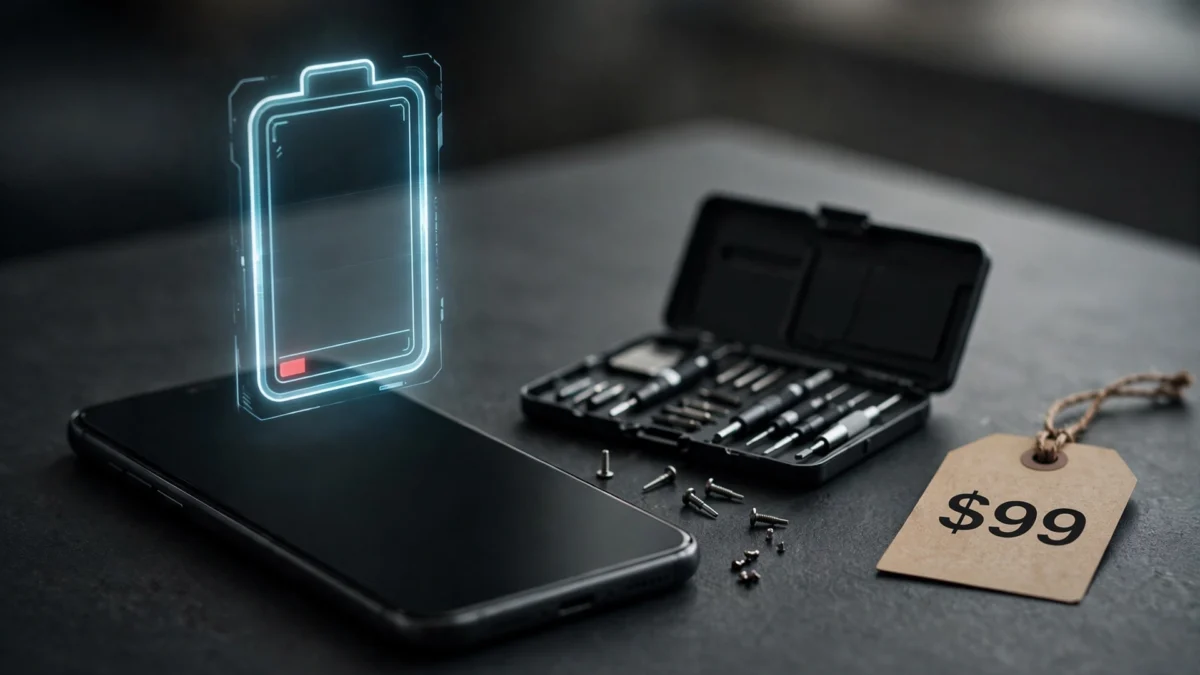
Apple will replace the battery in an iPhone 14, 15, 16, or 17 for $99. A new iPhone 17 starts at $899. That $800 gap makes the decision for most owners, and Apple’s own repair pricing makes the answer obvious for most owners: if your phone is under three years old and the battery health reads below 80%, the $99 fix wins. Here is the full table, the exceptions, and the one free option most people forget.
What Apple charges (checked Oct 10, 2026)
These are Apple’s out-of-warranty battery service fees in the US. Tax and any shipping fee are extra.
| Your iPhone | Battery replacement | A new iPhone costs |
|---|---|---|
| iPhone 14 / 15 (all models), 16, 16 Plus, 16e, 17, 17e | $99 | iPhone 17: $899 |
| iPhone 16 Pro / Pro Max, 17 Pro / Pro Max, iPhone Air | $119 | iPhone 18 Pro: $1,199 |
| iPhone 18 Pro / Pro Max | $129 | Already the newest |
| iPhone 11 / 12 / 13 (all models), XR, XS | $89 | iPhone 17e: $699 |
| iPhone SE (2nd/3rd gen), 8 and older | $69 | iPhone 17e: $699 |
The math that matters: a two-year-old iPhone 15 with a tired battery costs $99 to make feel new again. If $899 looks high, you’re not wrong: the iPhone 17 launched at $799 and went up $100 on September 9, along with the 17e, Air, and 16, as memory chip costs climbed. Cook had warned in June that price increases were ‘unavoidable.’ The cheapest current iPhone worth buying as an upgrade costs $699, so the $99 repair wins on price alone.
The 80% rule
Open Settings > Battery > Battery Health & Charging and look at Maximum Capacity. If it reads below 80%, Apple itself considers the battery consumed. That number is also the threshold Apple uses for free AppleCare+ replacements.
For context on how fast you get there: Apple says iPhone 14 and earlier batteries are designed to hold 80% of their original capacity for 500 complete charge cycles, while iPhone 15 and later are rated for 1,000 cycles. A full cycle means any combination of discharges adding up to 100%. Two days at 50% each counts as one cycle.
When the $99 fix wins
Replace the battery if three things are true: the phone is less than about three years old, the battery health is under 80%, and everything else works fine — screen, cameras, buttons. That describes most iPhone 14 and 15 owners reading this.
This is also the right call if your complaint is specifically “it dies by 4pm.” A new battery restores the runtime the phone had on day one. No new phone needed.
When to buy new instead
Buy the new phone when the battery is only one item on a list. Cracked screen plus dying battery plus 64GB of storage with no room left: at that point the repair bill starts approaching refurbished-phone money, and you are polishing a phone you will replace within a year anyway.
The other honest reason is wanting the new thing. A $99 battery will not give you a better camera or a bigger screen. If that is what you actually want, say so and buy the phone. Just do not pretend the battery forced your hand.
The free option: AppleCare+
If you have AppleCare+ and the battery health is below 80%, the replacement costs $0. Apple states this directly: “We’ll replace the battery for no extra charge if the capacity drops below 80%.” Check your coverage under Settings > General > About. People paying $99 with active AppleCare+ is one of the more avoidable mistakes in this whole process.
Two middle paths
Apple Refurbished. Apple sells refurbished iPhones with a one-year warranty; a refurbished iPhone 16 (128GB, unlocked) was listed at $659 when checked on Oct 10, 2026. That splits the difference if your phone is genuinely done but $899 stings.
Third-party repair. Shops like uBreakiFix typically charge $99 to $129 for newer iPhones, and iFixForU lists a flat $79 for any iPhone 14 model. Given Apple itself charges $99 with genuine parts, the third-party savings are rarely worth it here. This is one repair where the official price is already the sensible one.
Frequently asked questions
How do I check my iPhone battery health?
Go to Settings > Battery > Battery Health & Charging. The Maximum Capacity percentage is the number that matters. Below 80% means Apple considers the battery consumed, and below 80% with AppleCare+ means a free replacement.
Is it worth replacing an iPhone 13 battery in 2026?
Usually yes. Apple charges $89 for any iPhone 11, 12, or 13 battery. If the phone is otherwise fine and the battery is under 80%, $89 buys you another year or two. The alternative is $699 for the cheapest current iPhone.
Does Apple ever replace iPhone batteries for free?
Yes, with AppleCare+. If your plan is active and Maximum Capacity has dropped below 80%, the battery replacement costs nothing. Without AppleCare+, you pay the out-of-warranty fees in the table above.
Prices checked Oct 10, 2026, against Apple’s US repair and store pages. Apple occasionally adjusts service pricing; the table above reflects current published fees.