
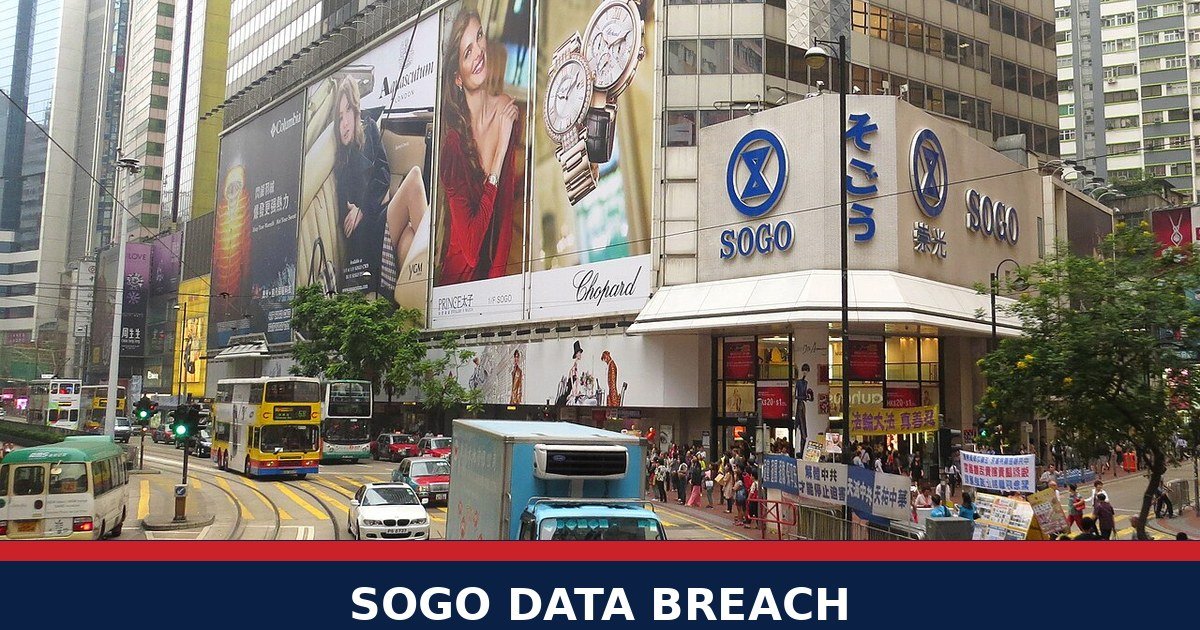
Hong Kong’s largest department store says unauthorised parties got into its membership system, and the city’s privacy regulator says up to 820,000 loyalty members may be affected. The Sogo data breach was disclosed on Thursday 12 November 2026, the same day Chow Sang Sang disclosed a separate breach of its own. Sogo itself did not disclose the scale of its incident; the 820,000 figure comes from Hong Kong’s Office of the Privacy Commissioner for Personal Data, the PCPD, which has opened a formal investigation.
What Sogo and Chow Sang Sang disclosed
Sogo, Hong Kong’s largest department store according to the South China Morning Post, discovered in November that unauthorised parties had accessed its membership system and obtained records, according to the company’s own statement, reported by the South China Morning Post. Sogo alerted the authorities about a week earlier, around 5 November, about abnormal data access inside the membership system. The company said it notified the relevant regulatory and government authorities, launched a comprehensive investigation and stepped up cybersecurity monitoring to prevent a recurrence.
Chow Sang Sang disclosed its own breach the same day, in an incident first identified on 9 November. Chow Sang Sang said it contained the malicious access, brought in cybersecurity experts to investigate and reported the incident to the PCPD and the police. It is notifying potentially affected customers.
The two disclosures landed on the same day, but no source links the two breaches, and the South China Morning Post describes them as separate incidents.
How the two breaches unfolded
| Date | What happened |
|---|---|
| Around 5 Nov 2026 | Sogo alerts the authorities about abnormal data access in its membership system |
| 9 Nov 2026 | Chow Sang Sang first identifies unauthorised access to its systems |
| 12 Nov 2026 | Both companies disclose publicly; the PCPD discloses the 820,000 Sogo figure and opens investigations into both incidents |
The 5 November date is corroborated by The Standard, which reports that Sogo discovered abnormal data reading records in its membership system on 5 November. The PCPD also said it received a data breach notification from Chow Sang Sang on Thursday 12 November, and that the company was still verifying how many people were affected.
What was exposed, and what was not
For Sogo, the PCPD’s preliminary findings say the compromised records may include members’ names, email addresses, phone numbers and membership point balances. Sogo’s own statement lists member numbers, names, phone numbers, email addresses and point balances.
For Chow Sang Sang, customer records potentially affected include names, contact numbers, email addresses, partial order details and the last four digits of credit card numbers. Employee records potentially affected include names, job titles, corporate email addresses and contact numbers.
What was not in either disclosure matters as much as what was. No passwords, full payment-card numbers or government ID numbers are listed among the exposed Sogo data, and for card data, Chow Sang Sang’s exposure covers only the last four digits. That shapes the risk: with no passwords or full card numbers listed as exposed, the warnings from both retailers focus on phishing.
The Sogo data breach is part of a bigger Hong Kong cluster
The two disclosures surfaced alongside PCPD findings on several older Hong Kong data-breach incidents. We track confirmed incidents with victim counts on our 2026 Breaches by the Numbers page.
| Incident | Disclosed | People affected (as reported) |
|---|---|---|
| Sogo membership system | 12 Nov 2026 | Up to 820,000 members |
| Chow Sang Sang | 12 Nov 2026 | Count still being verified |
| Hong Kong Examinations and Assessment Authority | 31 Oct 2026 | ~16,900 mainland applicants |
| Hong Kong Airlines, Yoho and Broadway | Late Oct to early Nov 2026 | 1,600+ (51 complaints, 48 enquiries to the PCPD) |
| Shun Hing Group | PCPD report 23 Mar 2026, disclosed Nov 2026 | ~920,000 customers |
| Dior Hong Kong | PCPD report 16 May 2025, probe disclosed Nov 2026 | ~950,000 customers |
| Hong Kong Institute of Bankers | 2022 incident, enforcement notice Nov 2026 | 13,000+ members, ~100,000 non-members |
Add the PCPD-reported counts in that table and the total reaches at least 2.8 million: Sogo’s 820,000 plus Shun Hing’s roughly 920,000, Dior’s roughly 950,000 and the Hong Kong Institute of Bankers’ roughly 113,000, before counting Chow Sang Sang, whose total is still unverified. That is our arithmetic, and it comes with a caveat: these incidents span 2022 to 2026 and are separate breaches, not one event. The sum shows the scale of the PCPD’s current disclosure cycle, not a single attack.
The older rows in that table are not new breaches. Shun Hing’s incident dates to a PCPD report from 23 March 2026, Dior’s to a report from 16 May 2025, and the Hong Kong Institute of Bankers case to a 2022 incident that drew an enforcement notice in November 2026. What is new is that the regulator’s findings on all three surfaced in the same disclosure cycle as the Sogo and Chow Sang Sang breaches, which is why so many Hong Kong consumer records have appeared in PCPD reporting in this disclosure cycle.
The two smaller rows matter too. The Hong Kong Examinations and Assessment Authority breach, disclosed on 31 October, affected about 16,900 mainland applicants, with names, dates of birth and email addresses involved. The Hong Kong Airlines, Yoho and Broadway cases together drew 51 complaints and 48 enquiries to the PCPD, and the personal details involved led to scam calls. Small counts beside 820,000, but the same pattern: breaches reaching the public through the regulator’s disclosures.
What should I do if I am a Sogo member?
Treat it as a phishing risk first: no passwords or full card numbers were listed as exposed. Watch for phishing messages pretending to be from Sogo, and verify anything about your membership through Sogo’s hotline on +852 2833 8338 or csteam@sogo.com.hk, never through a link in a message.
Several of these steps restate warnings Sogo and Chow Sang Sang published themselves; the rest are general precautions drawn from the findings, not instructions from either.
- Treat unexpected messages claiming to be from Sogo as phishing until you verify them another way.
- Call Sogo on +852 2833 8338 or email csteam@sogo.com.hk to check anything about your membership.
- Do not click links in messages about the breach, and do not share account details with unknown callers.
- Report suspected fraud to the police, and keep a record of every suspicious message you receive.
- Watch for scams impersonating Chow Sang Sang, financial institutions or e-payment platforms, and verify any suspicious message.
- Chow Sang Sang customers should call its hotline on +852 2192 3123 or email cs@chowsangsang.com for help.
What is still unknown
How many people Chow Sang Sang’s breach affected. The company was still verifying the number when it disclosed, and no count has surfaced since.
How the attackers got into either system. Neither Sogo nor the PCPD has stated an access method, and no ransomware group claim, extortion demand or data-leak-site listing has been reported for either breach.
Whether any Sogo member’s data has actually been misused. No misuse or fraud cases linked to the breach have been reported.
Whether the two breaches are connected. No source links them; they are separate incidents disclosed on the same day.
The exact number of Sogo members whose records were actually accessed, as opposed to put at risk. The PCPD’s figure is framed as up to 820,000 members who may have been exposed, and its findings are preliminary.
The Sogo data breach is a reminder that a loyalty programme is a data store, not just a discount card. Up to 820,000 members may have had names, phone numbers and point balances exposed, and the scale of the exposure came from the regulator, not the company. The count is preliminary, and the PCPD has launched an investigation. For now, both retailers have warned customers to remain vigilant against phishing scams, and both published a hotline and an email address for members to verify anything that looks suspicious.


