
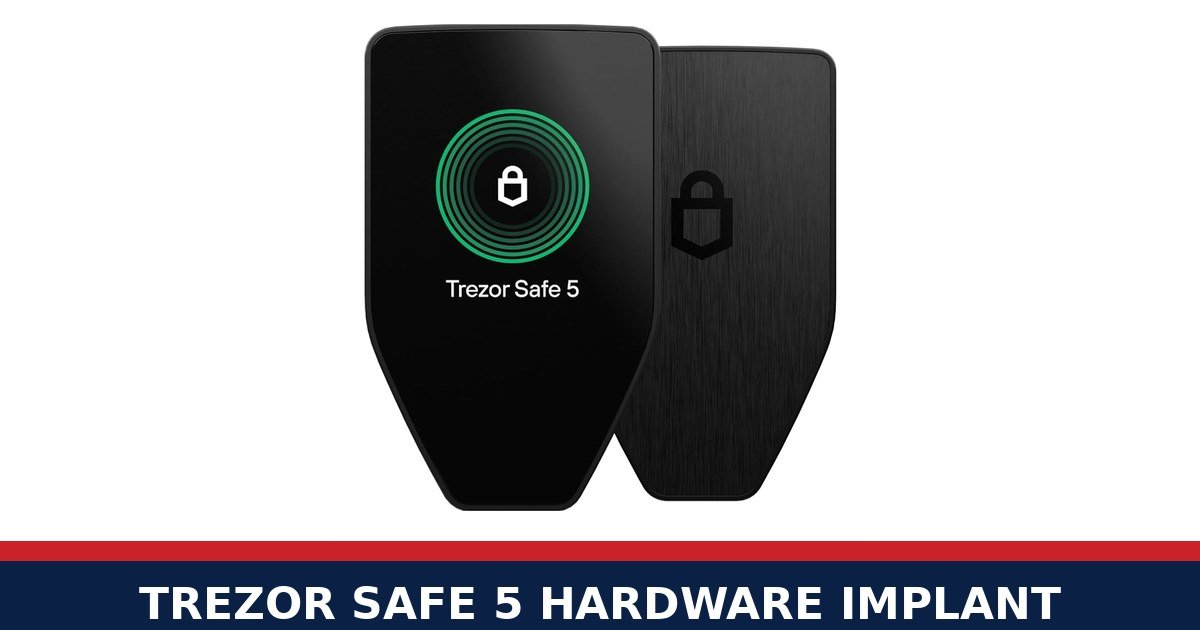
Trezor has confirmed a Trezor Safe 5 hardware implant in three of its Safe 5 wallets: a hidden circuit board that copied everything shown on the screen, identified and stored recovery phrases and passphrases, then encrypted and transmitted them over mobile networks to attacker-controlled servers. The three wallets were all bought from the same Southeast Asian reseller, CryptoBilis, between 20 August and 23 September 2026. Trezor released firmware 2.13.1 on 11 November. Trezor says the update stops the implants it has found from capturing anything more, making the current batch useless. The catch is that it cannot undo a recovery phrase that was already shown on a tampered screen, which is why Trezor is still telling CryptoBilis buyers to move their funds to a brand-new wallet with a fresh seed.
What the Trezor Safe 5 hardware implant does inside a wallet
The implant is an extra circuit board fitted between the Safe 5’s main board and its screen, according to Trezor’s own investigation update. It does not change the wallet’s firmware or its Secure Element, the dedicated security chip. Trezor says the breach was confined to the CryptoBilis sales channel rather than its manufacturing line.
Trezor describes the implant in one sentence: it only listens. It copies everything shown on the screen, including what the owner types on the device, and identifies and stores the recovery phrases and passphrases it recognises. It then encrypts what it captured and transmits it over a mobile network to servers controlled by the attackers. The board carries its own cellular module and antenna and transmits the captured data via mobile networks.
All three devices were sold through CryptoBilis between 20 August and 23 September 2026, via its Tokopedia or Shopee stores or directly from the reseller, Crypto Briefing reported on 12 November. Trezor examined one of the three in its own lab and relied on photographic evidence for the other two. The company says it has found no tampering in any other model and none in units sold through other resellers, and it has checked devices from its other resellers in the region and found no evidence of tampering.
The fix is a change in how the wallet talks to its own screen. Trezor’s embedded team extracted and analysed the firmware from the implant in the reported Safe 5, which is how the company confirmed what the board does and built the fix. The implant listens to the communication between the wallet’s microcontroller and the display and triggers the capture when it sees a specific sequence of commands. Trezor’s engineers changed the order of the commands sent to the display, so the trigger no longer works. Firmware 2.13.1, released on 11 November, carries that protection for the Safe 7, Safe 5, Safe 3 and Model T. Trezor says the update stops the implants it has found from capturing anything on devices that run it, making the current batch of implants useless.
The 49-to-83-day window the firmware cannot reach
The firmware fix has a hard limit, and Trezor states it plainly: the update can’t protect a wallet backup that was captured before it. Any recovery phrase captured from a tampered screen before 11 November cannot be protected retroactively by an update, which is why Trezor advises moving funds rather than just updating.
Our own calculation from the confirmed dates shows how long that exposure lasted. A device bought on 20 August ran unpatched for 83 days before firmware 2.13.1 arrived on 11 November. A device bought on 23 September ran unpatched for 49 days. Each of the three confirmed tampered Safe 5 wallets bought in that window sat with an implant for between 49 and 83 days before the patch arrived, meaning any recovery phrase displayed during that time could have been copied.
That window is also why the confirmed count of three is not the whole story. Trezor says 48 CryptoBilis devices have been brought forward for inspection, and checks are still ongoing. Three of the 48 devices inspected were confirmed to contain implants, a rate of 6.25% in that inspected group. But Trezor’s precautionary advice covers anyone who bought a Trezor from CryptoBilis from March 2026 onwards, and because Trezor has not published how many devices CryptoBilis sold since March 2026, the total size of the warned population remains unknown.
Trezor says no customer financial losses have been reported as of 12 November 2026. That claim is narrower than it sounds: Trezor cannot see customer holdings because its devices are self-custodial, so it can only report what owners have told it. The first customer to report the implant, an Indonesian buyer who noticed a weight difference and opened his device, had already moved his funds before he found the board.
How three wallets became a reseller purge
Trezor removed CryptoBilis from its authorised reseller list on 9 October, after Ledger began investigating physically tampered Ledger devices sold through the same channel. The first Safe 5 report reached Trezor on 28 October, from the Indonesian customer who bought through CryptoBilis’s Tokopedia store in August. Trezor warned buyers on 30 October, treating the report as credible while its lab examination was still pending. Firmware 2.13.1 shipped on 11 November, one day before Trezor disclosed its findings and wider reseller cuts on 12 November.
The disclosure came 34 days after CryptoBilis was removed as a reseller on 9 October, and 13 days after Trezor’s 30 October warning.
The purge went well beyond CryptoBilis. Trezor cut its authorised reseller network by about 80% and imposed stricter rules on the partners that remain, covering how devices are sourced, stored and physically accessed. CryptoBilis had already been removed on 9 October.
Users who bought Trezor devices from CryptoBilis since March 2026 may apply for a device replacement. Trezor is also warning that scammers are using the incident to promote fake refunds and replacements and to ask for recovery phrases. Trezor will never ask for a recovery phrase, and neither will a legitimate replacement process.
The Ledger side of the same reseller
The Trezor implants are not the only problem CryptoBilis sold. Ledger was already investigating physically tampered Ledger devices sold through the same channel when Trezor removed CryptoBilis from its reseller list on 9 October. Singapore Police said on 28 October that Ledger wallets from some Singapore retail stores contained malicious components that could capture recovery phrases or private keys, with at least two cases since 10 September.
The implant in the Ledger wallets appears to work like the one in the Trezor wallets, but that is an appearance, not a finding, and the two should not be described as the same implant. Trezor says it will not compare the two cases further while investigations continue.
What to do if you bought a Trezor from CryptoBilis
If you bought a Trezor from CryptoBilis, the steps below are general precautions, not instructions from Trezor, except where Trezor’s own advice is quoted. Trezor’s own advice is to move funds to a newly created wallet with a new seed as soon as possible.
- Check where you bought the device. The confirmed implants are in Safe 5 wallets bought from CryptoBilis between 20 August and 23 September 2026, but Trezor’s warning covers anyone who bought any Trezor model from CryptoBilis from March 2026 onwards.
- Update the firmware to 2.13.1. Trezor says it stops the implants it found from capturing data on devices running the update, but it cannot protect a wallet backup captured before installation.
- Move your funds to a brand-new wallet with a fresh seed phrase. Trezor advises this because the firmware update cannot protect a wallet backup captured before installation, so create the new wallet with a new seed phrase.
- Do not weigh the device or open it as a test. Trezor explicitly tells owners not to do either, because neither is a reliable way to detect the implant. The first customer noticed a weight difference, opened the device and found the extra board, but Trezor says weight, packaging and firmware checksums are not evidence either way.
- If you bought a Trezor from CryptoBilis since March 2026, you may apply for a device replacement. Be alert for scams promoting fake refunds or replacements and asking for recovery phrases. Never share a recovery phrase with anyone.
- Trezor says the three devices were tampered with before reaching customers, and that the breach was confined to the CryptoBilis sales channel rather than its manufacturing line. CryptoBilis was an authorized reseller at the time.
What happens next
Trezor says its investigation is still underway. The company is working with SEAL 911, the Security Alliance’s emergency response service, and says it will update its investigation post if implants turn up outside CryptoBilis or in other models, or if related fund losses are reported. Checks on the 48 CryptoBilis devices that customers have brought forward are still ongoing, so the confirmed count of three is a snapshot of an investigation that has not closed. Trezor says it will update its investigation post if the confirmed count changes, or if implants turn up outside CryptoBilis or in other models, or if related fund losses are reported.
The wider question is the supply chain. The Trezor Safe 5 hardware implant is a supply-chain problem rather than an existing firmware flaw, though Trezor mitigated the current implants via a firmware update (2.13.1) that changed the order of display commands. The firmware fix neutralises the implants Trezor has found, but it does not answer who fitted them or where in the chain they were fitted. Trezor advises anyone who bought a device from CryptoBilis from March 2026 onwards and uses it to store funds to move those funds to a newly created wallet with a new seed phrase.


