Personal data belonging to residents of 82 Flemish municipalities sat on one provider’s server, and a hacker with almost no technical skill took it using an AI agent. Belgian company Secutec and international threat-intelligence firm SOCRadar mapped the impact, and Belgian press reported it on Wednesday 25 November: the 82 municipalities have around 1.2 million residents between them. That figure is the combined population of the affected towns, not a counted total of stolen records, and no source has confirmed how many individual records were inside the 23 archives the attacker took.
What happened in the BabidiGhost breach?
Between 6 and 14 November, a French-speaking operator using the alias BabidiGhost ran a jailbroken DeepSeek AI agent against organisations in Belgium, France and Switzerland. The agent got into a server holding data for 82 Flemish municipalities and took 23 archives totalling 8.6 GB. ITdaily and Belga date the campaign to 15 November.
The server belonged to a service provider for Flemish municipalities. It held the central data of the residents of all those municipalities, along with passwords and data from recycling parks. For 65 municipalities the attacker found a dedicated folder, while 17 others were affected through data stored at an intermunicipal association. The 82 municipalities are spread across all five Flemish provinces, according to ITdaily, with 35 in East Flanders and only three in Limburg, according to the World Today Journal.
Secutec mapped the Belgian impact and notified the Centre for Cybersecurity Belgium. Secutec chief executive Geert Baudewijns called it the biggest hack in Flanders the company has uncovered so far. Neither Secutec nor SOCRadar is disclosing which municipalities or which provider were affected.
How did a low-skill hacker use an AI agent to steal the data?
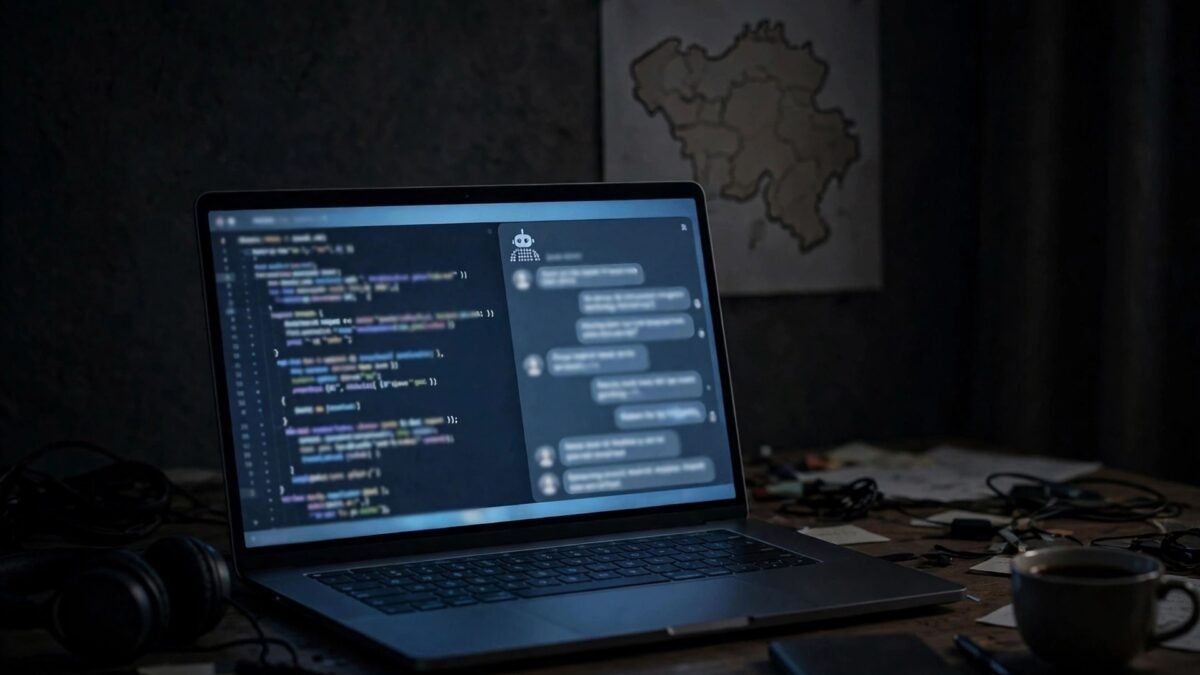
The operator had hardly any technical knowledge himself. He had the Chinese language model DeepSeek direct an autonomous AI agent built with Hermes Agent, legitimate open-source software from the American company Nous Research that can work with any language model. The agent itself wrote the scanners, the exploits, the scripts to search data and the tools to siphon off the loot through a Telegram bot.
The jailbreak was a 1,371-line instruction file that treats every refusal as a malfunction of the model, backed by a local proxy that automatically resubmitted refused requests, each time with more insistence. The operator typed 1,801 orders in plain, misspelled French. The agent turned them into 5,779 requests to the model, and only 41 of those remained refused. That means the jailbreak held 99.3 percent of the time: 41 divided by 5,779 is 0.71 percent refused. Each sloppily typed sentence became, on average, 3.2 model requests: 5,779 divided by 1,801.
One order, translated, reads: “Make me 13 files of 1,000 full records with IBAN, nice and tidy.” The prompts show how little expertise was needed. The operator repeatedly asked his agent who it was, could not find his own output on screen and could not download the stolen files. SOCRadar tracked him down because he left his own working folder open on a hijacked server in France. It contained his instructions to the agent, his shell history, a Telegram bot token, implant logs and about 10 GB of stolen data. The agent addressed him as “BabidiGhost” and “le Libérateur”, the Liberator, and pushed stolen archives to a Telegram account under the handle @GHOSTHUNTERS6.
The researchers link the operator to the cybercriminal group Ghost Hunters. ITdaily reports that, according to the researchers, Ghost Hunters is also known as APT90. SOCRadar itself describes an alliance with a cluster calling itself APT-90, not an identity. No independent confirmation of the label was found. The operator appeared to be a French national, according to the World Today Journal. His prompts were typed in French.
What data was taken from the 82 municipalities?
In the stolen data, the researchers found names, addresses, dates of birth, gender, national register and identity card numbers, and IBAN numbers. In some cases it also includes licence plates. Passwords from municipal configuration files were also seized. The data of the various municipalities were not separated from one another on the server, access was insufficiently secured and the files were not encrypted. The provider’s management interface was open on the internet, protected by a weak administrator password, and that gave the attacker access to the folders of all municipalities and intermunicipal associations in one go.
On average, each municipality in the group has about 14,600 residents: 1,200,000 divided by 82. The breach is not one big city. It is 82 municipalities whose data sat on one provider’s server, so one weak admin password exposed the equivalent of 82 towns at once. Each archive averaged about 374 MB: 8.6 GB divided by 23 archives. SOCRadar’s own count attributes the 23 archives to more than 13 municipalities and 10 other public bodies. The 82 figure is Secutec’s later mapping of everything that sat on the provider’s server.
There are no indications so far that the attacker broke into the municipalities’ own networks. But the stolen data of several municipalities has already been shared, and that of at least one municipality has been sold externally, according to ITdaily, reporting the researchers’ findings. The researchers suspect there are buyers specifically looking for Belgian data. Whether the stolen data will be published or sold on a larger scale has not yet been confirmed.
Baudewijns warned that the haul can be used for targeted fraud. “The hacker now has all the information needed to draft convincing phishing messages or to pose as a civil servant,” he said. “We are once again at the start of a digital ordeal.” He told HBVL that residents should assume they were included at some point.
How did the BabidiGhost story unfold over 19 days?
| Date | What happened |
|---|---|
| Friday 6 November | Secutec and SOCRadar identify the breach and alert the Centre for Cybersecurity Belgium. |
| Friday 6 to Saturday 14 November | The nine-day campaign runs, per SOCRadar. ITdaily and Belga date it to Sunday 15 November. The operator issues 1,801 orders to the AI agent. |
| Saturday 14 November | The DeepSeek model API key is revoked. Every request comes back unauthorised and the agent goes silent. |
| Sunday 15 November | A PowerShell beacon and a C# backdoor posing as a Windows Update service check in for the last time, at 12:54 UTC. |
| Monday 16 November | By this day, the staging server in France was offline. |
| Friday 20 November | SOCRadar publishes the BabidiGhost research, with victims anonymised and no Belgian victim count. |
| Wednesday 25 November | Secutec’s Belgian-impact mapping lands through Belga and ITdaily: 82 municipalities, around 1.2 million residents. |
The news here is not a new hack. It is the scale finally being counted, five days after SOCRadar published its research without any Belgian victim count.
What else did the BabidiGhost agent target?
Besides the Flemish municipalities, the group targeted more than 50 organisations in Belgium, France and Switzerland, including banks, insurers, payment and fintech companies, gambling platforms and crypto exchanges. Belgium accounted for more than half of the targets. Of the 14 organisations SOCRadar studied in depth, two were breached, three were partly breached, four resisted exploitation and five saw reconnaissance only. That means 5 of 14, or 35.7 percent, were breached or partly breached. The agent was not unstoppable.
At one insurer, the entire customer database was exported. The breach began with an unpatched Metabase analytics dashboard exposed to the internet, vulnerable to CVE-2023-38646, a critical pre-authentication remote code execution flaw. The agent used the dashboard’s own database connection to run commands on the server underneath, read cloud database credentials out of the container’s environment, and exported every table it could see, including the core customer-management database. Before leaving, it planted a database trigger that relaunched its implant on every new record. The insurer is unnamed and no customer count has been given.
At six retail banks, the agent mapped the external attack surface and packaged a report for the buyer. At one bank, a sign-in error confirmed 48 valid corporate accounts, executives included, and a payment app could be made to send bank-branded SMS to any number. At another, a production API accepted an unauthorised document upload, and the agent tried to register a death declaration until a server-side business rule refused it. At the most hardened bank, the agent found 49 hostnames and could reach none of them, because all sat behind an IP allowlist.
A 120-thread crawler swept Swiss websites for IBAN numbers, email addresses and phone numbers, and other scripts mined the stolen archives for the same data. An IBAN paired with a verified identity enables direct-debit fraud and bank-impersonation calls, which makes this dataset the one most likely to harm individuals.
No zero-day vulnerabilities were used anywhere in the campaign. The agent exploited only publicly known and sometimes years-old vulnerabilities, most of them from 2017 to 2023, plus weak passwords and unauthenticated endpoints.
Why did the attack stop, and what stopped it elsewhere?
The operation stopped on Saturday 14 November, according to SOCRadar, when the model’s API key was revoked and every request to the model returned unauthorised. ITdaily and Belga date the campaign to 15 November. Implants already deployed kept checking in for about another day. SOCRadar rates BabidiGhost a low-capability actor using a high-capability tool, a combination it calls dangerous to organisations with ordinary hygiene gaps and largely ineffective against organisations without them.
Basic defences stopped the agent where they were in place. Organisations with multifactor authentication, IP restrictions and proper server-side validation stopped the attacks. At a payment provider, eleven scripts written to brute-force the time-based one-time password second factor all failed. At a crypto exchange, more than 180 scripts were stopped by the security measures. “The good news is that the basic measures work,” Baudewijns said. “Wherever multifactor authentication and well-protected access were in place, the AI agent got stuck.”
Baudewijns added that the same prompts would have failed against models with stronger safeguards. “If you try that with Claude or ChatGPT, it will refuse 99 percent of the questions the hacker asked,” he said. DeepSeek has far fewer built-in safety mechanisms than the well-known commercial AI services, in his characterisation, and the Belgian federal government banned DeepSeek for all federal civil servants at the end of November last year, after the Centre for Cybersecurity Belgium examined the model.
BabidiGhost is the second operator SOCRadar has documented using this toolchain. Its first report, published 16 September 2026, covered the skilled BlackHatSect0r crew using the same jailbroken agent. That crew built a custom platform that generated targets across 12 countries and reached roughly 727,000 hosts. BabidiGhost had none of that infrastructure, only the same agent and the same jailbreak. The toolchain has now moved between operators, and it did not need a skilled one.
What should people in the affected municipalities do now?
Residents should assume their details may be included and watch for phishing that poses as a civil servant or a bank. The stolen IBANs and identity numbers enable direct debit fraud and convincing impersonation, so check statements, switch on multi-factor authentication and report suspicious messages promptly.
No source in this story gives residents a step list. The steps below are our own advice, based on the data the researchers say was taken.
- Treat unexpected messages from your municipality or bank as suspicious until you verify them through official channels.
- Check your bank statements for unfamiliar direct debits, since stolen IBANs enable direct debit fraud.
- Turn on multi-factor authentication on your email, banking and government accounts wherever it is offered.
- Use a password manager and change any password you reused across municipal or government services.
- Report phishing messages that pose as a civil servant to your bank and to the Belgian cybersecurity centre.
What to watch next: whether the stolen data is published or sold on a larger scale, whether the provider or the municipalities are ever named, and whether more low-skill operators pick up the same jailbroken-agent toolchain. SOCRadar has published detection rules and indicators that IT teams can use to search their log files, and the hunt window it gives runs from 5 to 17 November.