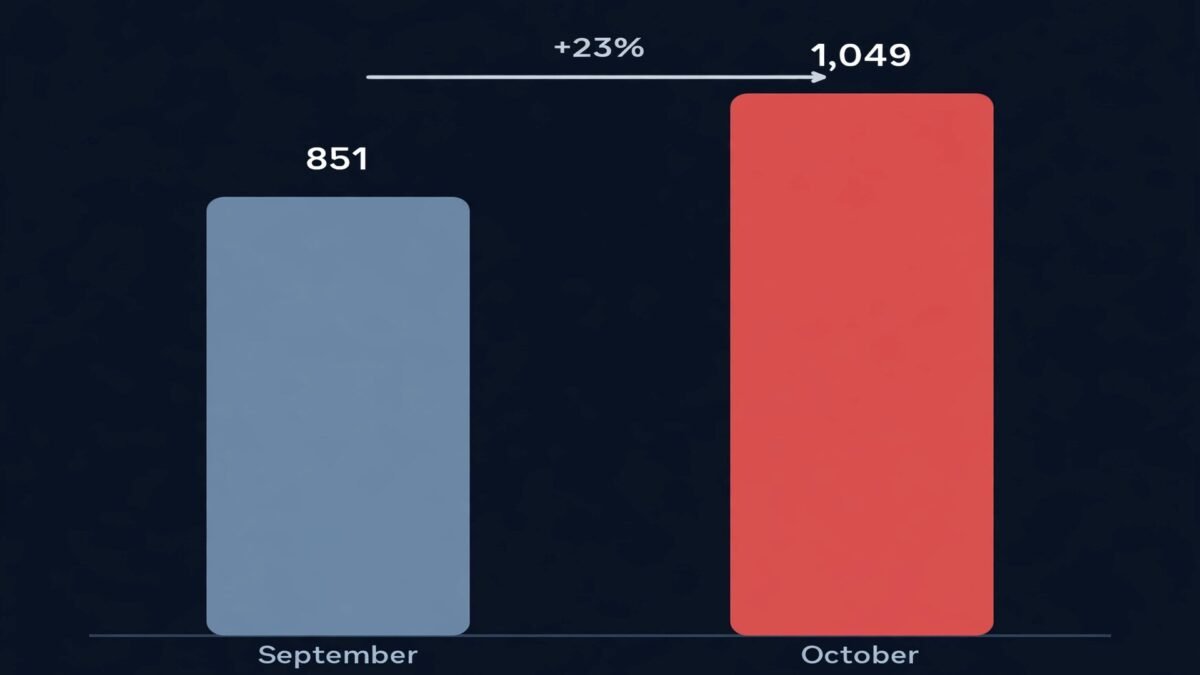
Ransomware attacks rose 23% in October 2026, and the month alone produced nearly two-fifths of all the claimed attacks in the record quarter before it. NCC Group counted 1,049 claimed incidents in October, up from 851 in September, and the industry has taken to calling the month “Black October”. The rise is not just a volume story. The researchers link it to AI finding software flaws faster, and October also produced a stark physical consequence: supermarket refrigeration systems attacked in Europe, food worth millions of euros thrown away, and small fires in some stores.
How bad was October for ransomware?
Ransomware attacks rose 23% in October 2026 to 1,049 claimed incidents, NCC Group reports, after the highest-ever quarterly volume in Q3. Three groups claimed nearly two in five attacks, and researchers link the rise to AI finding flaws faster. The figures are claimed attacks, not confirmed breaches.
One number needs stating plainly before any other: 1,049 is a count of claimed attacks, not a count of confirmed breaches. In Q3 2026, Comparitech counted 2,627 claimed attacks and found that only 247 had been confirmed by the organisation involved. That is 9.4% of the claims. The gap matters because claimed-attack counts overstate what is proven, and they miss any attack that never reaches a leak site at all. October’s reported claim count rose 23% from September, but a single month does not make a trend.
One month nearly matched two-fifths of a record quarter
The October total looks worse against the quarter that preceded it. Comparitech’s Q3 count of 2,627 claimed attacks was itself a record: up 27% on Q2 2026 and 61% on Q3 2025, according to Infosecurity Magazine. October alone produced 39.9% of that entire three-month total, our own calculation from the two figures. At October’s pace, three months would produce about 3,150 claims, roughly 20% above the record quarter. That is the arithmetic behind NCC Group’s warning that the spike is “more likely an early indicator of a new environment in which serious vulnerabilities are discovered and weaponised more rapidly”. The link to AI is the researchers’ assessment, not a proven causal finding, and the article presents it that way.
The Q3 figures also show what the surge costs when it lands. Comparitech put the average ransom demand in Q3 at $602,400. The largest known demand was $12.3 million, made by Everest against Swiss railway manufacturer Stadler Rail in July; Stadler refused, and Everest leaked 201 GB of stolen data. Rhysida demanded $2.3 million from the State of Berlin and published 5.7 TB after the government refused to pay. And paying does not end the matter: The Gentlemen attacked South African tech firm MIP Holdings in June, MIP paid to have the stolen data deleted, and the group has since started adding MIP’s clients to its leak site to demand ransoms from them too.
The three groups behind two in five claims
The Gentlemen claimed the most victims in October with 139 attacks, 13.3% of the month’s total. n0n followed with 133, and Qilin with 131. Together the three account for 403 of the 1,049 claims, or 38.4% of the month, our own calculation. Qilin and The Gentlemen were also the most prolific groups in Q3, with 357 and 342 claims respectively.
n0n is the month’s most uncertain number. Infosecurity Magazine notes the group was first observed in September 2026, and NCC Group ranks it second for October. In November, n0n claimed responsibility for data breaches affecting JPMorgan, Mastercard and Visa. Those November claims are claim-only and are already covered by our earlier reporting, including the Visa third-party claim; they are not new evidence, and this article does not re-report them as such.
Behind the top three, newer groups filled the rest of the top ten. On Infosecurity Magazine’s account of the top ten, Booba Project claimed 29 attacks, Emperador 27 and Wallstreet 22. NCC Group spells the first of those “Boba Project” in its release; Infosecurity Magazine and the independent tracker ervik.as both use “Booba Project”, and ervik.as counts it at 30. The three together account for 78 claims, 7.4% of the month. NCC Group’s researchers say the origins of these newer actors remain unknown and none has been linked to a specific country. They add that the groups might be better described as “newly observed brands, rather than entirely new threat actors”, since they may include experienced affiliates or developers previously associated with other groups.
Ransomware attacks October 2026: six trackers, six totals
The headline total depends on who is counting. Six independent trackers measured the same month and produced six different totals, spread across 498 claims, a gap of 58% from the lowest to the highest, and the lowest figure is itself a minimum, since ZeroFox counts “at least 855 incidents”. The trackers also count different things, claimed attacks, victim listings and incidents, collected by different methods, so the totals are not directly comparable. Four of the six report a month-on-month rise, NCC Group 23%, ervik.as 25%, Breachsense 21% and ZeroFox 24%. The direction is the same wherever a comparison exists; the size is not.
| Tracker | October 2026 count | Change on September |
|---|---|---|
| NCC Group | 1,049 claimed | Up 23% (from 851) |
| ervik.as | 1,353 victims | Up 25% (from 1,084) |
| Comparitech | 1,020 attacks | Second only to August’s 1,034 in 2026 |
| Breachsense | 953 victims | Up 21% (from 789) |
| Bitdefender Threat Debrief | 1,072 claimed (946 excluding n0n) | n0n’s 126 claims excluded as unreliable |
| ZeroFox | At least 855 incidents | Up 24% (from 690) |
The swing factor is n0n. Bitdefender drops the group’s 126 claims entirely because it does not consider that group’s listings reliable, while NCC Group counts n0n as the month’s second-most-active group. Whether n0n is real or noise moves the headline by more than a tenth on Bitdefender’s count alone: its 126 n0n claims are 11.75% of its 1,072 total. The ervik.as report, which cross-checks the other trackers, adds a second reason to distrust the daily counts: batch listings. Qilin posted 66 listings on 26 October alone, and The Gentlemen posted 120 of its 147 listings on just three days. n0n posted 39 listings at once on 12 October, a batch that named 38 maritime and port facilities across 18 countries, according to SOCRadar as reported by The Week and cited by ervik.as. None of the listed organisations had acknowledged a breach. With three groups posting between a quarter and just over a third of their month in a single day on ervik.as’s counts, daily and weekly counts are a poor measure of underlying activity.
Where the attacks landed
Industrials was the most heavily targeted sector in October, but the two sources disagree on the share: NCC Group’s own release puts it at 29%, while Infosecurity Magazine reports 31%. This article quotes both, because the gap is the point. The other sector shares come from Infosecurity Magazine only: consumer discretionary at 19%, healthcare at 12% and IT at 10%.
Geography is less contested. North America accounted for 46% of claimed attacks, followed by Europe at 23%, Asia at 15% and South America at 8%. The United States alone took 315 of the 784 victims with a country attribution in ervik.as’s data, about 40%, up from about 31% in September, though part of that rise may come from better country data rather than more American targets. In Q3, the US accounted for 1,066 claimed attacks, 41% of the quarter, followed by Germany with 121.
AI is finding the flaws faster
NCC Group’s explanation for the surge is that large language models and autonomous security agents are increasingly used to accelerate code reviews and identify unusual access paths. The models are not creating vulnerabilities, the report says, but speeding up the discovery of existing flaws, some of which could be more than 20 years old. Matt Hull, NCC Group’s vice president of cyber intelligence and response, put it directly: “While we’re already seeing the benefits of AI accelerating vulnerability discovery in cyber research, we’re not alone. As cyber criminals and state-sponsored threat groups use AI to assist with the discovery of vulnerabilities in their targets, organisations need to maintain visibility of internet-facing assets, retire unsupported software and prepare for emergency remediation.”
One of the first high-impact examples was two critical-severity vulnerabilities in PHP, collectively called PHP2Shell, discovered as part of OpenAI’s Patch the Planet initiative, which combines AI-assisted vulnerability research with expert human review. Details of the vulnerabilities were leaked, prompting organisations and government agencies to temporarily take websites offline while assessing their exposure. The NSA’s own October advisory named PHP2Shell, as we reported here. July also saw the JadePuffer campaign, believed to be the world’s first ransomware attack completely driven by AI, according to the Q3 report. The pattern is consistent: AI is compressing the time between a flaw existing and a flaw being used.
When ransomware breaks something physical
October’s most concrete consequence had nothing to do with leaked data. Cyber attacks targeting refrigeration systems in European supermarkets manipulated temperatures, forcing stores to dispose of food worth millions of euros and, in some cases, causing small fires. NCC Group names no stores, no group responsible and no affected countries, and this article does not fill in those gaps. The point the researchers make is about the interface between IT and operational technology: a compromised system that controls a physical process can destroy stock and start fires, not just encrypt files.
Hull’s advice on that interface is specific: “Reducing direct internet exposure, creating an inventory of operational assets, monitoring process changes, and practising isolation and recovery are all essential controls. Preventing compromise is one component of ensuring cyber attacks do not escalate into physical, operational and financial harm.” The food supply sector, he added, “has put the security risks at the interface between IT and OT in international headlines”. Industries providing critical services, he said, “need to review the security controls governing connections between their programmable systems and physical hardware”.
What should a small business do about the ransomware surge?
Start with what NCC Group’s Matt Hull advises: know your internet-facing assets, retire unsupported software, and prepare to fix things at short notice. For operational technology, reduce internet exposure, keep an asset inventory, and practise isolating and recovering systems. The steps below turn that advice into a checklist.
No source in this story gives small businesses a step list. The steps below are our own advice, based on the controls NCC Group’s researchers name in the report.
- List every internet-facing asset, including forgotten subdomains and test servers, and confirm each is patched.
- Retire unsupported software now, because attackers are finding flaws in code that is decades old.
- Prepare an emergency fix plan so a critical flaw can be patched within hours, not weeks.
- Reduce direct internet exposure for operational systems and keep a full, up-to-date inventory of them.
- Practise isolating and recovering a system, so a real incident does not become your first rehearsal.
What to watch next: whether n0n returns after going nearly silent after 25 October, whether Qilin’s output stays at this level once its 26 October batch is excluded, and whether November holds October’s pace or falls back. The next monthly counts will show whether “Black October” was a spike or the start of a new baseline. The Q3 record and the October surge point the same way, but a single month does not make a trend, and the claimed-versus-confirmed gap means October’s true scale may never be fully settled.