
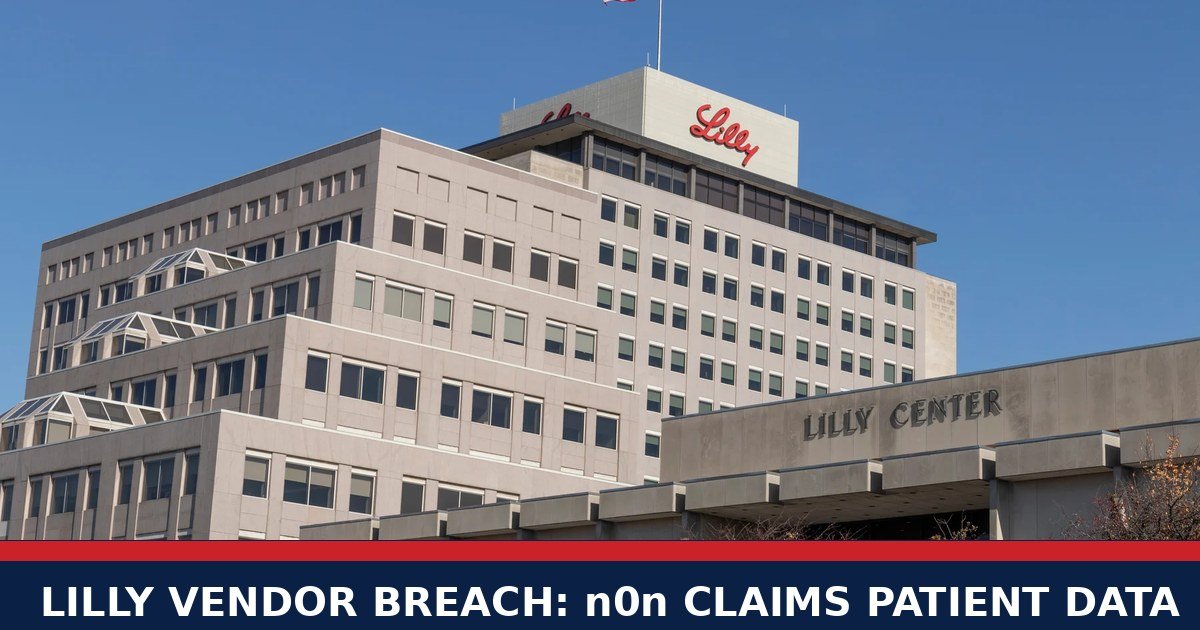
Extortion group n0n has named Eli Lilly in its latest leak-site wave, claiming prescription-fill data covering 1.24 million patients came from a third-party data provider the drugmaker uses. Lilly’s own systems were not breached, according to a person familiar with the matter who spoke to Barron’s, and the company found no evidence of unauthorized access to its own systems after an internal investigation. The vendor at the centre of the claim has not been named.
The claim landed on 16 November, when n0n named 59 organisations in a single day. Lilly had been on the group’s site since 9 November, listed anonymously under a numbered placeholder before its name was revealed. The figures n0n attaches to the Eli Lilly vendor breach claim are large, but every one of them is attacker-claimed: no company has confirmed the numbers, and no independent count exists. That distinction runs through the whole story, because what the four drug makers involved have said on the record is very different from what n0n claims.
What the Eli Lilly vendor breach claim actually says
According to the listing, mirrored by ransomware.live, n0n claims about 16 million prescription-fill rows covering 1,243,661 distinct patients, spanning Lilly’s neurology, immunology and inflammation products, with payer, copay and diagnosis detail attached. Barron’s rounds the patient figure to 1.2 million. Alongside it, n0n claims a prescriber master file holding about 7.6 million National Provider Identifier numbers, with names and addresses. Barron’s rounds that to 7.6 million.
The patient records are described as anonymized, and n0n does not say whether they carry names. Barron’s describes them as anonymized records stripped of details that could identify individuals. That matters, because the prescriber file is a different kind of exposure: NPI numbers are themselves public identifiers, and the sensitivity in the claim is the linkage to prescriber names and addresses, not the numbers alone. A related listing in the same batch, for Servier, lists birth years and three-digit ZIP codes, the fields HIPAA’s Safe Harbor method leaves in place of a full birth date and ZIP code, provided the population covered by those three digits meets the threshold the method requires. RansomNews, which reported the listings, has not seen the files.
Our own arithmetic on n0n’s claimed numbers puts the dataset in perspective. Dividing about 16 million rows by 1,243,661 patients gives about 12.9 rows per patient, so the claimed dataset averages more than one record per person. That is consistent with longitudinal prescription history, a run of fills over time, though the average alone does not prove it. That is TechReview’s calculation from n0n’s claimed figures, and it holds only if the claim itself is genuine.
Four companies, four different answers
The most revealing part of the story is not what n0n claims. It is what the companies said when Barron’s asked them. Lilly has issued no public statement of its own; its position comes through an unnamed person familiar with the matter. Two other drug makers in the same wave did go on the record, and a fourth said nothing at all.
| Company | What it said | What it ruled out |
|---|---|---|
| Eli Lilly | Via a person familiar with the matter: alerted earlier in the week; internal investigation found no evidence of unauthorized access to its own systems | Its own systems being breached |
| Vertex Pharmaceuticals | On the record: aware of a potential incident involving a third-party data provider; “no proprietary Vertex data or Vertex patient information was exposed in this incident, and no Vertex systems were involved” | Its data being exposed; its systems being involved |
| Vir Biotechnology | On the record: aware of claims that unauthorized actors had taken data; activated cybersecurity protocols and launched an investigation; “no indication… its systems were subject to unauthorized access, or that the data referenced… belongs to Vir Bio” | Its systems being accessed; the data belonging to Vir |
| Verastem | Did not respond to Barron’s request for comment | Nothing stated |
The split is the story. Four companies facing claims from the same extortion wave gave four different answers: one through an unnamed source, two on the record, one silent. Vertex went furthest, ruling out both exposure and involvement. Vir stopped shorter, saying only that it has found no indication so far. Lilly has said nothing publicly at all. None of the four confirmed that the data n0n claims to hold is genuine.
Vertex’s position also carries a complication. Barron’s reports that n0n posted data it claims belongs to Vertex last week, before the Lilly naming. Vertex’s statement says no proprietary Vertex data or Vertex patient information was exposed, which is a direct denial of the claim as it stands.
Eleven drug makers, one vendor’s client list
The 59 organisations n0n named on 16 November break down, by n0n’s own descriptions, into small businesses (19), retailers (13), drug makers (11), advertising and audience-data firms (10), card programmes (3) and three others. Drug makers are 11 of 59, about 19 percent of the wave. That pattern is the tell: the drug makers in the batch all share the same claims-data shape, prescription-fill records from a pharma data provider, which suggests the batch is one vendor’s client list rather than 11 separate breaches. RansomNews, which analysed the listings, reads the pattern the same way, noting that the same data type inside each group points to the firms that process it: a pharma analytics company for the drug makers, a search-software vendor for the retailers, an advertising data platform for the audience-data group.
That reading also has a named lead, and it needs careful handling. n0n listed pharma analytics firm 159 Solutions on 9 November, claiming to hold “client environments” for at least 17 drug makers, and listed LiveRamp on 11 November. That is a lead, not a confirmation: nothing in the reporting establishes that 159 Solutions is the vendor behind the Lilly data, and this article does not present it as such. Until a company or a second source names the provider, the vendor stays unnamed.
From an anonymous placeholder to a named target in a week
The Lilly listing has a short, traceable history. It appeared anonymously as a numbered placeholder on 9 November, one of 46 such placeholders that sat on n0n’s site that week. On 16 November, n0n revealed the names behind 59 listings at once, Lilly among them. All 59 were marked unpaid. Barron’s reported the Lilly claim the next day, 17 November, after speaking to the companies involved. The arc from anonymous placeholder to named target took seven days.
That naming wave is also where the Visa story connects. n0n named Visa and JPMorgan in the same 16 November batch, and TechReview covered that claim in a separate article. Visa confirmed a third-party incident, not a breach of its own systems, and its spokesperson told Cybernews the incident began at a third-party service provider in the Asia-Pacific region, adding that “Visa’s systems were not involved and were not impacted” and that the company had seen no sign payment data such as card numbers was affected. JPMorgan told Cybernews its 16 November outage was caused by a software bug, with no evidence tying it to a cyberattack. Barron’s states explicitly that no link has been established between n0n’s claims and the banking outages.
The two stories share a naming wave, not a vendor. The Lilly data comes from a pharma data and analytics provider; Visa’s confirmed incident is a specific Asia-Pacific third-party provider. Different data types, different vendor classes, and no evidence they are the same vendor. Treating them as one breach would be wrong, and this article keeps them separate. Expedia confirmed on 12 November, via Skift, that it was hit by a “supply chain attack” through an outside data platform provider that also compromised several other companies, though it did not name the provider, confirm n0n’s figures, or say n0n was responsible.
n0n’s own census does not survive scrutiny either. Its site claims data associated with at least 107 companies has leaked so far, with another 74 “exposed”, 8 listed as “pending” with names not yet released, and 19 unnamed companies purportedly spared after striking agreements. Add those together and the site claims 208 entries. Bitdefender, working from data on n0n’s own file server, says the group targeted just over 20 real victims, and it removed 126 n0n entries from its October total. The Ransomtracker database holds 363 n0n entries, 168 of them numbered placeholders. The gap between the group’s own census and the independent analysis is roughly tenfold on the site’s own count, 208 entries against about 20 real victims, and wider still on the tracker count, 363 entries against about 20, the same inflation pattern TechReview found in the Visa article. The 107 figure is n0n’s own claim, not a verified victim count, and 59 named does not mean 59 breaches.
n0n itself is a recent arrival. The group emerged in September 2026 and began listing claimed victims on the dark web within days, starting on 18 September. It is a data-theft extortion operation: it steals data and threatens to publish it, giving victims a window to reach a settlement first. A section of its site titled “Your data has a deadline” reads: “Those who honored their deadline are remembered with respect.” Cybersecurity firm SOCRadar’s profile of the group lists its country of origin as “Likely Russia” on its threat-actor card, while its written analysis says the available evidence offers no geographic or national attribution. SOCRadar also documents a ransomware locker, an AES-256-CBC file encryptor appending .n0n, used against AFRICA-TECH and FinSoft, and found encryptor code on a server the group left exposed. In the Lilly and Visa listings, though, the operation is extortion by threatened publication, not encryption of victim systems.
What to watch next
Several things would change this story. A public statement from Lilly itself would be the first, since everything attributed to the company so far comes through an unnamed source. The vendor being named would be the second, since it would show whether the 11 drug makers share one provider. Whether n0n publishes the Lilly data, and whether any of it is verified as genuine, would settle the central claim. Tier-1 pickup from Reuters, the Associated Press or Bloomberg would strengthen the reporting; as of 18 November, none had picked the story up. A filing with the US Department of Health and Human Services or a state attorney general would give the first confirmed count. A listing on the Department of Health and Human Services breach portal would also show how regulators classify the data, rather than relying on n0n’s description of it as anonymized. And the 48-hour deadline n0n gave Visa and JPMorgan, which runs out on 18 November, is the day’s other clock, though it applies to those two listings, not to Lilly.
Nothing in the reporting so far suggests patients need to act on the Eli Lilly vendor breach claim specifically: the records are described as anonymized, Lilly says its own systems were not accessed, and no company has confirmed the data is genuine. The general precautions after any health-data claim are the familiar ones: watch for phishing messages referencing prescriptions or insurers, check explanation-of-benefits statements for fills never made, and verify any message claiming to come from a drugmaker or insurer through the organisation’s own channels. These are general precautions, not steps tied to this incident, and they apply whether or not n0n’s claim turns out to be real.


