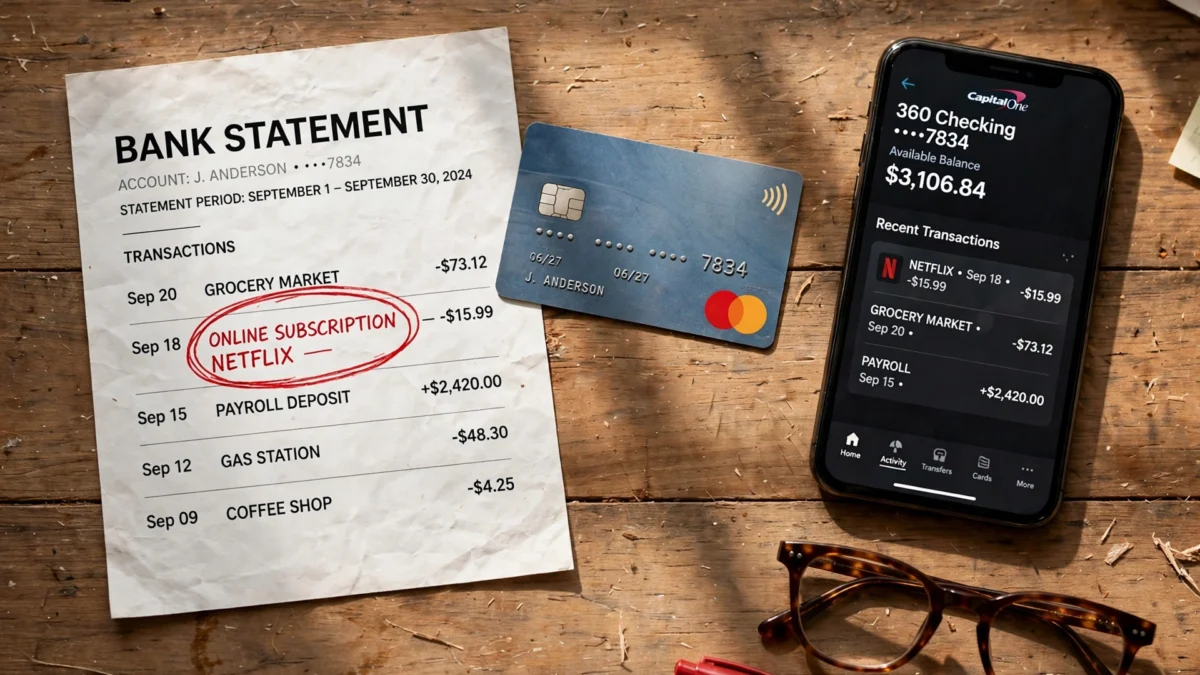
A charge you don’t recognize is sitting on your statement. Maybe it’s a subscription you cancelled months ago, maybe it’s a merchant name you’ve never seen — like the escam4.com descriptor readers keep asking us about. Either way, US law gives you a powerful tool to fight it: the dispute. Used correctly, it costs you nothing. Used wrong, you can lose your legal protection entirely.
How do I dispute a credit card charge?
You dispute a credit card charge by sending your card issuer written notice of the error within 60 days of the statement date. The Fair Credit Billing Act gives you this right. The letter must reach the issuer’s billing-inquiries address — not the payment address. While the issuer investigates, you can legally withhold the disputed amount.
- Gather your evidence first: statement showing the charge, receipts, cancellation emails, anything proving the error.
- Call the merchant once if it’s a simple mistake — a duplicate charge or a cancelled subscription. Keep notes of who you spoke to and when.
- Call your issuer to open the dispute immediately — this flags the charge while the clock is running.
- Follow up in writing. This step is the one people skip, and it’s the one the law actually requires. Send the letter to the billing-inquiries address on your statement, by certified mail with return receipt requested.
- Withhold only the disputed amount. Keep paying the rest of your bill normally — the undisputed balance is still due.
- Track the deadlines. The issuer must acknowledge your letter within 30 days and resolve the dispute within two billing cycles (90 days maximum).
What does the law actually guarantee?
The Fair Credit Billing Act (enforced under Regulation Z) is more specific than most guides admit:
- The 60-day window is strict. Your written notice must reach the issuer within 60 days of the first statement showing the error being sent — not the day you got around to reading it. Miss it, and you lose FCBA protection on that charge.
- Your liability for unauthorized use is capped at $50 by law. In practice, Visa’s Zero Liability policy makes it $0 for most cardholders.
- During the investigation, the issuer cannot report the disputed amount as delinquent, try to collect it, or close your account for disputing. They can tell credit bureaus you’re challenging the bill.
- If the issuer finds an error, they must remove the charge plus all related finance charges and late fees.
- If the issuer botches the procedure — misses its own deadlines — it forfeits up to $50 of the amount even if the bill turns out to be correct.
- If your dispute is denied, you’re owed written reasons, the amount now due, and the right to see the documents the issuer relied on. A CFPB complaint at that point is free and gets a company response, generally within 15 days.
Read also: Escam4.com charging your card? What it is and how to stop it
Credit card vs debit card disputes: the rules are NOT the same
This is the most dangerous confusion in personal finance. Credit disputes run under the FCBA; debit disputes run under the Electronic Fund Transfer Act (Regulation E) — with weaker protection and real money at stake.
| Credit card (FCBA) | Debit card (Reg E) | |
|---|---|---|
| Your max liability for fraud | $50 by law ($0 with Visa Zero Liability) | $50 if reported within 2 business days; $500 within 60 days; unlimited after 60 days |
| Whose money is held during the dispute? | The bank’s — you withhold payment | Yours — the money is already out of your account |
| Dispute window | Written notice within 60 days of statement | 60 days from statement for full protection |
| Issuer deadline | Acknowledge in 30 days; resolve in 2 billing cycles (max 90 days) | Decide in 10 business days, or provisionally credit you and take 45 days (90 for point-of-sale, foreign, or new-account transactions) |
| Written notice required? | Yes — to trigger full legal rights | Bank may require written confirmation after a phone report |
TechReview comparison from FTC, CFPB, and the regulation text (12 CFR 1005.6, 1005.11; Regulation Z §1026.12-13).
The practical takeaway: for online purchases, a credit card is structurally safer than a debit card — not because of rewards points, but because the dispute law was written in your favor.
Can I dispute a pending transaction?
No — and this trips up almost everyone. A pending charge can’t be formally disputed; the FCBA covers charges on your statement. Most issuers, Chase included, state plainly that a pending transaction must post first (usually 3–5 business days). Only the merchant can release a pending hold early.
The one exception to “wait”: if the pending charge is one you don’t recognize at all, call your issuer immediately anyway. You can’t dispute it yet, but you can flag possible fraud and lock the card before more charges land.
Three mistakes that kill disputes
1. Paying the full bill including the disputed amount, then disputing. You can still dispute, but you’ve handed over your leverage. Withhold the disputed portion (pay everything else) — the law protects you for exactly that amount.
2. Disputing only by phone. A call starts the conversation; it does not start the statutory clock. The written letter to the billing-inquiries address is what locks in your FCBA rights. Never write it on the payment stub, and never send it to the payment address.
3. Disputing a charge you actually made because the merchant name looks wrong. Many legitimate charges appear under a billing descriptor instead of the store name — payment processors, parent companies, subscription platforms. Search the descriptor first (we maintain guides on common ones). Filing disputes on charges you authorized is “friendly fraud” — it can get your account closed and the claim denied with prejudice.
What happens after you dispute: the timeline
- Day 0: Your written notice reaches the issuer. The legal clock starts.
- Within 30 days: The issuer must acknowledge your dispute in writing.
- During the investigation: The disputed amount is frozen — no interest, no late fees, no delinquency reporting on it.
- Within 2 billing cycles (max 90 days): Resolution. Error found: charge and all related fees removed. No error: written explanation, amount due, and a grace period of at least 10 days before it’s payable.
- If denied unfairly: File a CFPB complaint at consumerfinance.gov — companies generally respond within 15 days.
Bottom line: you have 60 days, the letter matters more than the phone call, and credit cards protect you in ways debit cards legally don’t. Most people lose disputes on paperwork, not on facts. Do the paperwork.
Published October 20, 2026. Sources: FTC and CFPB consumer guidance, Fair Credit Billing Act (Regulation Z), Electronic Fund Transfer Act (Regulation E). This is general information, not legal advice.